CAS 1988-11-0
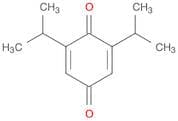
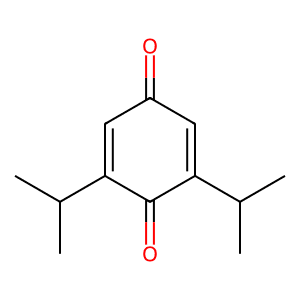
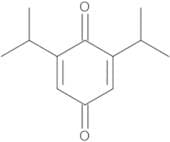
:2,6-Diisopropil-1,4-benzoquinona
Descripción:
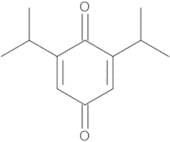
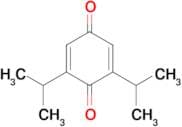
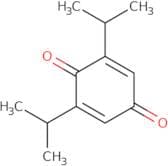
2,6-Diisopropil-1,4-benzoquinona es un compuesto orgánico caracterizado por su estructura de quinona, que presenta un anillo aromático de seis miembros con dos grupos isopropilo unidos en las posiciones 2 y 6. Este compuesto es conocido por su color amarillo brillante y se utiliza típicamente en síntesis orgánica y como reactivo en varias reacciones químicas. Exhibe fuertes propiedades oxidantes debido a la presencia del grupo funcional quinona, lo que le permite participar en reacciones redox. El compuesto es relativamente estable en condiciones estándar, pero puede sufrir reacciones adicionales, como polimerización o reducción, dependiendo del entorno y los reactivos presentes. Su solubilidad es generalmente mayor en disolventes orgánicos que en agua, lo que lo hace adecuado para aplicaciones en química orgánica. Además, 2,6-Diisopropil-1,4-benzoquinona puede tener implicaciones en sistemas biológicos, donde puede actuar como un aceptor de electrones. Se deben tomar precauciones de seguridad al manipular este compuesto, ya que puede representar riesgos para la salud si se inhala o se ingiere.
Fórmula:C12H16O2
InChI:InChI=1S/C12H16O2/c1-7(2)10-5-9(13)6-11(8(3)4)12(10)14/h5-8H,1-4H3
Clave InChI:InChIKey=DDXYWFGBQZICBD-UHFFFAOYSA-N
SMILES:C(C)(C)C=1C(=O)C(C(C)C)=CC(=O)C1
Sinónimos:- 2,3-Diisopropyl-p-benzoquinone
- 2,5-Cyclohexadiene-1,4-dione, 2,6-bis(1-methylethyl)-
- 2,6-Bis(1-methylethyl)-2,5-cyclohexadiene-1,4-dione
- 2,6-Bis(propan-2-yl)cyclohexa-2,5-diene-1,4-dione
- 2,6-Di(propan-2-yl)cyclohexa-2,5-diene-1,4-dione
- 2,6-Diisopropyl-1,4-benzoquinone
- 2,6-Diisopropyl-p-benzoquinone
- 2,6-Diisopropylcyclohexa-2,5-diene-1,4-dione
- p-Benzoquinone, 2,6-diisopropyl-
Ordenar por
Pureza (%)
0
100
|
0
|
50
|
90
|
95
|
100
Encontrado 12 productos.
Propofol impurity J
CAS:Propofol impurity JFórmula:C12H16O2Forma y color:YellowPeso molecular:192.2542Propofol Related Compound B (2,6-Diisopropyl-1,4-benzoquinone)
CAS:Other quinonesFórmula:C12H16O2Forma y color:Yellow LiquidPeso molecular:192.115032,5-Cyclohexadiene-1,4-dione, 2,6-bis(1-methylethyl)-
CAS:Fórmula:C12H16O2Pureza:95%Forma y color:LiquidPeso molecular:192.25422,6-Diisopropylcyclohexa-2,5-diene-1,4-dione
CAS:2,6-Diisopropylcyclohexa-2,5-diene-1,4-dionePureza:95%Peso molecular:192.26g/mol2,6-Diisopropyl-1,4-benzoquinone
CAS:Impurity Propofol EP Impurity J
Applications 2,6-Diisopropyl-1,4-benzoquinone (Propofol EP Impurity J) is a Propofol (P829750) impurity.
Not a dangerous good if item is equal to or less than 1g/ml and there is less than 100g/ml in the package
References McMahon, R., et al.: J. Med. Chem., 22, 1100 (1979), Mamada, K., et al.: Drug Metab. Dispos., 14, 509 (1986),Fórmula:C12H16O2Forma y color:NeatPeso molecular:192.252,6-Diisopropyl-1,4-benzoquinone
CAS:2,6-Diisopropyl-1,4-benzoquinone is a diphenol that reacts with a variety of organic compounds in the presence of heat. It has been used as a mesoporous material to adsorb hydrogen gas and carbon dioxide in the water treatment process. 2,6-Diisopropyl-1,4-benzoquinone is also able to react with oxygen to form an n-oxide. This compound is most often used for the manufacture of phenolic antioxidants such as dibenzoyl peroxide and pentafluorobenzoic acid. The active site on this molecule is thought to be at the double bond between carbons 6 and 7. Impurities may include anisidine and other aromatic amines that can cause reactions with hydrogen peroxide when exposed to light or certain wavelengths of radiation.Fórmula:C12H16O2Pureza:Min. 95%Peso molecular:192.25 g/mol