CAS 200630-46-2
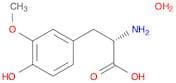
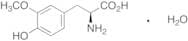
:3-Metoxi-L-Tirosina Monohidrato
(S)-2-Amino-3-(4-hydroxy-3-methoxyphenyl)propanoic acid hydrate
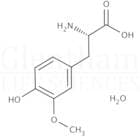
CAS:Fórmula:C10H15NO5Pureza:98%Forma y color:SolidPeso molecular:229.22983-O-Methyl-L-DOPA Monohydrate
CAS:Fórmula:C10H13NO4·H2OPureza:≥ 95.0%Forma y color:White to beige or light brown powderPeso molecular:229.233-O-methyl-L-DOPA (hydrate)
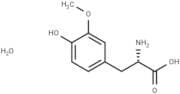
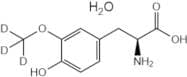
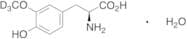
CAS:3-O-methyl-L-DOPA, a L-DOPA metabolite from catechol O-methyltransferase, may impact or compete with L-DOPA.Fórmula:C10H15NO5Forma y color:SolidPeso molecular:229.23L-3-(4-Hydroxy-3-methoxy-d3-phenyl)alanine
CAS:Pureza:99 atom % DForma y color:Off White To Brown SolidPeso molecular:232.243-O-Methyl-L-DOPA Monohydrate
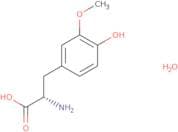
CAS:Applications 3-O-Methyl-L-DOPA is the major metabolite of L-DOPA via catechol O-methyltransferase (COMT). 3-Methoxy-L-tyrosine is neither a substrate for nor an inhibitor of L-amino acid decarboxylase activity. Inhibition of COMT enhances the anti-Parkinson activity of L-DOPA.
References Soares-da Silva, P., et al.: Brain Res., 863, 293 (2000), Deleu, D., et al.: Clin. Pharmacokinet., 41, 261 (2002),Fórmula:C10H13NO4·H2OForma y color:NeatPeso molecular:229.233-O-Methyl-L-DOPA-d3 Monohydrate
CAS:Producto controladoApplications Labelled 3-O-Methyl-L-DOPA (M303815). 3-O-Methyl-L-DOPA is the major metabolite of L-DOPA via catechol O-methyltransferase (COMT). 3-Methoxy-L-tyrosine is neither a substrate for nor an inhibitor of L-amino acid decarboxylase activity. Inhibition of COMT enhances the anti-Parkinson activity of L-DOPA.
References Soares-da Silva, P., et al.: Brain Res., 863, 293 (2000), Deleu, D., et al.: Clin. Pharmacokinet., 41, 261 (2002),Fórmula:C10H10D3NO4·H2OForma y color:NeatPeso molecular:232.248293-O-Methyl L-DOPA monohydrate
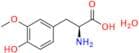
CAS:Producto controlado3-O-Methyl L-DOPA monohydrate is a chromatographic method that is used to diagnose Parkinson's disease. The method separates the catechol-o-methyltransferase (COMT) from plasma samples, which converts dopamine to 3-O-methyl dopamine. The 3-O-methyl dopamine reacts with an electrochemical detector and overlapped peaks can be seen on the chromatogram. This analytical method can be used to detect low levels of dopamine in the blood and diagnose Parkinson's disease.Fórmula:C10H13NO4·H2OPureza:Min. 95%Forma y color:White PowderPeso molecular:229.23 g/mol