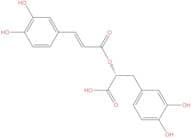
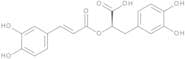
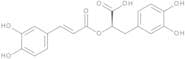
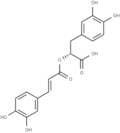
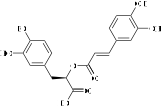
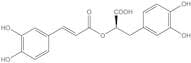
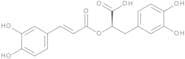
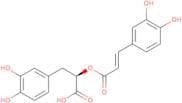
CAS 20283-92-5
:Ácido rosmarínico
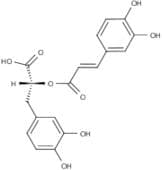
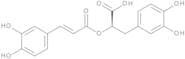
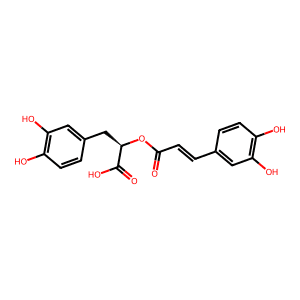
- (αR)-α-[[(2E)-3-(3,4-Dihydroxyphenyl)-1-oxo-2-propen-1-yl]oxy]-3,4-dihydroxybenzenepropanoic acid
- Benzenepropanoic acid, α-[[(2E)-3-(3,4-dihydroxyphenyl)-1-oxo-2-propen-1-yl]oxy]-3,4-dihydroxy-, (αR)-
- Benzenepropanoic acid, α-[[3-(3,4-dihydroxyphenyl)-1-oxo-2-propenyl]oxy]-3,4-dihydroxy-, [R-(E)]-
- Cinnamic acid, 3,4-dihydroxy-, 2-ester with 3-(3,4-dihydroxyphenyl)lactic acid
- Labiatenic acid
- Labiatic acid
- Mamorekku RUH 2
- Meiji Red Perilla Polyphenol
- Nplc 0542
- Propanoic acid, 3-(3,4-dihydroxyphenyl)-2-[3-(3,4-dihydroxyphenyl)-1-oxo-2-propenyloxy]-
- Rm 21A
- Rosemaric acid
- Rosemary acid
- Rosmarinic acid
- Syl 001
- trans-Rosmarinic acid
- Benzenepropanoic acid, α-[[(2E)-3-(3,4-dihydroxyphenyl)-1-oxo-2-propenyl]oxy]-3,4-dihydroxy-, (αR)-
- 3-(3,4-dihydroxyphenyl)-2-{[(2E)-3-(3,4-dihydroxyphenyl)prop-2-enoyl]oxy}propanoic acid
- Rosemarinic acid
- (2S)-3-(3,4-dihydroxyphenyl)-2-{[(2E)-3-(3,4-dihydroxyphenyl)prop-2-enoyl]oxy}propanoic acid
- (R)-alpha-[3-(3,4-Dihydroxyphenyl)-1-oxo-2E-propenyl]oxy-3,4-dihydroxybenzenepropanoic acid
- Ver más sinónimos
Rosmarinic acid
CAS:Rosmarinic acid analytical standard provided with w/w absolute assay, to be used for quantitative titration.Fórmula:C18H16O8Pureza:(HPLC) ≥99%Forma y color:PowderPeso molecular:360.33Rosmarinic Acid
CAS:Carboxylic acids with additional oxygen function and their anhydrides, halides, peroxides etc, nesoiFórmula:C18H16O8Forma y color:White Off-White Beige PowderPeso molecular:360.08452Rosmarinic acid
CAS:Fórmula:C18H16O8Pureza:≥ 97.0% (anhydrous basis)Forma y color:Off-white, pale yellow to beige or light-brown powderPeso molecular:360.31Rosmarinic acid
CAS:Rosmarinic acid is a naturally occurring hydroxylated compound, it is present in many plants, such as Artemisia capillaris , Calendulla officinalis; it shows antiviral, antibacterial, antiinflammatory and antioxidant activity, can produce anxiolytic-like effect without exerting locomotor alterations or DNA damage in brain tissue.Fórmula:C18H16O8Pureza:95%~99%Forma y color:PowderPeso molecular:360.318Rosmarinic acid
CAS:Rosmarinic acid (Labiatenic acid) is widely found in plants and has antioxidant, anti-inflammatory, and antibacterial activities.Fórmula:C18H16O8Pureza:98.88% - 99.73%Forma y color:Brown Fine PowderPeso molecular:360.31Rosmarinic acid
CAS:Carboxylic acid with phenol functionFórmula:C18H16O8Pureza:≥ 95.0 % (HPLC)Forma y color:PowderPeso molecular:360.32Rosmarinic Acid
CAS:Applications Rosmarinic Acid is a phenolic component of rosemary with antioxidant and anti-inflammatory activity. Rosmarinic Acid has been shown to inhibit againts peroxidative damage to biomembranes. Rosmarinic Acid also suppresses endotoxin-induced activation of complement and concomitant prostacyclin biosynthesis. Rosmarinic Acid inhibits the free-radical chain reaction that leads to the oxidatin of fats and oils in foods, thereby stablilzing and increasing the shelf life of meats.Rosmarinic Acid has been found to bind to a known quorum-sensing regulator protein used by the pathogenic bacteria Pseudomonas aeruginosa.
References Liu, G. et al.: Biochem. Pjharmacol., 34, 147 (192); Rampart, M. et al.: Biochem. Pharmacol., 35, 1397 (1986); Bult, H. et al.: Br. J. Pharmacol., 84, 317 (1985); Chem. and Eng. News Feb. 10, 2014 p. 13; Chem. and Eng. News Jan. 11, 2016 p. 26Fórmula:C18H16O8Forma y color:Yellow-OrangePeso molecular:360.31Rosmarinic acid
CAS:Anti-cancer agent; anti-oxidant; anti-inflammatory; antimicrobialFórmula:C18H16O8Pureza:Min. 94 Area-%Forma y color:Off-White PowderPeso molecular:360.31 g/mol