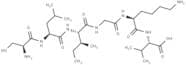
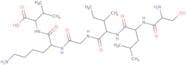
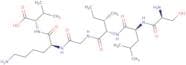
CAS 202933-49-1
:H-Ser-Leu-Ile-Gly-Lys-Val-Oh
Descripción:
La sustancia química conocida como H-Ser-Leu-Ile-Gly-Lys-Val-Oh, con el número CAS 202933-49-1, es un péptido compuesto por una secuencia de aminoácidos. Este péptido presenta una combinación de residuos hidrofílicos e hidrofóbicos, lo que contribuye a su potencial actividad biológica e interacciones. La presencia de serina (Ser), leucina (Leu), isoleucina (Ile), glicina (Gly), lisina (Lys) y valina (Val) indica una amplia gama de propiedades, incluida la capacidad de participar en enlaces de hidrógeno e interacciones hidrofóbicas. El grupo hidroxilo terminal (OH) sugiere que puede tener una solubilidad mejorada en entornos acuosos. Péptidos como este pueden desempeñar roles significativos en varios procesos biológicos, incluidos las vías de señalización y las funciones enzimáticas. Además, la secuencia específica de aminoácidos puede influir en la conformación, estabilidad y reactividad del péptido, lo que lo hace de interés en campos como la bioquímica, la farmacología y la biotecnología. Se necesitarían más estudios para elucidar sus funciones y aplicaciones específicas.
Ordenar por
Pureza (%)
0
100
|
0
|
50
|
90
|
95
|
100
Encontrado 4 productos.
PAR-2 (1-6) (human)
CAS:PAR-2 (1-6) (human) (SLIGKV), a peptide ligand, is a PAR-2 agonist [1] .Fórmula:C28H53N7O8Forma y color:SolidPeso molecular:615.76H-Ser-Leu-Ile-Gly-Lys-Val-OH
CAS:H-Ser-Leu-Ile-Gly-Lys-Val-OH is a potent inhibitor of the enzyme soybean trypsin. It is a member of the class of chemical inhibitors that are active against enzymes that regulate cell signaling and inflammatory responses. H-Ser-Leu-Ile-Gly-Lys-Val-OH inhibits toll receptor signaling, which triggers an inflammatory response in cells. This compound has been shown to be effective in animal models for bowel disease and asthma. H Ser Leu Ile Gly Lys Val OH also has low potency, which may be due to its ability to form covalent bonds with other molecules, such as DNA polymerase.Fórmula:C28H53N7O8Pureza:Min. 95%Peso molecular:615.76 g/molPAR-2 (1-6) (human) trifluoroacetate salt
CAS:PAR-2 is a cytosolic protein that is activated by calcium. PAR-2 activation induces the synthesis of prostaglandins and other inflammatory mediators, which stimulate the release of substances from cells such as cytokines and chemokines. PAR-2 also has an important role in cell proliferation, differentiation, apoptosis, and cancer development. PAR-2 activation is induced by proteases such as trypsin or soybean trypsin inhibitor. The trifluoroacetate salt form of PAR-2 (1-6) has been used to inhibit protease activity in colon cancer cells and prostate cancer cells. PAR-2 (1-6) (human) trifluoroacetate salt H-Ser-Leu-Ile-Gly-Lys-Val-OH trifluoroacetate salt is a potent chemical inhibitor of trypsin activity with IC50 values of 0.5 µM for soybean trypsin inhibitorFórmula:C28H53N7O8Pureza:Min. 95%Peso molecular:615.76 g/molPAR-2 (1-6) (human)
CAS:The PAR-2 agonist SLIGKV can be used for the investigation of receptor functions.
Fórmula:C28H53N7O8Pureza:98.6%Forma y color:White LyophilisatePeso molecular:615.77