CAS 20559-18-6
:1-Lauroil-2-hidroxi-sn-glicero-3-fosfocolina
Descripción:
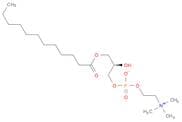
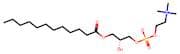
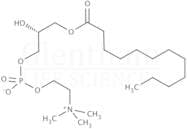
1-Lauroil-2-hidroxi-sn-glicero-3-fosfocolina, comúnmente conocido como LPC, es un fosfolípido que desempeña un papel significativo en las membranas celulares y los procesos de señalización. Presenta una cadena de ácido graso lauroil (dodecanoil), que contribuye a su naturaleza anfipática, permitiéndole interactuar con entornos tanto hidrofílicos como hidrofóbicos. La molécula contiene un esqueleto de glicerol, un grupo fosfato y un grupo cabeza de colina, lo que mejora su solubilidad en soluciones acuosas. Se conoce que LPC tiene la capacidad de formar bicapas lipídicas y micelas, lo que lo hace esencial en estudios relacionados con la dinámica de membranas y sistemas de entrega de fármacos. Además, se ha implicado en varios procesos biológicos, incluyendo la señalización celular, la inflamación y el metabolismo. Su estructura única le permite participar en la formación de balsas lipídicas, que son cruciales para la organización y función de la membrana. En general, LPC es un compuesto vital en bioquímica y farmacología, con aplicaciones en investigación y posibles usos terapéuticos.
Fórmula:C20H42NO7P
InChI:InChI=1S/C20H42NO7P/c1-5-6-7-8-9-10-11-12-13-14-20(23)26-17-19(22)18-28-29(24,25)27-16-15-21(2,3)4/h19,22H,5-18H2,1-4H3/t19-/m1/s1
Clave InChI:InChIKey=BWKILASWCLJPBO-LJQANCHMSA-N
SMILES:P(OC[C@@H](COC(CCCCCCCCCCC)=O)O)(OCC[N+](C)(C)C)(=O)[O-]
Sinónimos:- (2R)-3-(dodecanoyloxy)-2-hydroxypropyl 2-(trimethylammonio)ethyl phosphate
- 1-Dodecanoyl-sn-glycero-3-phosphocholine
- 1-Dodecanoyl-sn-glycerol-3-phosphorylcholine
- 1-Dodecanoyllysolecithin
- 1-Lauroyl-2-hydroxy-sn-glycero-3-phosphocholine
- 1-Lauroyl-<span class="text-smallcaps">L</span>-α-phosphorylcholine
- 3,5,9-Trioxa-4-phosphaheneicosan-1-aminium, 4,7-dihydroxy-N,N,N-trimethyl-10-oxo-, inner salt, 4-oxide, (7R)-
- 3,5,9-Trioxa-4-phosphaheneicosan-1-aminium, 4,7-dihydroxy-N,N,N-trimethyl-10-oxo-, inner salt, 4-oxide, (R)-
- C12-Lysophosphatidylcholine
- Choline, hydroxide, dihydrogen phosphate, inner salt, 3-ester with 1-monolaurin, <span class="text-smallcaps">L</span>-
- L-alpha-Lysophosphatidylcholine, lauroyl
- Laurin, 1-mono-, 3-(dihydrogen phosphate), monoester with choline hydroxide, inner salt, <span class="text-smallcaps">L</span>-
- LysoPC 12
- alpha-L-Lysophosphatidylcholine dodecyl
- Laurin, 1-mono-, 3-(dihydrogen phosphate), monoester with choline hydroxide, inner salt, L-
- Ver más sinónimos
Ordenar por
Pureza (%)
0
100
|
0
|
50
|
90
|
95
|
100
Encontrado 6 productos.
LysoFos Choline 12
CAS:LysoFos Choline 12 (1-lauroyl-2-hydroxy-sn-glycero-3-phosphocholine) is an amphoteric surfactant that acts as a biofilm mimic for self-aggregation in aqueous solution.Fórmula:C20H42NO7PPureza:99.89%Forma y color:SolidPeso molecular:439.52L-α-LYSOPHOSPHATIDYLCHOLINE, LAUROYL
CAS:Fórmula:C20H42NO7PPureza:99%Forma y color:SolidPeso molecular:439.52371-Lauroyl-2-Hydroxy-sn-Glycero-3-Phosphatidylcholine
CAS:Fórmula:C20H42NO7PPureza:>98%Forma y color:SolidPeso molecular:439.5241-Lauroyl-2-Hydroxy-sn-Glycero-3-Phosphatidylcholine
CAS:1-Lauroyl-2-Hydroxy-sn-Glycero-3-Phosphatidylcholine is a synthetic compound that has been shown to inhibit the growth of viruses, such as HIV and herpes simplex virus. It also inhibits the replication of hepatitis C virus in cell culture. This compound has been used to study the biochemical properties of phospholipids, including their function in gene expression and lipid metabolism, as well as their role in viral replication. 1-Lauroyl-2-Hydroxy-sn-Glycero-3-Phosphatidylcholine is not active against bacteria and fungi. This compound interacts with cellular membranes by binding with hydroxyl groups on glycerol molecules, which are part of the phospholipid bilayer structure, forming hydrogen bonds with other hydroxyl groups on adjacent molecules. The molecule can then be cleaved by an enzyme or oxidized by an organic acid to form a fattyFórmula:C20H42NO7PPureza:Min. 95%Peso molecular:439.52 g/mol