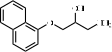
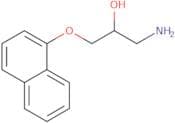
CAS 20862-11-7
:(±)-Desisopropilpropranolol
Descripción:
(±)-Desisopropilpropranolol, con el número CAS 20862-11-7, es un compuesto químico que sirve como un derivado del propranolol, un conocido antagonista beta-adrenérgico no selectivo. Esta sustancia se caracteriza por su naturaleza quiral, existiendo como una mezcla racémica de sus enantiómeros. Se reconoce principalmente por sus posibles efectos farmacológicos, que pueden incluir la modulación de las respuestas cardiovasculares y la influencia en el sistema nervioso central. El compuesto presenta una estructura de anillo naftalénico, lo que contribuye a su lipofilia, permitiendo una efectiva permeabilidad de membrana. Su perfil de solubilidad típicamente indica solubilidad moderada en disolventes orgánicos, mientras que es menos soluble en agua. Como un químico de investigación, (±)-Desisopropilpropranolol se estudia a menudo por sus interacciones con los receptores beta-adrenérgicos y sus implicaciones en varios contextos terapéuticos. Las precauciones de seguridad y manejo son esenciales debido a su actividad biológica, y es importante considerar sus posibles efectos tanto en entornos clínicos como experimentales.
Fórmula:C13H15NO2
InChI:InChI=1S/C13H15NO2/c14-8-11(15)9-16-13-7-3-5-10-4-1-2-6-12(10)13/h1-7,11,15H,8-9,14H2
Clave InChI:InChIKey=ZFMCITCRZXLMDJ-UHFFFAOYSA-N
SMILES:O(CC(CN)O)C=1C2=C(C=CC1)C=CC=C2
Sinónimos:- N-Desisopropylpropranolol
- 1-Amino-3-(1-naphthalenyloxy)-2-propanol
- Desisopropylpropranolol
- 2-Propanol, 1-amino-3-(1-naphthyloxy)-
- 2-Propanol, 1-amino-3-(1-naphthalenyloxy)-
Ordenar por
Pureza (%)
0
100
|
0
|
50
|
90
|
95
|
100
Se han encontrado 3 productos.
1-Amino-3-(naphthalen-1-yloxy)propan-2-ol
CAS:1-Amino-3-(naphthalen-1-yloxy)propan-2-ol (NAP) is a metabolite of propranolol. It is an inhibitor of cytochrome P450, which prevents the metabolism of propranolol and other drugs. NAP inhibits the activity of human liver microsomes in vitro, but does not inhibit the activity of rat liver microsomes. This may be due to the matrix effect on enzymes. NAP has been shown to have an inhibitory effect on a number of enzymes, including rat liver microsomes, human liver microsomes, and model systems such as fluorescence detection. NAP also reacts with propranolol hydrochloride to form naphthalene derivatives that are detectable using a fluorescence detector. The chemical structures for NAP and propranolol hydrochloride can be found below:Fórmula:C13H15NO2Pureza:Min. 95%Peso molecular:217.26 g/mol