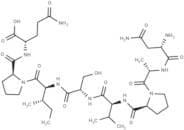
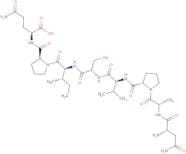
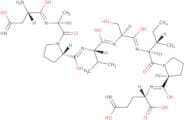
CAS 211439-12-2
:L-Glutamina, L-asparaginil-L-alanil-L-prolil-L-valil-L-seril-L-isoleucil-L-prolil-
Descripción:
La sustancia química con el nombre "L-Glutamina, L-asparaginilo-L-alanilo-L-prolilo-L-valilo-L-serilo-L-isoleucilo-L-prolilo-" y el número CAS 211439-12-2 es un péptido compuesto por múltiples aminoácidos, específicamente L-glutamina y varios otros L-aminoácidos. Este compuesto se caracteriza por su estructura, que incluye una secuencia de aminoácidos unidos por enlaces peptídicos, lo que contribuye a su potencial actividad biológica. Péptidos como este pueden desempeñar roles significativos en varios procesos fisiológicos, incluida la síntesis de proteínas, la señalización celular y la regulación metabólica. La presencia de múltiples L-aminoácidos sugiere que este péptido puede exhibir propiedades conformacionales específicas, influyendo en su estabilidad e interacciones con objetivos biológicos. Además, la secuencia de aminoácidos puede determinar la solubilidad, reactividad y funcionalidad general del péptido en sistemas biológicos. Tales compuestos a menudo se estudian por su potencial terapéutico, incluidas aplicaciones en nutrición, medicina y bioquímica. Sin embargo, serían necesarios estudios detallados para comprender completamente sus propiedades específicas y usos potenciales.
Fórmula:C36H60N10O12
Ordenar por
Pureza (%)
0
100
|
0
|
50
|
90
|
95
|
100
Encontrado 4 productos.
L-Asparaginyl-L-alanyl-L-prolyl-L-valyl-L-seryl-L-isoleucyl-L-prolyl-L-glutamine
CAS:Fórmula:C36H60N10O12Pureza:97%Forma y color:SolidPeso molecular:824.9214Davunetide
CAS:Davunetide: neuroprotective 8-amino acid peptide, improves daily function in schizophrenia, boosts memory in mild cognitive impairment.Fórmula:C36H60N10O12Pureza:98%Forma y color:SolidPeso molecular:824.92NAP
CAS:NAP is a neuroprotective peptide, which is derived from activity-dependent neuroprotective protein (ADNP), with a mechanism involving microtubule stabilization and neuronal protection. It exhibits the ability to protect neurons from various types of damage, including oxidative stress and conditions mimicking neurodegenerative diseases. NAP enhances axonal transport and increases the resilience of neurons to insults that would typically result in cell death. This peptide has shown promise in preclinical studies for its potential to halt or reverse cognitive decline, making it a focal point for research into therapeutic strategies for disorders like Alzheimer's disease and other tauopathies. The peptide operates by binding to microtubules, promoting stability, and facilitating efficient transport of cellular components. Studies have highlighted its role in traversing the blood-brain barrier, which makes it a viable candidate for central nervous system-targeted therapies. Researchers continue to explore its efficacy and possible applications in improving cognitive function and providing neuroprotection in aging populations.Pureza:(Hplc-Ms) Min. 98 Area-%NAP
CAS:NAP is a potent, selective and orally bioavailable inhibitor of bacterial nitrate reductase. It has been shown to have broad-spectrum activity against Gram-positive and Gram-negative bacteria. NAP inhibits the synthesis of DNA, which is essential for the bacterial cell cycle. It binds to the active site of the enzyme, thereby inhibiting the reduction of nitrite to nitric oxide. NAP also displays high selectivity for bacteria with respect to mammalian cells. This agent has been shown to be effective in treating bowel disease by reducing nitrate levels in the gut, as well as in models of neuronal death caused by cerebral ischemia.Fórmula:C36H60N10O12Pureza:(Hplc-Ms) Min. 98 Area-%Peso molecular:824.93 g/mol