CAS 2148-31-4
:N-acetil-S-(1,2-diclorovinil)-L-cisteína
Descripción:
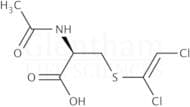
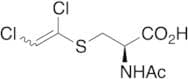
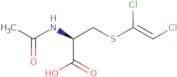
N-acetil-S-(1,2-diclorovinil)-L-cisteína, con el número CAS 2148-31-4, es un compuesto sintético que pertenece a la clase de compuestos organosulfurados. Presenta una estructura de cisteína, que es un aminoácido que contiene un grupo tiol, y está modificado con un grupo N-acetilo y un moiety diclorovinílico. Este compuesto es notable por su potencial actividad biológica, particularmente en el contexto de su papel como metabolito de ciertos pesticidas organoclorados. Su estructura permite interacciones con sistemas biológicos, lo que puede llevar a varios efectos bioquímicos. La presencia del grupo diclorovinílico sugiere una reactividad potencial, particularmente en reacciones de sustitución nucleofílica, debido a la naturaleza atrayente de electrones de los átomos de cloro. Además, la modificación N-acetilo puede influir en la solubilidad y estabilidad en entornos biológicos. En general, N-acetil-S-(1,2-diclorovinil)-L-cisteína es de interés en toxicología y química ambiental, particularmente en lo que respecta a sus implicaciones en la salud humana y los sistemas ecológicos.
Fórmula:C7H9Cl2NO3S
InChI:InChI=1S/C7H9Cl2NO3S/c1-4(11)10-5(7(12)13)3-14-6(9)2-8/h2,5H,3H2,1H3,(H,10,11)(H,12,13)/t5-/m0/s1
Clave InChI:InChIKey=LPPJGTSPIBSYQO-YFKPBYRVSA-N
SMILES:[C@@H](CSC(=CCl)Cl)(NC(C)=O)C(O)=O
Sinónimos:- (R)-2-Acetamido-3-((1,2-dichlorovinyl)thio)propanoic acid
- <span class="text-smallcaps">L</span>-Cysteine, N-acetyl-S-(1,2-dichloroethenyl)-
- Alanine, N-acetyl-3-[(1,2-dichlorovinyl)thio]-
- Alanine, N-acetyl-3-[(1,2-dichlorovinyl)thio]-, <span class="text-smallcaps">L</span>-
- N-Acetyl S-(1,2-dichlorovinyl)-<span class="text-smallcaps">L</span>-cysteine
- N-Acetyl-S-(1,2-dichloroethenyl)-<span class="text-smallcaps">L</span>-cysteine
- N-Acetyl-S-(1,2-dichlorovinyl)-L-cysteine
- L-Cysteine, N-acetyl-S-(1,2-dichloroethenyl)-
- Alanine, N-acetyl-3-[(1,2-dichlorovinyl)thio]-, L-
- N-Acetyl-S-(1,2-dichloroethenyl)-L-cysteine
Ordenar por
Pureza (%)
0
100
|
0
|
50
|
90
|
95
|
100
Encontrado 4 productos.
N-Acetyl-S-(1,2-dichloroethenyl)-L-cysteine
CAS:Producto controladoApplications Trichloroethylene metabolite
References Werner, M., et al.: Chem. Res. Toxicol., 9, 41 (1996), Bruning, T., et al.: Toxicol. Sci., 41, 157 (1998), Newman, D., et al.: Drug Metab. Disposition, 35, 43 (2007),Fórmula:C7H9Cl2NO3SForma y color:NeatPeso molecular:258.12N-Acetyl-S-(1,2-dichloroethenyl)-L-cysteine-13C,d3
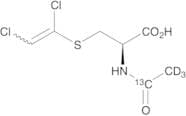
CAS:Producto controladoApplications Labelled trichloroethylene metabolite
References Werner, M., et al.: Chem. Res. Toxicol., 9, 41 (1996), Bruning, T., et al.: Toxicol. Sci., 41, 157 (1998), Newman, D., et al.: Drug Metab. Disposition, 35, 43 (2007),Fórmula:C613CH6D3Cl2NO3SForma y color:NeatPeso molecular:262.13N-Acetyl-S-(1,2-dichloroethenyl)-L-cysteine
CAS:N-Acetyl-S-(1,2-dichloroethenyl)-L-cysteine is a reactive compound that is formed from the metabolism of acetaminophen. It has been shown to cause oxidative injury in the mitochondria of proximal tubule cells. N-Acetyl-S-(1,2-dichloroethenyl)-L-cysteine disrupts mitochondrial membrane potential and causes ATP depletion. It also causes mitochondrial dysfunction by inhibiting respiratory chain activity and lowering cytosolic calcium levels. N-Acetyl-S-(1,2-dichloroethenyl)-L-cysteine has been shown to be toxic in animals and humans. The main analytical method used to detect this compound is the tetrazolium dye assay.Fórmula:C7H9Cl2NO3SPureza:Min. 95%Peso molecular:258.12 g/mol