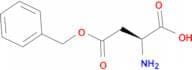
CAS 2177-63-1
:4-(Fenilmetil) hidrógeno L-aspartato
Descripción:
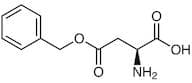
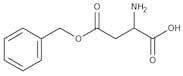
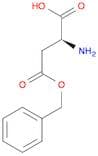
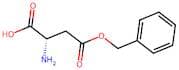
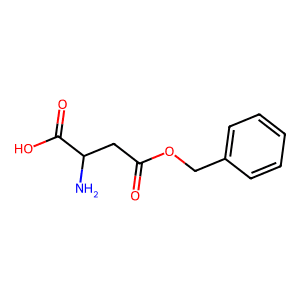
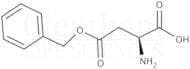
4-(Fenilmetil) hidrógeno L-aspartato, también conocido por su número CAS 2177-63-1, es un derivado de aminoácido que presenta un grupo fenilmetilo unido a la estructura de aspartato. Este compuesto se caracteriza por su complejidad estructural, que incluye un grupo funcional ácido carboxílico y un grupo amino, típicos de los aminoácidos. La presencia del grupo fenilmetilo contribuye a sus características hidrofóbicas, influyendo en su solubilidad e interacción con sistemas biológicos. Este compuesto es de interés en la investigación bioquímica, particularmente en estudios relacionados con la neurotransmisión y las vías metabólicas, ya que el aspartato desempeña un papel crucial como neurotransmisor en el sistema nervioso central. Además, sus derivados pueden exhibir propiedades farmacológicas potenciales, convirtiéndolo en un objeto de investigación en química medicinal. La estabilidad y reactividad de 4-(Fenilmetil) hidrógeno L-aspartato pueden verse influenciadas por el pH y la temperatura, que son factores importantes a considerar en aplicaciones experimentales. En general, este compuesto ejemplifica la intrincada relación entre estructura y función en contextos bioquímicos.
Fórmula:C11H13NO4
InChI:InChI=1S/C11H13NO4/c12-9(11(14)15)6-10(13)16-7-8-4-2-1-3-5-8/h1-5,9H,6-7,12H2,(H,14,15)/t9-/m0/s1
Clave InChI:InChIKey=VGALFAWDSNRXJK-VIFPVBQESA-N
SMILES:C(OC(C[C@@H](C(O)=O)N)=O)C1=CC=CC=C1
Sinónimos:- (2S)-2-Amino-4-(benzyloxy)-4-oxobutanoic acid
- (2S)-2-Amino-4-oxo-4-phenylmethoxybutanoic acid
- (2S)-2-amino-3-benzyloxy-3-oxo-propanoic acid
- (2S)-2-amino-4-(benzyloxy)-4-oxobutanoic acid (non-preferred name)
- (3S)-3-ammonio-4-(benzyloxy)-4-oxobutanoate
- 2-Amino-4-(Benzyloxy)-4-Oxobutanoic Acid (Non-Preferred Name)
- 3-Amino-4-(Benzyloxy)-4-Oxobutanoic Acid (Non-Preferred Name)
- 4-(Phenylmethyl) hydrogen <span class="text-smallcaps">L</span>-aspartate
- 4-Benzyl <span class="text-smallcaps">L</span>-aspartate
- <span class="text-smallcaps">L</span>-Aspartic acid 4-O-benzyl ester
- <span class="text-smallcaps">L</span>-Aspartic acid 4-benzyl ester
- <span class="text-smallcaps">L</span>-Aspartic acid β-benzyl ester
- <span class="text-smallcaps">L</span>-Aspartic acid, 4-(phenylmethyl) ester
- Aspartic acid β-benzyl ester
- Aspartic acid, 4-benzyl ester, <span class="text-smallcaps">L</span>-
- Benzyl aspartate
- H-Asp(OBzl)-OH
- H-Asp-OBzl
- L-Aspartic acid b-benzyl ester
- L-Aspartic acid benzyl ester
- NSC 524167
- β-Benzyl <span class="text-smallcaps">L</span>-aspartate
- β-Benzyl aspartate
- Aspartic acid, 4-benzyl ester, L-
- 4-(Phenylmethyl) hydrogen L-aspartate
- L-Aspartic acid, 4-(phenylmethyl) ester
- Ver más sinónimos
Ordenar por
Pureza (%)
0
100
|
0
|
50
|
90
|
95
|
100
Encontrado 10 productos.
4-Benzyl L-Aspartate
CAS:Fórmula:C11H13NO4Pureza:>98.0%(T)Forma y color:White to Almost white powder to crystalPeso molecular:223.23L-Aspartic acid 4-benzyl ester, 98%
CAS:L-Aspartic acid -benzyl ester is used in the synthesis of peptides with a 1,4-diazepine-2,5-dione ring structure and in development of block copolymers. This Thermo Scientific Chemicals brand product was originally part of the Alfa Aesar product portfolio. Some documentation and label information maFórmula:C11H13NO4Pureza:98%Forma y color:Powder, WhitePeso molecular:223.23H-Asp(OBzl)-OH
CAS:Bachem ID: 4000257.
Fórmula:C11H13NO4Pureza:98.6%Forma y color:WhitePeso molecular:223.23L-Aspartic acid 4-O-benzyl ester
CAS:Fórmula:C11H13NO4Pureza:98%Forma y color:SolidPeso molecular:223.2252L-Aspartic Acid 4-Benzyl Ester
CAS:L-Aspartic Acid 4-Benzyl EsterPureza:98%Peso molecular:223.23g/molL-Aspartic Acid 4-Benzyl Ester
CAS:L-Aspartic Acid 4-Benzyl EsterPureza:≥98%Peso molecular:223.23g/molL-Aspartic Acid 4-Benzyl Ester
CAS:L-Aspartic Acid 4-Benzyl Ester chelates metals, studies enzyme activity, and gene regulation.Fórmula:C11H13NO4Pureza:98.69%Forma y color:White PowderPeso molecular:223.23L-Aspartic acid b-benzyl ester
CAS:L-Aspartic acid b-benzyl ester (L-ABE) is a cytostatic drug that is biodegradable and can be used in a variety of animal species. It has been shown to inhibit the growth of cancer cells in vitro and in vivo, as well as micelles. L-ABE inhibits the action of dehydroascorbic acid reductase, an enzyme that reduces dehydroascorbic acid to ascorbic acid. This inhibition leads to an increase in the concentration of dehydroascorbic acid, which may cause cell death by damaging DNA. L-ABE also has been shown to inhibit P-glycoprotein (Pgp), leading to increased accumulation of anticancer drugs such as doxorubicin, which can lead to cell death.Fórmula:C11H13NO4Pureza:Min. 95%Forma y color:White PowderPeso molecular:223.23 g/molH-Asp(OBzl)-OH
CAS:M03009 - H-Asp(OBzl)-OH
Fórmula:C11H13NO4Pureza:98%Forma y color:White powderPeso molecular:223.228