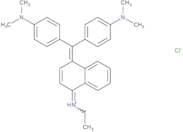
CAS 2185-86-6
:Azul Básico 11
Descripción:
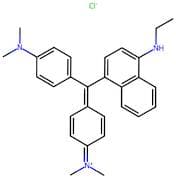
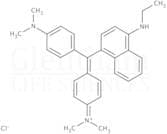
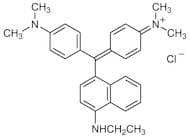
Azul Básico 11, con el número CAS 2185-86-6, es un colorante sintético que pertenece a la clase de colorantes catiónicos, utilizado específicamente en diversas aplicaciones como el teñido de textiles, la coloración de papel y la tinción biológica. Se caracteriza por su vibrante color azul y alta solubilidad en agua, lo que lo hace adecuado para su uso en soluciones acuosas. El colorante exhibe buena resistencia a la luz y a menudo se emplea en aplicaciones que requieren una coloración brillante y vívida. Azul Básico 11 es conocido por su afinidad hacia superficies cargadas negativamente, lo que le permite unirse de manera efectiva a materiales como tejidos y tejidos biológicos. Sin embargo, al igual que muchos colorantes sintéticos, puede plantear preocupaciones ambientales y de salud, lo que requiere un manejo y disposición cuidadosos. Su estructura química incluye típicamente un grupo de amonio cuaternario, lo que contribuye a su naturaleza catiónica. En general, Azul Básico 11 es un colorante versátil con aplicaciones industriales y de investigación significativas, pero debe usarse considerando la seguridad y el impacto ambiental.
Fórmula:C29H32N3·Cl
InChI:InChI=1S/C29H31N3.ClH/c1-6-30-28-20-19-27(25-9-7-8-10-26(25)28)29(21-11-15-23(16-12-21)31(2)3)22-13-17-24(18-14-22)32(4)5;/h7-20H,6H2,1-5H3;1H
Clave InChI:InChIKey=JEVGKYBUANQAKG-UHFFFAOYSA-N
SMILES:C(C=1C2=C(C(NCC)=CC1)C=CC=C2)(C3=CC=C(N(C)C)C=C3)=C4C=CC(=[N+](C)C)C=C4.[Cl-]
Sinónimos:- Aizen Victoria Blue BOH
- Basic Victoria Blue R
- Basic blue K
- Conbasic Blue AA
- Dycosbasic Victoria Blue R
- Hidaco Victoria Blue R
- Methanaminium, N-[4-[[4-(dimethylamino)phenyl][4-(ethylamino)-1-naphthalenyl]methylene]-2,5-cyclohexadien-1-ylidene]-N-methyl-, chloride
- Methanaminium, N-[4-[[4-(dimethylamino)phenyl][4-(ethylamino)-1-naphthalenyl]methylene]-2,5-cyclohexadien-1-ylidene]-N-methyl-, chloride (1:1)
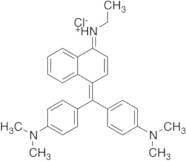
- N-[(1E)-4-{bis[4-(dimethylamino)phenyl]methylidene}naphthalen-1(4H)-ylidene]ethanaminium chloride
- Victoria Blue R
- Victoria Blue RS
- Victoria Lake Blue R
- [4-[[4-(Dimethylamino)phenyl][4-(ethylamino)-1-naphthyl]methylene]cyclohexa-2,5-dien-1-ylidene]dimethylammonium chloride
- C.I. Basic Blue 11 (7CI,8CI)
- C.I. 44040
- Ver más sinónimos
Ordenar por
Pureza (%)
0
100
|
0
|
50
|
90
|
95
|
100
Encontrado 5 productos.
N-(4-((4-(Dimethylamino)phenyl)(4-(ethylamino)naphthalen-1-yl)methylene)cyclohexa-2,5-dien-1-ylidene)-N-methylmethanaminium chloride
CAS:N-(4-((4-(Dimethylamino)phenyl)(4-(ethylamino)naphthalen-1-yl)methylene)cyclohexa-2,5-dien-1-ylidene)-N-methylmethanaminium chloridePureza:98%Peso molecular:458.05g/molBasic Blue 11
CAS:Fórmula:C29H32ClN3Pureza:>80.0%(T)(HPLC)Forma y color:Dark green to Dark blue to Black powder to crystalPeso molecular:458.05Victoria Blue R (C.I. 44040) (Technical Grade)
CAS:Producto controladoApplications Victoria Blue R (C.I. 44040) (cas# 2185-86-6) is a useful research chemical. Dyes and metabolites.It is used in preparation and photocatalytic activity of tio2/ppy/go for degrdation of rose bengal and victoria blue dye in visible light in aqueous solution.
References Pandey, G., et al.: Desalination and Water Treatment, 114, 265-284 (2018);Fórmula:C29H32N3·ClForma y color:Dark GreenPeso molecular:458.04Victoria Blue R
CAS:Victoria Blue R is a dye that is used in histology and cytology to stain tissue sections and cell smears. It binds to the amyloid protein in the extracellular matrix of cells, which causes them to turn blue when stained with this dye. Victoria Blue R is a synthetic dye that has been prepared by various methods, including synthesis from diazotized benzidine and phenol. The specific antibody for Victoria Blue R binds to an epitope on the amyloid protein, which is then stained by the dye. The main use of Victoria Blue R is as a counterstain in immunohistochemistry, where it can be used to identify glandular cells or tissues containing mitochondria. Victoria Blue R can also be used as an analytical method for determining phosphotungstic acid-haematoxylin reactions or as a reaction mechanism for polymeric matrix formation.Fórmula:C29H32N3ClForma y color:PowderPeso molecular:458.04 g/mol