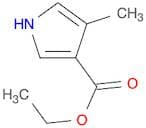
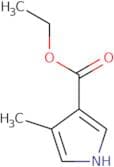
CAS 2199-49-7
:Etil 4-metilpirrol-3-carboxilato
Descripción:
Etil 4-metilpirrol-3-carboxilato es un compuesto orgánico caracterizado por su estructura de anillo de pirrol, que es un heterociclo aromático de cinco miembros que contiene nitrógeno. Este compuesto presenta un grupo funcional de éster etílico, que contribuye a sus propiedades de reactividad y solubilidad. La presencia del grupo metilo en la posición 4 del anillo de pirrol influye en sus propiedades electrónicas y en la hindrance estérica, lo que puede afectar su reactividad en diversas reacciones químicas. Etil 4-metilpirrol-3-carboxilato es típicamente un líquido o sólido incoloro a amarillo pálido, dependiendo de su pureza y forma. Es soluble en disolventes orgánicos, lo que lo hace útil en la síntesis orgánica y como intermediario en la producción de productos farmacéuticos y agroquímicos. El compuesto puede exhibir actividad biológica, lo que es de interés en la química medicinal. Se deben consultar los datos de seguridad para el manejo, como con cualquier sustancia química, para asegurar que se tomen las precauciones adecuadas durante su uso.
Fórmula:C8H11NO2
InChI:InChI=1/C8H11NO2/c1-3-11-8(10)7-5-9-4-6(7)2/h4-5,9H,3H2,1-2H3
SMILES:CCOC(=O)c1c[nH]cc1C
Sinónimos:- ethyl 4-methyl-1H-pyrrole-3-carboxylate
Ordenar por
Pureza (%)
0
100
|
0
|
50
|
90
|
95
|
100
Encontrado 5 productos.
Ethyl 4-methyl-1H-pyrrole-3-carboxylate
CAS:Fórmula:C8H11NO2Pureza:97%Forma y color:SolidPeso molecular:153.1784Ethyl 4-methyl-1H-pyrrole-3-carboxylate
CAS:Ethyl 4-methyl-1H-pyrrole-3-carboxylatePureza:95%Peso molecular:153.181g/molEthyl 4-methyl-1H-pyrrole-3-carboxylate
CAS:Fórmula:C8H11NO2Pureza:95%Forma y color:SolidPeso molecular:153.181Ethyl 4-methylpyrrole 3-carboxylate
CAS:Ethyl 4-methylpyrrole 3-carboxylate is a monomer that belongs to the group of functional groups. It is used in the polymerization process and has been shown to be able to imprint or introduce other functional groups into polymers. The following are some of its properties: it can be used as an operational group, it has chemical interactions with other functional groups, and it can be used for selectivity techniques. It also has isomeric properties, which depend on the type of functional group attached. Some examples of these properties are electrochemical polymerization and electropolymerization. The molecule also interacts with different polarities depending on the type of functional group attached.Fórmula:C8H11NO2Pureza:Min. 95%Forma y color:Yellow PowderPeso molecular:153.18 g/mol