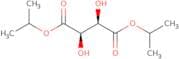
CAS 2217-15-4
:Tartarato de diisopropilo
Descripción:
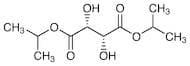
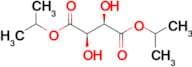
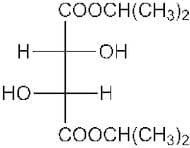
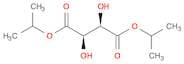
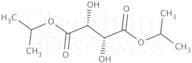
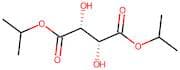
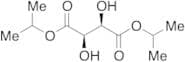
Tartarato de diisopropilo, con el número CAS 2217-15-4, es un compuesto orgánico que pertenece a la clase de ésteres derivados del ácido tartárico. Se caracteriza por su forma líquida incolora a amarillo pálido y es conocido por su baja volatilidad y su relativamente alto punto de ebullición. El compuesto es soluble en disolventes orgánicos como el etanol y el éter, pero tiene una solubilidad limitada en agua debido a sus grupos isopropílicos hidrofóbicos. Tartarato de diisopropilo se utiliza a menudo como un auxiliar quiral en la síntesis asimétrica, ayudando en la producción de compuestos enantioméricamente puros. Además, exhibe propiedades que lo hacen útil como disolvente y en varias reacciones químicas. Su estructura presenta dos grupos isopropílicos esterificados a los grupos hidroxilo del ácido tartárico, lo que contribuye a su reactividad y funcionalidad únicas en la química orgánica sintética. Los datos de seguridad indican que debe manejarse con cuidado, al igual que muchos disolventes orgánicos, para evitar posibles riesgos para la salud.
Fórmula:C10H18O6
InChI:InChI=1S/C10H18O6/c1-5(2)15-9(13)7(11)8(12)10(14)16-6(3)4/h5-8,11-12H,1-4H3/t7-,8-/m1/s1
Clave InChI:InChIKey=XEBCWEDRGPSHQH-HTQZYQBOSA-N
SMILES:[C@@H]([C@H](C(OC(C)C)=O)O)(C(OC(C)C)=O)O
Sinónimos:- (+)-Diisopropyl <span class="text-smallcaps">L</span>-tartrate
- (+)-Dipt
- (+)-Tartaric acid diisopropyl ester
- <span class="text-smallcaps">L</span>-(+)-Diisopropyl tartrate
- <span class="text-smallcaps">L</span>-(+)-Tartaric acid diisopropyl ester
- Bis(1-methylethyl) [R-(R*,R*)]-2,3-dihydroxybutanedioate
- Butanedioic acid, 2,3-dihydroxy- (2R,3R)-, 1,4-bis(1-methylethyl) ester
- Butanedioic acid, 2,3-dihydroxy- (2R,3R)-, bis(1-methylethyl) ester
- Butanedioic acid, 2,3-dihydroxy-[R-(R*,R*)]-, bis(1-methylethyl) ester
- Diisopropyl (2R,3R)-tartrate
- Diisopropyl L-(+)-tartarate
- Diisopropyl R,R-tartrate
- Diisopropyl tartrate
- Dipropan-2-Yl 2,3-Dihydroxybutanedioate
- L-Dipt
- bis(1-methylethyl) (2R,3R)-2,3-dihydroxybutanedioate
- Ver más sinónimos
Ordenar por
Pureza (%)
0
100
|
0
|
50
|
90
|
95
|
100
Encontrado 9 productos.
Diisopropyl L-(+)-Tartrate
CAS:Fórmula:C10H18O6Pureza:>98.0%(GC)Forma y color:Colorless to Almost colorless clear liquidPeso molecular:234.25(+)-Diisopropyl L-tartrate, 97%
CAS:This Thermo Scientific Chemicals brand product was originally part of the Alfa Aesar product portfolio. Some documentation and label information may refer to the legacy brand. The original Alfa Aesar product / item code or SKU reference has not changed as a part of the brand transition to Thermo SciFórmula:C10H18O6Pureza:97%Forma y color:Clear colorless to pale yellow, Liquid or viscous liquidPeso molecular:234.25(+)-Diisopropyl L-tartrate
CAS:Fórmula:C10H18O6Pureza:≥ 99.0%Forma y color:Colourless to light yellow liquidPeso molecular:234.25L-(+)-Tartaric acid diisopropyl ester
CAS:L-(+)-Tartaric acid diisopropyl esterFórmula:C10H18O6Pureza:≥95%Forma y color: clear. almost colourless liquidPeso molecular:234.24631g/molDiisopropyl tartrate
CAS:Diisopropyl tartrate is a reagent for kinetic resolution of racemic allylic alcohols and α-furfuryl amides. It acts by enantioselective epoxidation.Fórmula:C10H18O6Pureza:98%Forma y color:Clear Colorless LiquidPeso molecular:234.24(+)-Diisopropyl L-Tartrate
CAS:Producto controladoApplications (+)-Diisopropyl L-Tartrate is a reagent for kinetic resolution of racemic allylic alcohols and α-furfuryl amides by enantioselective epoxidation.
References Lee, E., et al.: J. Org. Chem., 59, 14444 (1994); Jung, M., et al.: J. Am. Chem. Soc., 115, 12208 (1993);Fórmula:C10H18O6Forma y color:NeatPeso molecular:234.25(+)-Diisopropyl L-tartrate
CAS:(+)-Diisopropyl L-tartrate is a chiral, hydrophobic, synthetic chemical that is soluble in organic solvents. It has been used as an intermediate for the synthesis of other compounds such as aldehydes and threonine. (+)-Diisopropyl L-tartrate is also used to separate mixtures of enantiomers. This compound has been shown to be effective at extracting styrene from gasoline or methyl esters from crude oil. The optimal extraction temperature is between 60°C and 100°C.
Fórmula:C10H18O6Pureza:Min. 95%Forma y color:Clear LiquidPeso molecular:234.25 g/mol