CAS 2233-18-3
:3,5-Dimetil-4-hidroxibenzaldehído
Descripción:
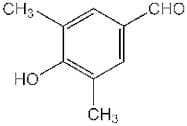
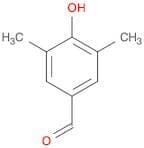
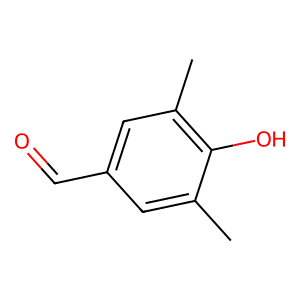
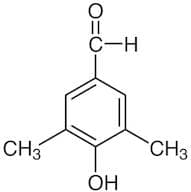
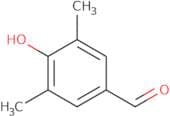
3,5-Dimetil-4-hidroxibenzaldehído, con el número CAS 2233-18-3, es un compuesto orgánico que pertenece a la clase de los aldehídos aromáticos. Presenta un anillo bencénico sustituido con dos grupos metilo en las posiciones 3 y 5, un grupo hidroxilo en la posición 4 y un grupo funcional aldehído. Este compuesto se caracteriza típicamente por su apariencia de color amarillo pálido a marrón claro y tiene un olor aromático distintivo. Es soluble en disolventes orgánicos como el etanol y el éter, pero su solubilidad en agua es limitada debido a sus grupos metilo hidrofóbicos. La presencia del grupo hidroxilo contribuye a su reactividad, permitiéndole participar en varias reacciones químicas, incluyendo oxidación y condensación. 3,5-Dimetil-4-hidroxibenzaldehído se utiliza a menudo en síntesis orgánica y puede servir como un intermedio en la producción de colorantes, fragancias y productos farmacéuticos. Sus propiedades lo convierten en un compuesto valioso tanto en aplicaciones de investigación como industriales.
Fórmula:C9H10O2
InChI:InChI=1/C9H10O2/c1-6-3-8(5-10)4-7(2)9(6)11/h3-5,11H,1-2H3
Clave InChI:InChIKey=UYGBSRJODQHNLQ-UHFFFAOYSA-N
SMILES:C(=O)C1=CC(C)=C(O)C(C)=C1
Sinónimos:- 3,5-Dimethyl-4-hydroxybenzaldehyde
- 4-Formyl-2,6-xylenol
- Benzaldehyde, 4-hydroxy-3,5-dimethyl-
- NSC 128405
- 4-Hydroxy-3,5-dimethylbenzaldehyde
- BUTTPARK 96\57-68
- 4-hydroxy-3,5-dimethyl-benzaldehyd
- 3,5-Dimethyl-4-Hydroxybenzalde
- 3,5-Dimethyl-4-Hydorxybenzaldehyde
- 4-Hydroxy-3,5-dimethylbenzaldehyde, TECH
- Syringnldehyde
Ordenar por
Pureza (%)
0
100
|
0
|
50
|
90
|
95
|
100
Encontrado 6 productos.
4-Hydroxy-3,5-dimethylbenzaldehyde, 97+%
CAS:This Thermo Scientific Chemicals brand product was originally part of the Alfa Aesar product portfolio. Some documentation and label information may refer to the legacy brand. The original Alfa Aesar product / item code or SKU reference has not changed as a part of the brand transition to Thermo Sci
Fórmula:C9H10O2Pureza:97+%Forma y color:White to cream or yellow to orange or pale brown, Crystals or Crystalline powderPeso molecular:150.183,5-Dimethyl-4-hydroxybenzaldehyde
CAS:Fórmula:C9H10O2Pureza:97%Forma y color:SolidPeso molecular:150.17453,5-Dimethyl-4-hydroxybenzaldehyde
CAS:3,5-Dimethyl-4-hydroxybenzaldehydeFórmula:C9H10O2Pureza:≥95%Forma y color: off-white powderPeso molecular:150.17g/mol4-Hydroxy-3,5-dimethylbenzaldehyde
CAS:Fórmula:C9H10O2Pureza:>98.0%(T)Forma y color:White to Light yellow to Dark green powder to crystalPeso molecular:150.184-Hydroxy-3,5-dimethylbenzaldehyde
CAS:4-Hydroxy-3,5-dimethylbenzaldehyde (HDA) is an aromatic hydrocarbon that can be found in plants. It is a product of the oxidation of hydroxyl groups by inorganic acids and has been shown to induce hepatic steatosis in mice. This reaction is mediated by malic acid, which reacts with the benzyl group to form a cavity. The molecular modeling study of this reaction mechanism shows that the carboxylate group deprotonates, which leads to the formation of a carbocation intermediate when it attacks the aromatic ring. The aromatic ring opens up during this step, leading to a carbocation. The carbocation then collapses and hydrogen from the hydroxyl group attaches to carbon 2 on C4, forming HDA and releasing water.Fórmula:C9H10O2Pureza:Min. 95%Forma y color:Off-White PowderPeso molecular:150.17 g/mol4-Hydroxy-3,5-dimethylbenzaldehyde
CAS:Fórmula:C9H10O2Pureza:97%Forma y color:Crystalline Powder,PowderPeso molecular:150.177