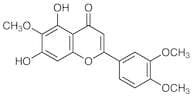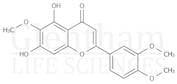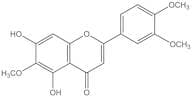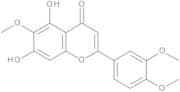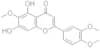
CAS 22368-21-4
:Eupatilina
Descripción:
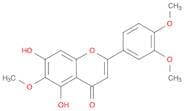
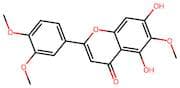
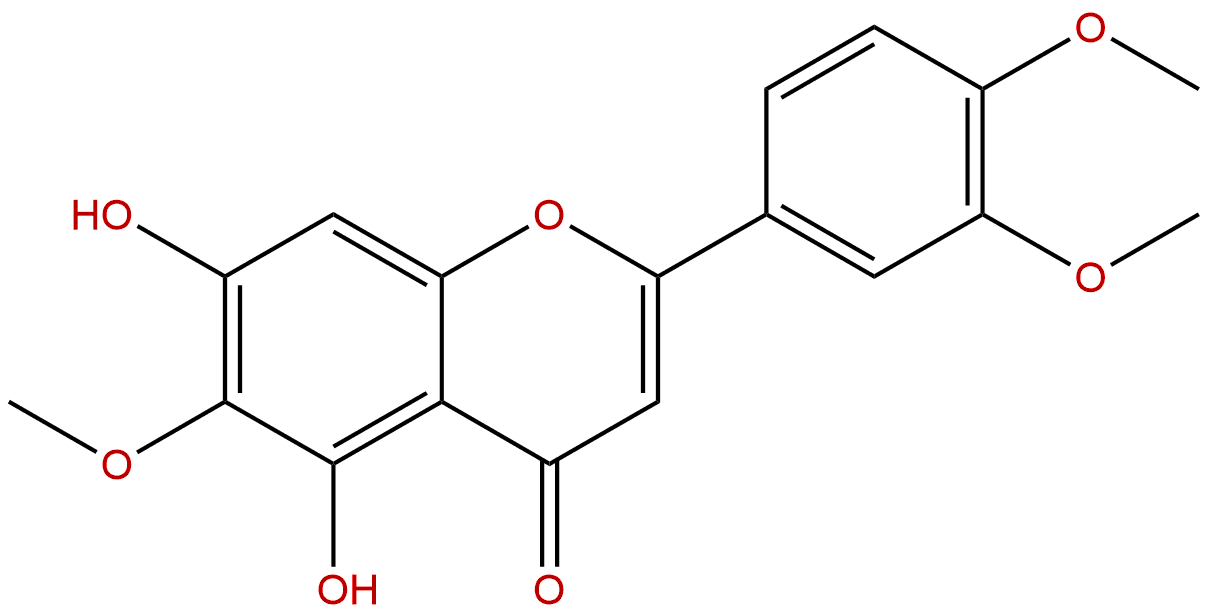
Eupatilina, con el número CAS 22368-21-4, es un compuesto flavonoide que se encuentra de forma natural, derivado principalmente de varias plantas, especialmente aquellas de la familia Asteraceae. Se conoce por sus posibles propiedades farmacológicas, incluyendo efectos antiinflamatorios, antioxidantes y hepatoprotectores. Eupatilina exhibe una estructura compleja caracterizada por múltiples grupos hidroxilo, que contribuyen a su actividad biológica y solubilidad en disolventes polares. El compuesto ha despertado interés en la química medicinal debido a su capacidad para modular diversas vías bioquímicas, lo que lo convierte en un candidato para aplicaciones terapéuticas. Además, el perfil de seguridad de Eupatilina y su baja toxicidad en estudios preliminares sugieren su potencial para ser utilizado en suplementos dietéticos o como ingrediente funcional en alimentos. Sin embargo, se necesita más investigación para elucidar completamente sus mecanismos de acción y eficacia en entornos clínicos. En general, Eupatilina representa un área prometedora de estudio dentro de la química de productos naturales y la farmacología.
Fórmula:C18H16O7
InChI:InChI=1S/C18H16O7/c1-22-12-5-4-9(6-14(12)23-2)13-7-10(19)16-15(25-13)8-11(20)18(24-3)17(16)21/h4-8,20-21H,1-3H3
Clave InChI:InChIKey=DRRWBCNQOKKKOL-UHFFFAOYSA-N
SMILES:OC1=C2C(OC(=CC2=O)C3=CC(OC)=C(OC)C=C3)=CC(O)=C1OC
Sinónimos:- 2-(3,4-Dimethoxyphenyl)-5,7-dihydroxy-6-methoxy-4H-1-benzopyran-4-one
- 2-(3,4-Dimethoxyphenyl)-5,7-dihydroxy-6-methoxychromen-4-one
- 2-(3,4-dimethoxyphenyl)-5,7-dihydroxy-6-methoxy-4H-chromen-4-one
- 4H-1-Benzopyran-4-one, 2-(3,4-dimethoxyphenyl)-5,7-dihydroxy-6-methoxy-
- 5,7-Dihydroxy-3′,4′,6-trimethoxyflavone
- 5,7-Dihydroxy-6,3′,4′-trimethoxyflavone
- Flavone, 5,7-dihydroxy-3′,4′,6-trimethoxy-
- NSC 122413
- Stillen
- Eupatilin
Ordenar por
Pureza (%)
0
100
|
0
|
50
|
90
|
95
|
100
Encontrado 12 productos.
Ref: IN-DA00BDN5
1gA consultar1mg50,00€5mg50,00€10mg66,00€25mg127,00€50mg171,00€100mg195,00€250mg328,00€2-(3,4-Dimethoxyphenyl)-5,7-Dihydroxy-6-Methoxy-4H-Chromen-4-One
CAS:2-(3,4-Dimethoxyphenyl)-5,7-Dihydroxy-6-Methoxy-4H-Chromen-4-OnePureza:99%Peso molecular:344.32g/molEupatilin
CAS:Eupatilinthe has anti-proliferative effect in MCF10A- ras cells, is associated with its blockade of cell cycle progression which appears to be attributable in part to inhibition of ERK1/2 activation.Fórmula:C18H16O7Pureza:95%~99%Forma y color:Yellow powderPeso molecular:344.319Eupatilin
CAS:Fórmula:C18H16O7Pureza:>97.0%(HPLC)Forma y color:White to Light yellow to Green powder to crystalPeso molecular:344.32Eupatilin
CAS:Eupatilin (NSC-122413), a flavone derived from Artemisia princepsPampanini, is a PPARα agonist, with pharmacological activity.Fórmula:C18H16O7Pureza:98.53% - 99%Forma y color:SolidPeso molecular:344.32Eupatilin
CAS:Oxygen-heterocyclic compoundFórmula:C18H16O7Pureza:≥ 95.0 % (HPLC)Forma y color:PowderPeso molecular:344.32Eupatilin
CAS:Producto controladoStability Hygroscopic
Applications Eupatilin maintains anticoagulant and antiplatelet activity isolated from the Artemisia princeps Pampanini flower.
References Ryu, R. et al.: Prev. Nutr. Food Sci., 18, 181 (2013);Fórmula:C18H16O7Forma y color:Light Yellow To BeigePeso molecular:344.32Eupatilin
CAS:Eupatilin is a flavonoid compound, which is derived from the Artemisia species. This plant-based source has been traditionally used in various medicinal applications across different cultures. Eupatilin’s mode of action involves inhibition of pro-inflammatory cytokines and modulation of signaling pathways associated with inflammation, such as the NF-kB pathway. Additionally, it has been found to possess antioxidant activities, which further contributes to its therapeutic potential.Fórmula:C18H16O7Pureza:Min. 95%Forma y color:PowderPeso molecular:344.32 g/mol