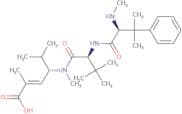
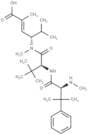
![N,β,β-Trimethyl-L-phenylalanyl-N-[(1S,2E)-3-carboxy-1-(1-methylethyl)-2-buten-1-yl]-N,3-dimethyl-L…](/_next/image/?url=https%3A%2Fstatic.cymitquimica.com%2Fcas-image%2Fthumb-webp%2F464767-n-b-b-trimethyl-l-phenylalanyl-n-1s-2e-3-carboxy-1-1-methylethyl-2-buten-1-yl-n-3-dimethyl-l-valinamide.webp&w=3840&q=75)
CAS 228266-40-8
:N,β,β-Trimetil-L-fenilalanil-N-[(1S,2E)-3-carboxi-1-(1-metiletil)-2-buten-1-il]-N,3-dimetil-L-valinamida
Descripción:
N,β,β-Trimetil-L-fenilalanil-N-[(1S,2E)-3-carboxi-1-(1-metiletil)-2-buten-1-il]-N,3-dimetil-L-valinamida, con número CAS 228266-40-8, es un compuesto sintético que pertenece a la clase de derivados de aminoácidos. Esta sustancia presenta una estructura compleja caracterizada por múltiples centros quirales, lo que contribuye a su potencial actividad biológica. La presencia de los grupos de fenilalanina y valina sugiere que puede interactuar con sistemas biológicos, posiblemente influyendo en la síntesis de proteínas o la actividad enzimática. Los grupos funcionales de ácido carboxílico y alqueno del compuesto indican una reactividad potencial, lo que lo hace de interés en la química medicinal y el diseño de fármacos. Su estereoequilibrio específico también puede desempeñar un papel crucial en sus propiedades farmacológicas, afectando la afinidad de unión y la selectividad por los objetivos biológicos. Al igual que muchos compuestos sintéticos, entender su solubilidad, estabilidad y reactividad bajo diversas condiciones es esencial para aplicaciones en investigación y desarrollo. Se necesitarían más estudios para elucidar su perfil biológico completo y sus posibles usos terapéuticos.
Fórmula:C27H43N3O4
InChI:InChI=1S/C27H43N3O4/c1-17(2)20(16-18(3)25(33)34)30(10)24(32)22(26(4,5)6)29-23(31)21(28-9)27(7,8)19-14-12-11-13-15-19/h11-17,20-22,28H,1-10H3,(H,29,31)(H,33,34)/b18-16+/t20-,21-,22-/m1/s1
Clave InChI:InChIKey=CNTMOLDWXSVYKD-PSRNMDMQSA-N
SMILES:[C@H](C(C)(C)C1=CC=CC=C1)(C(N[C@H](C(N([C@H](/C=C(/C(O)=O)\C)C(C)C)C)=O)[C@@](C)(C)C)=O)NC
Sinónimos:- <span class="text-smallcaps">L</smallcap>-Valinamide, N,β,β-trimethyl-<smallcap>L</span>-phenylalanyl-N-[(1S,2E)-3-carboxy-1-(1-methylethyl)-2-buten-1-yl]-N,3-dimethyl-
- <span class="text-smallcaps">L</smallcap>-Valinamide, N,β,β-trimethyl-<smallcap>L</span>-phenylalanyl-N-[(1S,2E)-3-carboxy-1-(1-methylethyl)-2-butenyl]-N,3-dimethyl-
- Hti 286
- N,beta,beta-Trimethyl-L-phenylalanyl-N-[(1S,2E)-3-carboxy-1-(1-methylethyl)-2-butenyl]-N,3-dimethyl-L-valinamide
- N,β,β-Trimethyl-<span class="text-smallcaps">L</smallcap>-phenylalanyl-N-[(1S,2E)-3-carboxy-1-(1-methylethyl)-2-buten-1-yl]-N,3-dimethyl-<smallcap>L</span>-valinamide
- Spa 110
- L-Valinamide, N,β,β-trimethyl-L-phenylalanyl-N-[(1S,2E)-3-carboxy-1-(1-methylethyl)-2-buten-1-yl]-N,3-dimethyl-
- N,β,β-Trimethyl-L-phenylalanyl-N-[(1S,2E)-3-carboxy-1-(1-methylethyl)-2-buten-1-yl]-N,3-dimethyl-L-valinamide
- L-Valinamide, N,β,β-trimethyl-L-phenylalanyl-N-[(1S,2E)-3-carboxy-1-(1-methylethyl)-2-butenyl]-N,3-dimethyl-
Ordenar por
Pureza (%)
0
100
|
0
|
50
|
90
|
95
|
100
Encontrado 3 productos.
L-Valinamide,N,b,b-trimethyl-L-phenylalanyl-N-[(1S,2E)-3-carboxy-1-(1-methylethyl)-2-butenyl]-N,3-dimethyl-
CAS:Fórmula:C27H43N3O4Pureza:99.65%Peso molecular:473.6480Taltobulin
CAS:<p>Taltobulin is a nitrogen-containing analog that binds to the α subunit of the renal tubular adenylate cyclase and inhibits its activity. This results in decreased levels of cyclic AMP and less activation of protein kinases, which are important for regulating cellular functions. Taltobulin has been shown to inhibit cancer cells in culture as well as bladder and other cancers in animal studies. It also has minimal toxicity, with most side effects being mild and reversible. Taltobulin is used to treat autoimmune diseases such as lupus erythematosus, rheumatoid arthritis, and multiple sclerosis. Antibodies against taltobulin have been found in patients who were treated with this drug. These antibodies were found to be specific for the α subunit of the renal tubular adenylate cyclase and may be used as a diagnostic marker for patients who have been exposed to taltobulin or other similar drugs.</p>Fórmula:C27H43N3O4Pureza:Min. 98 Area-%Forma y color:PowderPeso molecular:473.65 g/molTaltobulin
CAS:Taltobulin (HTI-286) is a synthetic analog of the tripeptide cysteine, a microtubule protein inhibitor that inhibits liver tumor cell proliferation in vitro and tumor growth in vivo.Taltobulin is cytotoxic, induces mitotic arrest and apoptosis, and may be used in the study of breast cancer and microtubule tissue-related diseases.Fórmula:C27H43N3O4Pureza:99.86%Forma y color:SolidPeso molecular:473.65
![L-Valinamide,N,b,b-trimethyl-L-phenylalanyl-N-[(1S,2E)-3-carboxy-1-(1-methylethyl)-2-butenyl]-N,3-…](/_next/image/?url=https%3A%2Fstatic.cymitquimica.com%2Fproducts%2FIN%2Fthumb%2FDA00BF4U.jpg&w=3840&q=75)