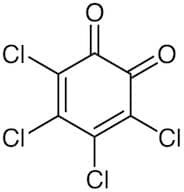
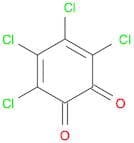
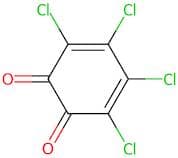
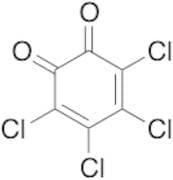
CAS 2435-53-2
:o-Cloranil
- 3,4,5,6-Tetrachloro-1,2-benzoquinone
- 3,4,5,6-Tetrachloro-3,5-cyclohexadiene-1,2-dione
- 3,4,5,6-Tetrachloro-o-benzoquinone
- 3,4,5,6-Tetrachlorobenzoquinone
- 3,4,5,6-Tetrachlorocyclohexa-3,5-Diene-1,2-Dione
- 3,4,5,6-Tetrachlorocyclohexadiene-1,2-dione
- 3,5-Cyclohexadiene-1,2-dione, 3,4,5,6-tetrachloro-
- Isochloranil
- NSC 403503
- Tetrachloro-1,2-benzoquinone
- Tetrachloro-o-quinone
- Tetrachloro-ortho-benzoquinone
- Tetrachloroorthobenzoquinone
- o-Benzoquinone, 3,4,5,6-tetrachloro-
- o-Benzoquinone, tetrachloro-
- Ver más sinónimos
o-Chloranil
CAS:Fórmula:C6Cl4O2Pureza:>97.0%(T)(HPLC)Forma y color:Orange to Brown to Dark purple powder to crystalPeso molecular:245.86Tetrachloro-1,2-benzoquinone
CAS:Tetrachloro-1,2-benzoquinonePureza:97%Forma y color:Red SolidPeso molecular:245.88g/molo-Chloranil
CAS:Producto controladoApplications o-Chloranil is used as a reagent in the synthesis of fused triazolotriazines and triazolotriazepines which exhibit antibacterial activity. Also used as a reagent in the synthesis of nickel diimine catecholate charge-transfer complexes.
References Aly, A.A., et al.: J. Chem. Res., 35, 169 (2011); Kramer, W.W., et al.: Inorg. Chem., 53, 8825 (2014)Fórmula:C6Cl4O2Forma y color:NeatPeso molecular:245.883,4,5,6-Tetrachlorocyclohexa-3,5-diene-1,2-dione
CAS:Fórmula:C6Cl4O2Pureza:95%Forma y color:Yellow red – deep purple powderPeso molecular:245.86o-Chloranil
CAS:O-Chloranil is a chemical compound that has a molecular weight of 144.07 g/mol and the IUPAC name 2,4-dichloro-1-nitrobenzene. O-Chloranil is a pyridine derivative with an intramolecular hydrogen bond, which makes it a kinetically stable molecule. The redox potential of o-chloranil lies at +0.6 V (vs Ag/AgCl). This means that o-chloranil is not easily oxidized and less likely to react with other substances in the environment. The phase transition temperature for o-chloranil is -5 °C, which means that it will change from solid to liquid at this temperature. It can also be activated by light or heat, which allows reactions to occur more quickly than they would otherwise. O-Chloranil has been used as the model system for the reaction mechanism of thiophenol oxidation in
Fórmula:C6Cl4O2Pureza:Min. 95%Forma y color:Red PowderPeso molecular:245.87 g/mol