CAS 2492-75-3
:Ácido 2-oxohexanoico
Descripción:
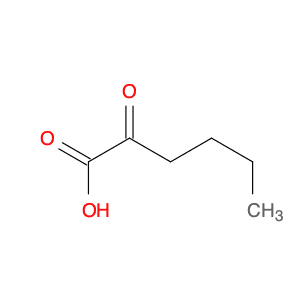
Ácido 2-oxohexanoico, también conocido como ácido 6-oxohexanoico, es un ácido carboxílico caracterizado por la presencia de un grupo cetona y un grupo carboxilo en su estructura molecular. Presenta una cadena de seis carbonos con un grupo cetona ubicado en el segundo carbono y un grupo ácido carboxílico en el carbono terminal. Este compuesto es típicamente un líquido o sólido incoloro a amarillo pálido, dependiendo de su estado y pureza. Es soluble en agua y en disolventes orgánicos, lo que lo hace versátil para diversas aplicaciones en síntesis orgánica e investigación química. Ácido 2-oxohexanoico puede participar en varias reacciones químicas, incluyendo esterificación y condensación, y a menudo se utiliza como intermediario en la síntesis de productos farmacéuticos, agroquímicos y otros compuestos orgánicos. Además, puede exhibir actividad biológica, lo que puede ser de interés en química medicinal. Se deben consultar los datos de seguridad para su manipulación, ya que puede representar riesgos para la salud si se ingiere o inhala.
Fórmula:C6H10O3
InChI:InChI=1S/C6H10O3/c1-2-3-4-5(7)6(8)9/h2-4H2,1H3,(H,8,9)
Clave InChI:InChIKey=XNIHZNNZJHYHLC-UHFFFAOYSA-N
SMILES:C(C(O)=O)(CCCC)=O
Sinónimos:- 2-Ketocaproic Acid
- 2-Ketohexanoic acid
- 2-Oxocaproic acid
- Alpha-Ketocaproic Acid
- Hexanoic Acid, 2-Oxo-
- α-Ketocaproic acid
- α-Ketohexanoic acid
- α-Oxo-n-caproic acid
- α-Oxocaproic acid
- 2-Oxohexanoic acid
- 2-Oxohexanoic acid
Ordenar por
Pureza (%)
0
100
|
0
|
50
|
90
|
95
|
100
Encontrado 5 productos.
2-Oxohexanoic Acid
CAS:Producto controladoApplications 2-Oxohexanoic Acid (cas# 2492-75-3) has been useful in a biological study that investigated the impact of glutathione on wines oxidative stability.
References Nikolantonaki, M., et al.: Front. Chem. (Lausanne, Switzerland), 6, 182 (2018)Fórmula:C6H10O3Forma y color:NeatPeso molecular:130.142-Oxohexanoic acid
CAS:2-Oxohexanoic acid (2-OHBA) is a fatty acid that is synthesized from the amino acids lysine and methionine. It is involved in mitochondrial metabolism and has been found to be necessary for spermatozoa motility. 2-OHBA has been shown to inhibit the activity of glutamate dehydrogenase, an enzyme that catalyzes the conversion of glutamate to α-ketoglutarate, which is required for energy production. This inhibition leads to a decrease in ATP levels, which may cause a variety of symptoms, including fatigue and weight loss. Furthermore, 2-OHBA inhibits protein synthesis by blocking the incorporation of amino acids into proteins. The inhibition of this process can lead to high ammonia levels in the blood and accumulation of other nitrogenous wastes in tissues such as liver or muscle tissue. Analysis of urine samples has shown that 2-OHBA is excreted unchanged in urine.Fórmula:C6H10O3Pureza:Min. 95%Peso molecular:130.14 g/mol