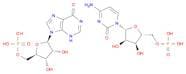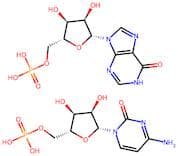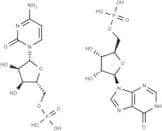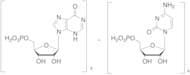
CAS 24939-03-5
:Poli(I:C)
Descripción:
Poli(I:C), o ácido poliinosinico-policitídico, es una molécula de ARN de doble cadena sintética que actúa como un potente inmunoestimulante. Se reconoce principalmente por su papel en la simulación de infecciones virales, activando así la respuesta inmune, particularmente a través de la estimulación de los receptores tipo Toll (TLRs), específicamente TLR3. Esta activación conduce a la producción de diversas citoquinas e interferones, mejorando las defensas antivirales del cuerpo. Poli(I:C) se utiliza a menudo en investigaciones y aplicaciones terapéuticas, incluyendo el desarrollo de vacunas y la inmunoterapia contra el cáncer, debido a su capacidad para inducir una respuesta inmune robusta. La sustancia se caracteriza típicamente por su alto peso molecular y es soluble en agua, lo que la hace adecuada para varios ensayos biológicos. Además, Poli(I:C) puede ser modificado para mejorar su estabilidad y eficacia, como a través de la incorporación de modificaciones químicas que aumentan su resistencia a la degradación por nucleasas. En general, Poli(I:C) es una herramienta valiosa en la inmunología y la investigación terapéutica, contribuyendo a nuestra comprensión de los mecanismos inmunes y las estrategias de tratamiento potenciales.
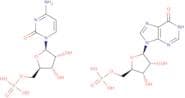
Fórmula:(C10H13N4O8P)x·(C9H14N3O8P)x
InChI:InChI=1S/C10H13N4O8P.C9H14N3O8P/c15-6-4(1-21-23(18,19)20)22-10(7(6)16)14-3-13-5-8(14)11-2-12-9(5)17;10-5-1-2-12(9(15)11-5)8-7(14)6(13)4(20-8)3-19-21(16,17)18/h2-4,6-7,10,15-16H,1H2,(H,11,12,17)(H2,18,19,20);1-2,4,6-8,13-14H,3H2,(H2,10,11,15)(H2,16,17,18)/t4-,6-,7-,10-;4-,6-,7-,8-/m11/s1
Clave InChI:InChIKey=ACEVNMQDUCOKHT-ZLOOHWKQSA-N
SMILES:O[C@H]1[C@H](N2C3=C(N=C2)C(=O)N=CN3)O[C@H](COP(=O)(O)O)[C@H]1O.O[C@H]1[C@@H](O[C@H](COP(=O)(O)O)[C@H]1O)N2C(=O)N=C(N)C=C2
Sinónimos:- 4-amino-1-(5-O-phosphonopentofuranosyl)pyrimidin-2(1H)-one - 9-(5-O-phosphonopentofuranosyl)-3,9-dihydro-6H-purin-6-one (1:1)
- 5'-Cytidylic Acid - 5'-Inosinic Acid (1:1)
- 5′-Cytidylic acid, homopolymer, complex with 5′-inosinic acid homopolymer (1:1)
- 5′-Cytidylic acid, polymers, complex with 5′-inosinic acid polymers (1:1)
- 5′-Inosinic acid homopolymer-5′-cytidylic acid homopolymer complex (1:1)
- 5′-Inosinic acid, homopolymer, complex with 5′-cytidylic acid homopolymer (1:1)
- 5′-Inosinic acid, polymers, complex with 5′-cytidylic acid polymers (1:1)
- NSC 120949
- NSC 123233
- NSC 128576
- Poly I:C
- Poly I:C Polyinosinicacid-polycytidylic acid
- Poly(C).poly(I)
- Poly(C:I)
- Poly(I)-poly(C)
- Poly(I).poly(C) complex
- Poly(cytidylic acid)-poly(inosinic acid)
- Poly(rI)-poly(rC)
- Poly(rI:rC)
- Polycytidylic-polyinosinic acid
- Polycytidysic acid
- Polyinosinate-polycytidylate complex
- Polyinosinate:polycytidylate
- Polyinosine-polycytidylic acid
- Polyinosinic acid-polycytidylic acid
- Polyinosinic acid:polycytidylic acid complex
- Polyinosinic-polycytidylic acid complex
- Ver más sinónimos
Ordenar por
Pureza (%)
0
100
|
0
|
50
|
90
|
95
|
100
Encontrado 8 productos.
5'-Inosinic acid, homopolymer, complex with 5'-cytidylic acidhomopolymer (1:1)OTHER CA INDEX NAMES:5'-Cytidylic acid, homopolymer, complex with 5'-inosinic acidhomopolymer (1:1)
CAS:Fórmula:C21H35N7O16P2Pureza:90%Forma y color:SolidPeso molecular:703.4874Polyinosinic-polycytidylic acid
CAS:Polyinosinic-polycytidylic acid (Poly(I:C)) is a synthetic double-stranded RNA (dsRNA) analog and an immunostimulant that acts as the most potent IFN inducer.Fórmula:(C10H13N4O8P)x·(C9H14N3O8P)xPureza:90%Forma y color:SolidPeso molecular:671.406Poly(I:C) (~90%)
CAS:Producto controladoApplications Poly(I:C) is a toll-like receptor 3 dsRNA inflammatory stimulant.
References Smith, G.A., et al.: PLoS One, 10, e0121072 (2015); Dauletbaev, N., et al.: J. Immunol., 195, 2829 (2015); Broering, R., et al.: J. Viral Hepatitis, 21, 480 (2014); Colapicchioni, V., et al.: J. Mater. Chem. B: Mater. Biol. Med., 3, 7408 (2015)Fórmula:H2(C10H11N4O8P)n·H2(C9H12N3O8P)nPureza:~90%Forma y color:NeatPeso molecular:671.4Polyinosinic acid-polycytidylic acid, homopolymer (1:1)
CAS:Polyinosinic acid-polycytidylic acid (Poly I:C), an agonist of TLR3 toll-like receptors, is a synthetic double-stranded RNA analog, consisting of polyinosinic acid (poly I) paired with polycytidylic acid (poly C), forming a stable duplex structure.PolyI:C stimulates the secretion of pro-inflammatory cytokines and type I interferon through its interaction with endosomal Toll-like receptor 3 (TLR-3) and the cytoplasmic receptors melanoma differentiation-associated gene 5 (MDA-5) and retinoic acid-inducible gene I (RIG-I). This immunostimulant activity makes Poly I:C a useful vaccine adjuvant and is used in vaccine formulations. Poly I:C and its stabilized analogs (e.g., poly-ICLC) are also being actively researched for their dual role in oncology: directly targeting tumors and acting as immune potentiators. For example Poly I:C can induce apoptosis in tumor cells and stimulate immunogenic cell death and is therefore being explored alongside chemotherapy, radiotherapy, and checkpoint inhibitors, helping to overcome resistance mechanisms and strengthen treatment outcomes.We can supply PolyI:C to all stages of your project - from R&D and preclinical phases right up to GMP commercial manufacture. Contact our team for custom Poly I:C products. For more on poly I:C read out blog 'Poly I:C: A Vaccine Adjuvant With Oncological Potential.'Fórmula:(C10H13N4O8P)x•(C9H14N3O8P)xForma y color:PowderPolyinosinic acid-polycytidylic acid, homopolymer (1:1)
CAS:Polyinosinic acid-polycytidylic acid (Poly I:C), an agonist of TLR3 toll-like receptors, is a synthetic double-stranded RNA analog, consisting of polyinosinic acid (poly I) paired with polycytidylic acid (poly C), forming a stable duplex structure.PolyI:C stimulates the secretion of pro-inflammatory cytokines and type I interferon through its interaction with endosomal Toll-like receptor 3 (TLR-3) and the cytoplasmic receptors melanoma differentiation-associated gene 5 (MDA-5) and retinoic acid-inducible gene I (RIG-I). This immunostimulant activity makes Poly I:C a useful vaccine adjuvant and is used in vaccine formulations. Poly I:C and its stabilized analogs (e.g., poly-ICLC) are also being actively researched for their dual role in oncology: directly targeting tumors and acting as immune potentiators. For example Poly I:C can induce apoptosis in tumor cells and stimulate immunogenic cell death and is therefore being explored alongside chemotherapy, radiotherapy, and checkpoint inhibitors, helping to overcome resistance mechanisms and strengthen treatment outcomes.We can supply PolyI:C to all stages of your project - from R&D and preclinical phases right up to GMP commercial manufacture. Contact our team for custom Poly I:C products. For more on poly I:C read out blog 'Poly I:C: A Vaccine Adjuvant With Oncological Potential.'Fórmula:(C10H13N4O8P)x•(C9H14N3O8P)xPureza:(Hplc-Ms) Min. 95.0 Area-%