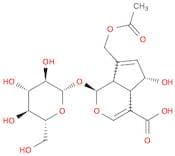
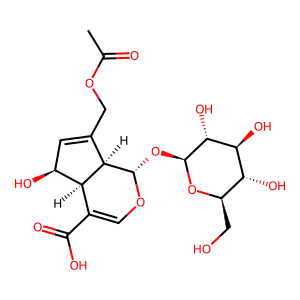
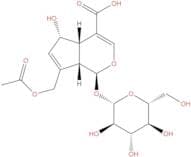
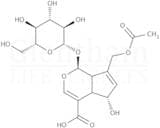
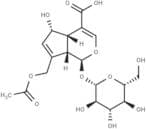
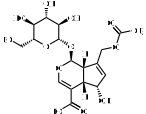
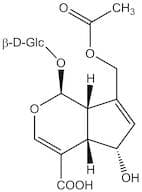
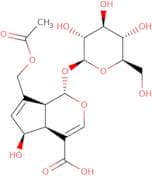
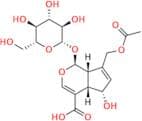
CAS 25368-11-0
:Ácido asperulosídico
Descripción:
Ácido asperulosídico es un glucósido iridoide que se encuentra de forma natural, principalmente en varias especies de plantas, particularmente en la familia Rubiaceae. Se caracteriza por su compleja estructura molecular, que incluye un moiety de azúcar unido a un núcleo iridoide. Este compuesto es conocido por sus potenciales propiedades farmacológicas, incluyendo actividades antiinflamatorias, antioxidantes y antimicrobianas. Ácido asperulosídico se estudia a menudo por su papel en la medicina tradicional y sus posibles aplicaciones terapéuticas. Es típicamente soluble en disolventes polares, lo que facilita su extracción de materiales vegetales. La estabilidad y reactividad del compuesto pueden verse influenciadas por factores ambientales como el pH y la temperatura. Además, su presencia en formulaciones herbales destaca su importancia en la fitociencia y la investigación de productos naturales. En general, Ácido asperulosídico representa un tema de estudio interesante debido a sus propiedades bioactivas y sus posibles beneficios para la salud.
Fórmula:C18H24O12
InChI:InChI=1S/C18H24O12/c1-6(20)27-4-7-2-9(21)12-8(16(25)26)5-28-17(11(7)12)30-18-15(24)14(23)13(22)10(3-19)29-18/h2,5,9-15,17-19,21-24H,3-4H2,1H3,(H,25,26)/t9-,10+,11+,12-,13+,14-,15+,17-,18-/m0/s1
Clave InChI:InChIKey=DGDWCRWJRNMRKX-DILZHRMZSA-N
SMILES:O([C@H]1[C@]2([C@@](C(C(O)=O)=CO1)([C@@H](O)C=C2COC(C)=O)[H])[H])[C@@H]3O[C@H](CO)[C@@H](O)[C@H](O)[C@H]3O
Sinónimos:- Cyclopenta[c]pyran-4-carboxylic acid, 1α-(β-D-glucopyranosyloxy)-1,4aα,5,7aα-tetrahydro-5β-hydroxy-7-(hydroxymethyl)-, 7-acetate
- (1S,4aS,5S,7aS)-7-[(Acetyloxy)methyl]-1-(β-D-glucopyranosyloxy)-1,4a,5,7a-tetrahydro-5-hydroxycyclopenta[c]pyran-4-carboxylic acid
- Cyclopenta[c]pyran-4-carboxylic acid, 7-[(acetyloxy)methyl]-1-(β-D-glucopyranosyloxy)-1,4a,5,7a-tetrahydro-5-hydroxy-, (1S,4aS,5S,7aS)-
- Asperulosidic acid
- Cyclopenta[c]pyran-4-carboxylic acid, 7-[(acetyloxy)methyl]-1-(β-D-glucopyranosyloxy)-1,4a,5,7a-tetrahydro-5-hydroxy-, [1S-(1α,4aα,5β,7aα)]-
Ordenar por
Pureza (%)
0
100
|
0
|
50
|
90
|
95
|
100
Encontrado 9 productos.
Asperulosidic acid
CAS:Asperulosidic acid has been recently used in chinese medicine as a useful drug against some tumors. It has anticlastogenic activity, since the anticlastogenic irridoids have an alpha-unsaturated carbonyl group, this structure is considered to play an important role in the anticlastogenicity. Asperulosidic acid can inhibit the seed germination and growth of seedlings of large crabgrass. Asperulosidic acid, and 6-O-(beta-D-glucopyranosyl)-1-O-octanoyl-beta-D-glucopyranose are effective in suppressing 12-O-tedtradecanoylphorbol-13-acetate (TPA)- or epidermal growth factor (EGF)-induced cell transformation and associated AP-1 activity.Fórmula:C18H24O12Pureza:95%~99%Forma y color:PowderPeso molecular:432.378Asperulosidic acid
CAS:Fórmula:C18H24O12Pureza:≥ 98.0%Forma y color:White to off-white solidPeso molecular:432.38Asperulosidic acid
CAS:Asperulosidic acid (ASPA) has anti-tumor, anti-oxidant, and anti-inflammatory activities. ASPA is related to the inhibition of inflammatory cytokines.Fórmula:C18H24O12Pureza:99.47%Forma y color:SolidPeso molecular:432.38Ref: TM-TN1410
1mg120,00€2mg170,00€5mg260,00€1mL*10mM (DMSO)286,00€10mg432,00€25mg708,00€50mg964,00€100mg1.288,00€Asperulosidic acid
CAS:Natural glycosideFórmula:C18H24O12Pureza:≥ 90.0 % (HPLC)Forma y color:PowderPeso molecular:432.38Asperulosidic acid
CAS:Asperulosidic acid is a glycoside derivative that belongs to the natural compounds. It has been shown to be an enzyme inducer in bacteria, yeast and plants. Asperulosidic acid can be found in the leaves of asperula odorata, a plant commonly known as sweet woodruff. It is also found in fructus asperuli, which is made from the fruit of asperula odorata. Asperulosidic acid has been shown to increase the activity of enzymes such as β-glucuronidase and esterase in bacteria, which may have an effect on their metabolism. This compound also increases the activity of proteases and other enzymes in plants and yeast. The matrix effect can be used to determine the concentration of this compound by measuring its effects on enzyme activity. Matrix effects can be measured using a plate test or by plasma mass spectrometry. Asperulosidic acid has been shown to have growthFórmula:C18H24O12Pureza:Min. 95%Forma y color:SolidPeso molecular:432.38 g/mol