CAS 25679-24-7
:fragmento de colecistoquinina 26-33 amida*no sulfatado
Descripción:
El fragmento 26-33 de la colecistoquinina, no sulfatado, es un péptido derivado de la molécula más grande de colecistoquinina (CCK), que desempeña un papel crucial en la digestión y la regulación del apetito. Este fragmento específico consiste en una secuencia de aminoácidos que están involucrados en la estimulación de la contracción de la vesícula biliar y en la promoción de la liberación de enzimas digestivas del páncreas. La forma no sulfatada indica que carece de modificaciones de sulfato, lo que puede influir en su actividad biológica e interacciones con receptores. El número CAS 25679-24-7 identifica de manera única este compuesto en bases de datos químicas, facilitando su estudio y aplicación en la investigación. Característicamente, este péptido es soluble en agua y exhibe actividad biológica a concentraciones nanomolares, lo que lo hace significativo en procesos fisiológicos. Su papel en el sistema gastrointestinal y las posibles implicaciones en la regulación del apetito y la saciedad lo convierten en un tema de interés tanto en la investigación farmacológica como nutricional. Comprender su estructura y función puede proporcionar información sobre enfoques terapéuticos para trastornos digestivos y el manejo de la obesidad.
Fórmula:C49H62N10O13S2
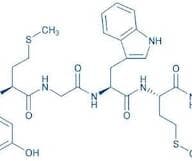
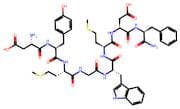
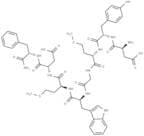
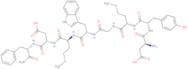
InChI:InChI=1/C49H62N10O13S2/c1-73-18-16-34(55-47(70)37(21-28-12-14-30(60)15-13-28)58-44(67)32(50)23-41(62)63)45(68)53-26-40(61)54-38(22-29-25-52-33-11-7-6-10-31(29)33)48(71)56-35(17-19-74-2)46(69)59-39(24-42(64)65)49(72)57-36(43(51)66)20-27-8-4-3-5-9-27/h3-15,25,32,34-39,52,60H,16-24,26,50H2,1-2H3,(H2,51,66)(H,53,68)(H,54,61)(H,55,70)(H,56,71)(H,57,72)(H,58,67)(H,59,69)(H,62,63)(H,64,65)
SMILES:CSCCC(C(=NCC(=NC(Cc1c[nH]c2ccccc12)C(=NC(CCSC)C(=NC(CC(=O)O)C(=NC(Cc1ccccc1)C(=N)O)O)O)O)O)O)N=C(C(Cc1ccc(cc1)O)N=C(C(CC(=O)O)N)O)O
Sinónimos:- Cholecystokinin Octapeptide (desulfated)
- H-Asp-Tyr-Met-Gly-Trp-Met-Asp-Phe-NH2
- N-[(2S)-2-hydrazino-3-phenylpropanoyl]-L-alpha-aspartyl-L-methionyl-L-tryptophylglycyl-N-[(1S,4S)-4-amino-5-carboxy-1-(4-hydroxybenzyl)-2,3-dioxopentyl]-L-methioninamide
- Alpha-Aspartyltyrosylmethionylglycyltryptophylmethionyl-Alpha-Aspartylphenylalaninamide
Ordenar por
Pureza (%)
0
100
|
0
|
50
|
90
|
95
|
100
Encontrado 6 productos.
Cholecystokinin Octapeptide (desulfated)
CAS:Bachem ID: 4003323.
Fórmula:C49H62N10O13S2Pureza:98.1%Forma y color:White LyophilisatePeso molecular:1063.22Cholecystokinin Octapeptide, desulfated
CAS:Cholecystokinin Octapeptide, desulfatedPureza:≥95%Peso molecular:1063.21g/molCholecystokinin Octapeptide, desulfated
CAS:Cholecystokinin Octapeptide, desulfated (CCK Octapeptide, non-sulfated) is an octapeptide composed of 8 amino acids from cholecystokinin-8.Fórmula:C49H62N10O13S2Pureza:97.12%Forma y color:SolidPeso molecular:1063.21CCK octapeptide Cholecystokinin (26-33)
CAS:The octapeptide cholecystokinin (26-33), known as CCK-8, has the full biological activity of the full-length cholecystokinin (CCK). CCK acts as a hormone and neurotransmitter and is found in the GI and central nervous systems. CCK-8 is a satiety peptide that inhibits food intake.CCK-8 can also inhibit amanitin uptake into hepatocytes.Fórmula:C49H62N10O13S2Peso molecular:1,063.21 g/molCCK-Octapeptide (26-33) (Non-Sulfated Form)
CAS:CCK-Octapeptide (26-33) is a peptide that is a member of the cholecystokinin family of peptides. CCK-Octapeptide (26-33) is an activator of the CCK receptor and can be used for research purposes. This peptide has been shown to inhibit ion channels, which are proteins that regulate the flow of ions across cell membranes, and may be used as a pharmacological tool or research tool.
Fórmula:C49H62N10O13S2Pureza:Min. 95%Peso molecular:1,063.2 g/molCholecystokinin Octapeptide (desulfated)
CAS:Cholecystokinin octapeptide (CCK-8) is a peptide hormone that is secreted from the pancreas. It is a conjugate of CCK and desulfated cholinesterase, which has been shown to have surfactant properties. The concentration-response curves for CCK-8 are biphasic, with an initial increase in contractility followed by a decrease. This response is caused by activation of both the B2 and B1 receptors in the paraventricular nucleus of the hypothalamus and subsequently release of pancreatic enzymes into the bloodstream. CCK-8 has also been shown to stimulate protein synthesis in gland cells such as those found in the pancreas.Fórmula:C49H62N10O13S2Pureza:Min. 95%Peso molecular:1,063.21 g/mol