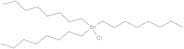
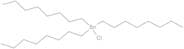
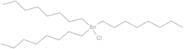
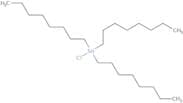
CAS 2587-76-0
:Cloruro de trioctiltina
Descripción:
Cloruro de trioctiltina, con el número CAS 2587-76-0, es un compuesto organoestánico caracterizado por sus tres grupos octilo unidos a un átomo de estaño, junto con un ion cloruro. Aparece como un líquido incoloro a amarillo pálido y es conocido por sus propiedades hidrofóbicas, lo que lo hace insoluble en agua pero soluble en disolventes orgánicos. Este compuesto se utiliza principalmente como estabilizador en la producción de PVC y como biocida en diversas aplicaciones, incluyendo pinturas antifouling y preservantes de madera. Cloruro de trioctiltina exhibe toxicidad, particularmente para organismos acuáticos, y plantea preocupaciones ambientales debido a su potencial de bioacumulación. Es importante manejar esta sustancia con cuidado, siguiendo los protocolos de seguridad apropiados para minimizar la exposición y el impacto ambiental. Además, su uso está regulado en muchas regiones debido a su naturaleza peligrosa, lo que requiere adherirse a las pautas y regulaciones de seguridad en aplicaciones industriales.
Fórmula:C24H51ClSn
InChI:InChI=1S/3C8H17.ClH.Sn/c3*1-3-5-7-8-6-4-2;;/h3*1,3-8H2,2H3;1H;/q;;;;+1/p-1
Clave InChI:InChIKey=MCNGJXAXOJDJKO-UHFFFAOYSA-M
SMILES:[Sn](CCCCCCCC)(CCCCCCCC)(CCCCCCCC)Cl
Sinónimos:- Chloro(Trioctyl)Stannane
- Chlorotrioctylstannane
- Chlorotrioctyltin
- NSC 65479
- Stannane, chlorotrioctyl-
- Tin, chlorotrioctyl-
- Tri-n-octyltin chloride
- Trioctylchlorostannane
- Trioctyltin chloride
Ordenar por
Pureza (%)
0
100
|
0
|
50
|
90
|
95
|
100
Encontrado 4 productos.
Trioctyltin chloride 1000 µg/mL in Methanol
CAS:Producto controladoFórmula:C24H51ClSnForma y color:ColourlessPeso molecular:493.82Trioctyltin chloride
CAS:Producto controladoFórmula:C24H51ClSnForma y color:NeatPeso molecular:493.82Tri-n-octylchlorotin
CAS:Producto controladoStability Moisture Sensitive
Applications Tri-n-octylchlorotin is an octyltin compound used to study the growth and fatty acid of the microscopic fungus Cochliobolus lunatus. It is also an organotin reagents used to covalently functionalize oxide nanostructures and multi-walled C nanotubes.
Not a dangerous good if item is equal to or less than 1g/ml and there is less than 100g/ml in the package
References Felczak, A., et al.: Process Biochem., 49, 295-300 (2014); Gomathi, A., et al.: J. Mater. Chem., 19, 988-995 (2009);Fórmula:C24H51ClSnForma y color:NeatPeso molecular:493.82Trioctyltin chloride
CAS:Trioctyltin chloride is a polymer that is synthesized by the reaction of two equivalents of tributyltin chloride with fatty acids. Trioctyltin chloride is reactive and can be extracted from a variety of sources using a variety of solvents. It has been used to extract chloride ions from mesenchymal stromal cells, which are cells that are involved in tissue repair. The trioctyltin chloride polymer can be used as an analytical method for 3β-hydroxysteroid dehydrogenase, which catalyzes the conversion of 3β-hydroxysteroids into 3-keto steroids. This reaction is reversible and it produces hydrogen ions as a product. The hydrogen ions cause the polymer to undergo ring-opening reactions, leading to the formation of polymeric matrixes on solid surfaces. These matrices have been used in membrane systems as well as in microextraction experiments for solid phase extraction with gas chromatography (SPE).Fórmula:C24H51ClSnPureza:Min. 95%Peso molecular:493.82 g/mol