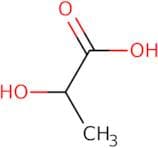
CAS 26100-51-6
:(±)-Poli(ácido láctico)
Descripción:
(±)-Poli(ácido láctico) (PLA) es un termoplástico biodegradable y bioactivo hecho de monómeros de ácido láctico. Se caracteriza por su capacidad para descomponerse en subproductos no tóxicos, lo que lo convierte en una alternativa ecológica a los plásticos tradicionales a base de petróleo. PLA exhibe buenas propiedades mecánicas, incluyendo resistencia a la tracción y flexibilidad, que pueden variar dependiendo de su peso molecular y la proporción de sus estereoisómeros (ácido láctico D y L). Tiene una temperatura de transición vítrea que permite su procesamiento utilizando técnicas termoplásticas estándar como el moldeo por inyección y la extrusión. PLA también es conocido por su transparencia y brillo, lo que lo hace adecuado para diversas aplicaciones, incluyendo envases, textiles y dispositivos biomédicos. Además, tiene una temperatura de fusión relativamente baja, lo que puede limitar su uso en aplicaciones de alta temperatura. Su biodegradabilidad está influenciada por las condiciones ambientales, como la temperatura y la humedad, y generalmente se descompone en ácido láctico en entornos de compostaje. En general, (±)-Poli(ácido láctico) representa un avance significativo en la ciencia de materiales sostenibles.
Fórmula:(C3H6O3)x
InChI:InChI=1/C3H6O3/c1-2(4)3(5)6/h2,4H,1H3,(H,5,6)
Clave InChI:InChIKey=JVTAAEKCZFNVCJ-UHFFFAOYSA-N
SMILES:C(C(O)=O)(C)O
Sinónimos:- (.+-.)-2-Hydroxypropanoic acid homopolymer
- (.+-.)-Lactic acid homopolymer
- (.+-.)-Poly(lactic acid)
- <span class="text-smallcaps">D</smallcap><smallcap>L</span>-Lactic acid polymer
- <span class="text-smallcaps">DL</span>-Lactic acid homopolymer
- <span class="text-smallcaps">DL</span>-Polylactic acid
- Acide lactique homopolymerise
- D,L-polylactic acid
- DL-Lactic acid homopolymer
- DL-Lactic acid polymer
- DL-Polylactic acid
- Lactates, polylactates
- Lactic acid polymer
- Lactic acid, polyesters
- Lactic acid, polymers
- NeoOrtho
- New-Fill
- Poly(<span class="text-smallcaps">D</smallcap><smallcap>L</span>-lactic acid)
- Poly(DL-lactic acid)
- Poly(dl-lactate)
- Poly(lactic acid) (High M.Wt.)
- Polycondensate of lactic acid (insoluble in water, acid and alkali also containing 1% or less of component having less than 1,000 of molecular weight)
- Polylactate
- Polylactates
- Polylactic acid
- Propanoic acid, 2-hydroxy-, homopolymer
- Poly(L-lactide), acrylate terminated
- PLA
- POLYLACTIC ACID ISO 9001:2015 REACH
- polylactic acid standard 78'000
- 2-hydroxy-propanoicacihomopolymer
- China Polylactic acid PLA plastics
- 2 k PLLA-ATRP
- POLYD,L-LACTICACIDNANOPARTICLES
- PLLA acrylate
- Poly(L-lactide) average Mn 5,000, PDI <=1.2
- POLY(2-HYDROXYPROPIONIC ACID)
- polylactic acid(PLA)
- 3DXMAX(TM) CFR-PLA carbon fiber reinforced PLA 3D printing filament black, diam. 2.85 mm
- 3DXMAX(TM) CFR-PLA carbon fiber reinforced PLA 3D printing filament black, diam. 1.75 mm
- Polylactic acid Mw ~60,000
- Poly(L-lactic Acid)(Mw ~60,000)
- Poly(L-lactide) average Mn 20,000, PDI <=1.1
- Poly(L-lactide) viscosity ~2.0 dL/g, 0.1 % (w/v) in chloroforM(25 C)
- PLA_PLLA_PDLA_PLLA_PDLLA
- Poly(lactic acid) (Low M.Wt.)
- ATRP terminated PLLA
- 3DXMAX(TM) CFR-PLA carbon fiber reinforced PLA 3D printing filament
- Poly(L-lactide), propargyl terminated
- Polylactic acid Standard 225μ000
- PLLA acetylene
- 3DXMAX CFR-PLA carbon fiber reinforced PLA 3D printing filament
- POLYLACTIC ACID STANDARD 78'000 CERTIF. REF. MAT. ACC.TO BAM
- Poly(2-hydroxypropionic acid), Polylactic acid
- polylactide, polylactic acid, PLA
- ATRP Macromonomer
- Poly(L-lactide) average Mn 10,000, PDI <=1.1
- Poly(L-lactide) viscosity ~4.0 dL/g, 0.1 % (w/v) in chloroform(25 C)
- Poly(L-lactide), 2-bromoisobutyryl terminated
- Poly(L-lactide) average Mn 50,000
- propargyl PLLA
- acrylate-PLA-OH
- POLYLACTIC ACID STANDARD 225'000 CERT.
- 10 k PLLA-ATRP
- PDLA
- polylactide, polylactic acid
- Ver más sinónimos
Ordenar por
Pureza (%)
0
100
|
0
|
50
|
90
|
95
|
100
Encontrado 7 productos.
Poly(DL-lactic acid) (Mw=ca. 100000, ester terminated)
CAS:Forma y color:White to Light yellow powder to crystalPoly(DL-lactic acid) (Mw=ca. 300000, ester terminated)
CAS:Forma y color:White to Light yellow powder to crystalPoly(DL-lactic acid) (Mw=ca. 200000, ester terminated)
CAS:Forma y color:White to Almost white powder to crystalPolylactic acid - MW 40,000~80,000
CAS:Polylactic acid is a polymer that has been used as a suture and in tissue engineering. It is synthesized by the polymerization of lactic acid, which is derived from renewable resources such as cornstarch, potatoes, and sugar beets. Polylactic acid has been shown to be effective against squamous carcinoma cells and colorectal adenocarcinoma cells. The mechanism of action for polylactic acid is not fully understood but it may have an effect on mitochondrial membrane potential, blood sampling, multivariate logistic regression, antibacterial efficacy, enzyme activities and transcriptional regulation. This polymer may also inhibit the growth of bacteria through the inhibition of glycol ethers or benzalkonium chloride.Forma y color:White Powder