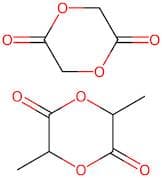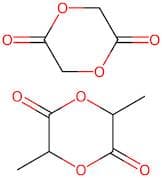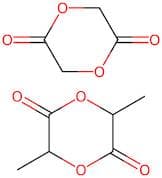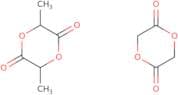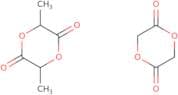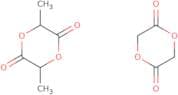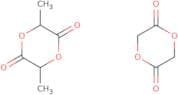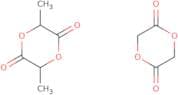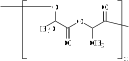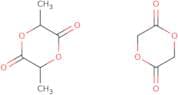
CAS 26780-50-7
:Poli-(DL)-lactida-co-glicolida
- 5050Dl2A
- Atrigel
- Medisorb
- OsteoScaf
- Poly(D,L-lactide-co-glycolide)
- Poly(DL-lactide-co-glycolide)
- Poly(glycolide-co-lactide)
- Poly(glycolide-lactide)
- Poly(lactide-co-glycolide)
- Poly(lactide-glycolide)
- Poly[(rac-lactide)-co-glycolide]
- Polygalactin
- Polyglactin
- Vicryl
- Glycolide-lactide polymer
- RESOMER RG 503 H
- 1,4-dioxane-2,5-dione - 3,6-dimethyl-1,4-dioxane-2,5-dione (1:1)
- 1,4-Dioxane-2,5-dione, polymer with 3,6-dimethyl-1,4-dioxane-2,5-dione
- p-Dioxane-2,5-dione, polyester with 3,6-dimethyl-p-dioxane-2,5-dione
- 1,4-Dioxane-2,5-dione, 3,6-dimethyl-, polymer with 1,4-dioxane-2,5-dione
- Ver más sinónimos
PLG 50:50 DLLG 5A (Poly(DL-lactide-co-glycolide) acid terminated (50:50))
CAS:Polyesters, saturated, in primary forms, nesoiFórmula:HC6H8O4nC4H4O4nOHForma y color:White PowderPeso molecular:54.000-69.000 DaPLG 50:50 DLLG 3A (Poly(DL-lactide-co-glycolide) acid terminated (50:50))
CAS:Polyesters, saturated, in primary forms, nesoiFórmula:HC6H8O4nC4H4O4nOHForma y color:White PowderPeso molecular:24.000-38.000 Da1,4-Dioxane-2,5-dione, polymer with 3,6-dimethyl-1,4-dioxane-2,5-dione
CAS:Fórmula:C10H12O8Forma y color:SolidPeso molecular:260.1975Poly(Dl-Lactide-Glycolide)
CAS:Poly(Dl-Lactide-Glycolide)Pureza:acid terminated,lactide:glycolide 50:50,Mw 7000-17Poly(D,L-lactide-co-glycolide), lactide: glycolide (85:15), average MW 50000 to 75000
CAS:Poly(D,L-lactide-co-glycolide) is a synthetic polymer that is used for subcutaneous implantation. It is used to treat incisional hernias and rectoceles in women. Poly(D,L-lactide-co-glycolide) can be implanted in tissues where the natural tissue has been removed or damaged. This polymer has been shown to reduce postoperative pain and improve the quality of life after surgery. Poly(D,L-lactide-co-glycolide) has also been shown to induce neuronal death in rats with experimental spinal cord injury when injected into the injured area. The polymer was injected at two different doses (5% and 10%) and induced significant neuronal death at both doses. Histological analysis showed that the tissue around the injection site had a moderate number of macrophages, but few microglia cells were observed. The presence of macrophages suggests that inflammation may have
Pureza:10 To 20%Poly(D,L-lactide-co-glycolide);lactide:glycolide (50:50), MW 54000-69000Da
CAS:Poly(D,L-lactide-co-glycolide) is a biocompatible polymer that has been shown to be resistant to bacterial infections. It is a multivariate logistic regression analysis that shows the material's resistance to growth factor-β1 and neuronal death. The polymer has a low carcinogenic potential and toxicity studies have shown it is safe for use in humans. This polymer has been used in an experimental model of chronic oral toxicity and was shown to be biocompatible with human serum.
Fórmula:(C6H8O4·C4H4O4)xPureza:Min. 95%Forma y color:PowderPoly(D,L-lactide-co-glycolide - lactide:glycolide (50:50), average MW 7000-17000Da
CAS:Poly(D,L-lactide-co-glycolide - lactide:glycolide (50:50), average MW 7000-17000Da (PLGA) is a biocompatible polymer that has been shown to have high resistance to infectious diseases and the potential for use in biomedical applications. The polymer is often used as a drug carrier molecule and has been shown to inhibit the growth of human breast cancer cells. It also has been shown to inhibit neuronal death. PLGA stimulates the production of basic fibroblast growth factor (bFGF) which may promote wound healing and tissue regeneration. PLGA is also used in radiation therapy because it does not produce any harmful byproducts when irradiated with ionizing radiation. Toxicity studies have found that PLGA does not produce any toxicity when irradiated with ionizing radiation as well as untreated controls.Pureza:Min. 95%Forma y color:PowderPoly(D,L-lactide-co-glycolide), lactide: glycolide (50:50), average MW 10000 to 15000
CAS:Poly(D,L-lactide-co-glycolide) is a biodegradable polymer with a low melting point. It has been used in the form of sutures for surgical procedures and has also been shown to be effective against staphylococcus. Poly(D,L-lactide-co-glycolide) also has an effect on neuronal death and incisional wound healing. The polymer can be degraded by hydrolysis or enzymatic cleavage and is therefore not suitable as an implant material. This material is used in the form of films for drug delivery systems as well as in surgical meshes for hernia repair, abdominal wall hernias, and rectocele repair.
Fórmula:(C6H8O4•C4H4O4)xPureza:Min. 95%Poly(D,L-lactide-co-glycolide) - lactide: glycolide (75:25), average MW 50000 to 75000
CAS:Poly (D,L-lactide-co-glycolide) is a synthetic polymer that consists of 75% lactide and 25% glycolide. It has been used in the treatment of incisional hernia, which is a type of hernia that occurs when an organ protrudes through an incision made in the abdominal wall. Poly (D,L-lactide-co-glycolide) has also been used to prevent neuronal death in experimental animals. Histological analysis of the subcutaneous tissue showed significantly less neuronal death with poly (D,L-lactide-co-glycolide). This polymer has also been shown to be effective for women with rectocele and was found to be safe for use in this population. Poly (D,L-lactide-co-glycolide) is a synthetic polymer consisting primarily of 75% lactides and 25% glycolides. This polymer has been used as anFórmula:C3H4O2xC2H2O2yPureza:Min. 95%Forma y color:White PowderPoly(D,L-lactide-co-glycolide) - lactide: glycolide (75:25), average MW 10000 to 15000
CAS:Poly (DL-lactide-co-glycolide) is a biodegradable polymer that is used in the manufacture of medical devices. It is made from lactic acid and glycolic acid. Poly (DL-lactide-co-glycolide) can degrade by hydrolysis to produce lactic acid and glycolic acid, which are both naturally occurring substances in the body. This polymer has been shown to be effective in treating staphylococcal infections, such as rectoceles. A predictive factor for treatment success with poly (DL-lactide-co-glycolide) is the morphology of the rectocele before surgery. In this study, multivariate logistic regression was used to analyze preoperative factors that predicted treatment success with poly (DL-lactide-co-glycolide). The results showed that women who had an incisional rectocele were more likely to have a successful outcome when treated
Fórmula:C3H4O2xC2H2O2yPureza:Min. 95%PLG 75:25 DLLG 3A (Poly(DL-lactide-co-glycolide) acid terminated (75:25))
CAS:Polyesters, saturated, in primary forms, nesoi
Fórmula:HC6H8O4nC4H4O4mOHPLG 75:25 DLLG 10A (Poly(DL-lactide-co-glycolide) acid terminated (75:25))
CAS:Polyesters, saturated, in primary forms, nesoiFórmula:HC6H8O4nC4H4O4mOHForma y color:White PowderPeso molecular:~150.000 DaRef: 4Z-L-159006
Producto descatalogadoPoly(D,L-lactide-co-glycolide) - lactide: glycolide (90:10), average MW 10000 to 15000
CAS:Poly(D,L-lactide-co-glycolide) is a biodegradable polymer that is used in the manufacture of sutures. It is made from the monomers L-lactide and glycolide and has an average molecular weight of 10,000 to 15,000 Daltons. Poly(D,L-lactide-co-glycolide) can be sterilized by autoclaving or gamma irradiation. The polymerization process does not produce any toxic byproducts. Polymers are soluble in solvents such as acetic acid or alcohols. They are also resistant to degradation by enzymes or bacteria. This polymer is used in the manufacturing of sutures because it has good adhesive properties and is more water resistant than other polymers. Poly(D,L-lactide-co-glycolide) can be used as an ophthalmic device because it is transparent and biocompatible with
Fórmula:C3H4O2xC2H2O2yPureza:Min. 95%