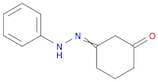
CAS 27385-45-1
:1,3-Ciclohexanodiona, 1-(2-fenilhidrazona)
Descripción:
1,3-Ciclohexanodiona, 1-(2-fenilhidrazona) es un compuesto orgánico caracterizado por su grupo funcional hidrazona, que se forma a partir de la reacción de 1,3-ciclohexanediona con fenilhidrazina. Este compuesto típicamente aparece como un sólido y es conocido por sus posibles aplicaciones en síntesis orgánica y como reactivo en varias reacciones químicas. Presenta un anillo de ciclohexano con dos grupos cetona en las posiciones 1 y 3, lo que contribuye a su reactividad y capacidad para formar derivados. La presencia del moiety fenilhidrazona mejora sus propiedades, haciéndolo útil en el desarrollo de colorantes y productos farmacéuticos. Además, este compuesto puede exhibir propiedades ópticas específicas debido a su configuración estructural, que pueden ser explotadas en química analítica. Al igual que muchos compuestos orgánicos, es importante manejarlo con cuidado, considerando su posible reactividad y la necesidad de protocolos de seguridad adecuados durante su uso.
Fórmula:C12H14N2O
InChI:InChI=1S/C12H14N2O/c15-12-8-4-7-11(9-12)14-13-10-5-2-1-3-6-10/h1-3,5-6,13H,4,7-9H2
Clave InChI:InChIKey=ASBKHKGFGCNQJB-UHFFFAOYSA-N
SMILES:N(NC1=CC=CC=C1)=C2CC(=O)CCC2
Sinónimos:- 1,3-Cyclohexanedione, 1-(2-phenylhydrazone)
- 1,3-Cyclohexanedione, mono(phenylhydrazone)
Ordenar por
Pureza (%)
0
100
|
0
|
50
|
90
|
95
|
100
Encontrado 3 productos.
3-(2-phenylhydrazin-1-ylidene)cyclohexan-1-one
CAS:Fórmula:C12H14N2OPureza:95%Forma y color:SolidPeso molecular:202.2524(Z)-3-(2-Phenylhydrazono)cyclohexanone
CAS:The method involves refluxing ethanol with a solid acid catalyst and a condensation agent. The reaction is catalyzed by the acid catalyst, which can be either an inorganic or organic acid. The reaction time is typically 3 to 4 hours. Effective catalysts include aluminum chloride, zinc chloride, and titanium tetrachloride. Carvedilol is an effective product of this reaction because it has a high yield and a low production cost. Solid-acid catalysts are used for this synthesis because they have excellent stability in the presence of water and air and can be easily recovered from the reaction mixture. The reactants are heated at reflux until the desired product is formed. This process is typically carried out using a reflux apparatus equipped with an efficient condenser and an ice bath to maintain the temperature below boiling point. The yields of the desired product are typically high, ranging from 80% to 95%.Fórmula:C12H14N2OPureza:Min. 95%Peso molecular:202.25 g/mol