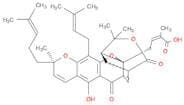
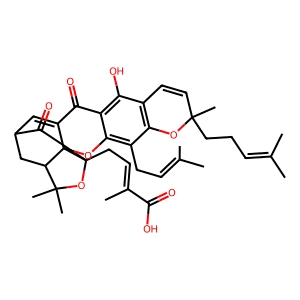
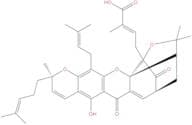
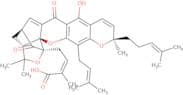
CAS 2752-65-0
:Ácido gambógico
Descripción:
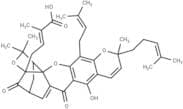
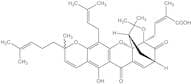
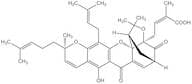
Ácido gambógico, con el número CAS 2752-65-0, es un compuesto natural derivado de la resina del árbol Garcinia hanburyi, comúnmente conocido como gamboge. Este pigmento amarillento está compuesto principalmente por una mezcla compleja de xantonas policíclicas. Ácido gambógico exhibe una variedad de actividades biológicas, incluyendo propiedades antiinflamatorias, antioxidantes y potenciales anticancerígenas, lo que lo convierte en un tema de interés en la investigación farmacéutica. Se caracteriza por su color amarillo y es soluble en disolventes orgánicos, pero tiene una solubilidad limitada en agua. El compuesto ha sido estudiado por sus efectos en varias líneas celulares de cáncer, mostrando promesas en la inhibición del crecimiento tumoral. Además, Ácido gambógico se ha utilizado en la medicina tradicional, particularmente en el sudeste asiático, por sus propiedades terapéuticas. Sin embargo, su uso se acompaña de precaución debido a la posible toxicidad a concentraciones más altas. En general, Ácido gambógico representa un área significativa de estudio en la química de productos naturales y sus aplicaciones en medicina.
Fórmula:C38H44O8
InChI:InChI=1/C38H44O8/c1-20(2)10-9-15-36(8)16-14-24-29(39)28-30(40)26-18-23-19-27-35(6,7)46-37(33(23)41,17-13-22(5)34(42)43)38(26,27)45-32(28)25(31(24)44-36)12-11-21(3)4/h10-11,13-14,16,18,23,27,39H,9,12,15,17,19H2,1-8H3,(H,42,43)/b22-13-/t23?,27?,36-,37?,38-/m1/s1
Clave InChI:InChIKey=GEZHEQNLKAOMCA-RRZNCOCZSA-N
SMILES:C(/C=C(\C(O)=O)/C)[C@@]12[C@]34C(C(=O)C=5C(O3)=C(CC=C(C)C)C6=C(C5O)C=C[C@](CCC=C(C)C)(C)O6)=C[C@@](C1=O)(C[C@]4(C(C)(C)O2)[H])[H]
Sinónimos:- (2Z)-2-Methyl-4-[(1R,3aS,5S,11R,14aS)-3a,4,5,7-tetrahydro-8-hydroxy-3,3,11-trimethyl-13-(3-methyl-2-buten-1-yl)-11-(4-methyl-3-penten-1-yl)-7,15-dioxo-1,5-methano-1H,3H,11H-furo[3,4-g]pyrano[3,2-b]xanthen-1-yl]-2-butenoic acid
- (2Z)-4-[(11R,14aS)-8-hydroxy-3,3,11-trimethyl-13-(3-methylbut-2-en-1-yl)-11-(4-methylpent-3-en-1-yl)-7,15-dioxo-3a,4,5,7-tetrahydro-3H,11H-1,5-methanofuro[3,4-g]pyrano[3,2-b]xanthen-1-yl]-2-methylbut-2-enoic acid
- 1,5-Methano-1H,3H,11H-furo(3,4-g)pyrano(3,2-b)xanthene-1-crotonic acid, 3a,4,5,7-tetrahydro-8-hydroxy-alpha,3,3,11-tetramethyl-13-(3-methyl-2-butenyl)-11-(4-methyl-3-pentenyl)-7,15-dioxo-, (Z)-
- 1,5-Methano-1H,3H,11H-furo[3,4-g]pyrano[3,2-b]xanthene-1-crotonic acid, 3a,4,5,7-tetrahydro-8-hydroxy-α,3,3,11-tetramethyl-13-(3-methyl-2-butenyl)-11-(4-methyl-3-pentenyl)-7,15-dioxo-, (Z)-
- 2-Butenoic acid, 2-methyl-4-[(1R,3aS,5S,11R,14aS)-3a,4,5,7-tetrahydro-8-hydroxy-3,3,11-trimethyl-13-(3-methyl-2-buten-1-yl)-11-(4-methyl-3-penten-1-yl)-7,15-dioxo-1,5-methano-1H,3H,11H-furo[3,4-g]pyrano[3,2-b]xanthen-1-yl]-, (2Z)-
- 2-Butenoic acid, 2-methyl-4-[(1R,3aS,5S,11R,14aS)-3a,4,5,7-tetrahydro-8-hydroxy-3,3,11-trimethyl-13-(3-methyl-2-butenyl)-11-(4-methyl-3-pentenyl)-7,15-dioxo-1,5-methano-1H,3H,11H-furo[3,4-g]pyrano[3,2-b]xanthen-1-yl]-, (2Z)-
- 2-Butenoic acid, 2-methyl-4-[3a,4,5,7-tetrahydro-8-hydroxy-3,3,11-trimethyl-13-(3-methyl-2-butenyl)-11-(4-methyl-3-pentenyl)-7,15-dioxo-1,5-methano-1H,3H,11H-furo[3,4-g]pyrano[3,2-b]xanthen-1-yl]-, [1R-[1α,1(Z),3aβ,5α,11β,14aS*]]-
- B''-Guttiferin
- Cambogic acid
- R-Gambogic acid
- Ui1907
- beta-Guttiferin
- Gambogic acid
- Gambogic acid, 95%, a caspases activator
- 3,3,11-tetramethyl-13-(3-methyl-2-butenyl)-11-(4-7-tetrahydro-8-hydroxy-alph
- Guttic acid
- β-Guttilactone
- B"-Guttiferrin
- Gambogic acid, 97%(HPLC)
- 1,51,5-Methano-1H,3H,11H-furo(3,4-G)pyrano(3,2-B)xanthene-1-crotonic acid
- cambogicacid
- Beta-Guttiferrin
- R,S-Gambogic acid
- alpha-GaMbogic acid
- BETA-GUTTILACTONE
- Guttatic acid
- (z)-methyl-3-pentenyl)-
- GaMbogic aci
- GUTTATIC ACID
- 1,5-methano-1h,3h,11h-furo(3,4-g)pyrano(3,2-b)xanthene-1-crotonicacid,3a,4,5,
- (2Z)-2-Methyl-4-[(1R,3aS,5S,11R,14aS)-3a,4,5,7-tetrahydro-8-hydroxy-3,3,11-trimethyl-13-(3-methyl-2-butenyl)-11-(4-methyl-3-pentenyl)-7,15-dioxo-1,5-methano-1H,3H,11H-furo[3,4-g]pyrano[3,2-b]xanthen-1-yl]-2-butenoicacid
- GUTTIC ACID
- 1,5-Methano-1H,3H,11H-furo(3,4-g)pyrano(3,2-b)xanthene-1-crotonic acid
- Gambogic acid, >=98%
- Ver más sinónimos
Ordenar por
Pureza (%)
0
100
|
0
|
50
|
90
|
95
|
100
Encontrado 9 productos.
Gambogic acid
CAS:Gambogic acid is a tissue-specific proteasome inhibitor, which has anticancer, anti-inflammatory, and anti-angiogenesis activities. Gambogic acid induces LRIG1 (leucine-rich repeat and Ig-like domain-containing-1) upregulation, which is responsible for EGFR (epidermal growth factor receptor) degradation and its downstream Akt/mTORC1 inhibition.Fórmula:C38H44O8Pureza:95%~99%Peso molecular:628.762Gambogic acid
CAS:Fórmula:C38H44O8Pureza:≥ 98.0%Forma y color:Yellow to orange powderPeso molecular:628.75Gambogic Acid
CAS:Gambogic Acid (Guttic Acid) ( EC50=0.78-1.64 uM) activates caspases.Fórmula:C38H44O8Pureza:97.16% - 98.67%Forma y color:SolidPeso molecular:628.75R,s-gambogic acid
CAS:Oxygen-heterocyclic compoundFórmula:C38H44O8Pureza:≥ 95.0 % (HPLC)Forma y color:PowderPeso molecular:628.76R-gambogic acid
CAS:Oxygen-heterocyclic compoundFórmula:C38H44O8Pureza:≥ 90.0 % (HPLC)Forma y color:PowderPeso molecular:628.76Gambogic acid
CAS:Gambogic acid is a xanthonoid compound, which is a naturally occurring product derived from the resin of Garcinia hanburyi, a tree found in Southeast Asia. It functions primarily through its apoptotic and anti-proliferative effects on cancer cells. Mechanistically, Gambogic acid binds to transferrin receptors, leading to the disruption of cell survival pathways, inhibition of the NF-kB signaling pathway, and induction of apoptosis by activating caspases and influencing mitochondrial pathways.Pureza:Min. 95%