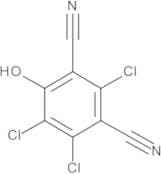
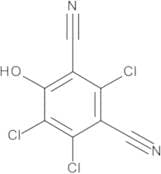
CAS 28343-61-5
:4-Hidroxi-2,5,6-tricloroisofthalonitrilo
Descripción:
4-Hidroxi-2,5,6-tricloroisofthalonitrilo, con el número CAS 28343-61-5, es un compuesto químico caracterizado por su estructura, que incluye un grupo hidroxilo y múltiples sustituyentes de cloro en un marco de isoftalonitrilo. Este compuesto típicamente aparece como un sólido y es conocido por su estabilidad bajo diversas condiciones. Exhibe propiedades como alta estabilidad térmica y resistencia a la degradación, lo que lo hace adecuado para aplicaciones en ciencia de materiales, particularmente en el desarrollo de retardantes de llama y polímeros. La presencia de átomos de cloro contribuye a su reactividad y uso potencial en síntesis, mientras que el grupo hidroxilo puede participar en enlaces de hidrógeno, influyendo en su solubilidad e interacción con otras sustancias. Además, debido a sus grupos nitrilo, puede exhibir ciertas propiedades toxicológicas, lo que requiere un manejo y evaluación cuidadosos en aplicaciones industriales. En general, 4-Hidroxi-2,5,6-tricloroisofthalonitrilo es un compuesto de interés tanto en investigación como en aplicaciones prácticas, particularmente en los campos de la química y la ingeniería de materiales.
Fórmula:C8HCl3N2O
InChI:InChI=1/C8HCl3N2O/c9-5-3(1-12)6(10)7(11)8(14)4(5)2-13/h14H
Clave InChI:InChIKey=MDQKYGOECVSPIW-UHFFFAOYSA-N
SMILES:C(#N)C1=C(Cl)C(C#N)=C(O)C(Cl)=C1Cl
Sinónimos:- 1,3-Benzenedicarbonitrile, 2,4,5-Trichloro-6-Hydroxy-
- 1,3-Dicyano-4-Hydroxy-2,5,6-Trichlorobenzene
- 2,4,5-Trichloro-6-hydroxy-1,3-benzenedicarbonitrile
- 2,4,5-Trichloro-6-hydroxyisophthalonitrile
- 2,5,6-Trichloro-4-hydroxy-1,3-benzenedicarbonitrile
- 28343-61-5
- 4-Hydroxy-2,5,6-trichloroisophthalonitrile
- 4-Hydroxychlorothalonil
- Hydroxychlorothalonil
- Isophthalonitrile, 2,4,5-trichloro-6-hydroxy-
- Sds 3701
- 2,5,6-Trichloro-4-
- Hydroxy Chlorothalonil Q: What is the storage condition of
- Hydroxy Chlorothalonil Q: What is the CAS Number of
- 2,4,5-Trichloro-6-hydroxy-
- Hydroxy Chlorothalonil
- Tribenoside Impurity 6
- Chlorothalonil Metabolite R182281
- hydroxy-1,3-benzenedicarbonitrile
- 4-hydroxy-2,5,6-trichloro-1,3-benzenedicarbonitrile
- Hydroxy ChlorothalonilQ: What is
- 4-hydroxy-2,5,6-trichloro-3-benzenedicarbonitrile
- Hydroxy Chlorothalonil Q: What are the applications of
- TPN-OH
- DRE-C11510400 Chlorothalonil-4-hydroxy
- isophthalonitrile
- Chlorothalonil-4-hydroxy 10.0 μg/ml Acetonitrile
- Ver más sinónimos
Ordenar por
Pureza (%)
0
100
|
0
|
50
|
90
|
95
|
100
Encontrado 5 productos.
Chlorothalonil-4-hydroxy 10 µg/mL in Acetonitrile
CAS:Fórmula:C8HCl3N2OForma y color:Single SolutionPeso molecular:247.47Chlorothalonil-4-hydroxy
CAS:Producto controladoFórmula:C8HCl3N2OForma y color:NeatPeso molecular:247.47Hydroxy Chlorothalonil
CAS:Producto controladoApplications Hydroxychlorothalonil is a metabolite of Chlorothalonil (C411250).
Not a dangerous good if item is equal to or less than 1g/ml and there is less than 100g/ml in the package
References Katayama, A., et al.: J. Pest Sci., 22, 12 (1997), Godard, T., et al.: Mutat. Res., 444, 103 (1999), Zeng, L., et al.: Appl. Microbiol. Biotechnol., 79, 881 (2008), Wang, G., et al.: J. Bacteriol., 192, 2737 (2010),Fórmula:C8HCl3N2OForma y color:Off-WhitePeso molecular:247.472,4,5-Trichloro-6-hydroxyisophthalonitrile
CAS:2,4,5-Trichloro-6-hydroxyisophthalonitrile is a fungicide. It is used in the control of plant diseases such as powdery mildew, rust and blight. 2,4,5-Trichloro-6-hydroxyisophthalonitrile can be applied to plants through foliar spray or root drenching. It acts by inhibiting the enzyme activities of fungi that are responsible for cell growth. This compound has been shown to have genotoxic activity in vivo and in vitro models and may be carcinogenic to humans. The mechanism of action of 2,4,5-trichloro-6-hydroxyisophthalonitrile remains unclear due to its high resistance to degradation in vivo. 2,4,5-Trichloro-6-hydroxyisophthalonitrile has also shown synergistic effects when combined with zirconium oxide and matrixFórmula:C8HCl3N2OPureza:Min. 95%Peso molecular:247.47 g/mol