CAS 28526-44-5
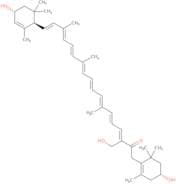
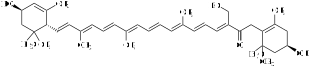
:3,3',19-trihidroxi-4',5'-didehidro-5',6',7,8-tetrahidro-beta,beta-caroten-8-ona
Descripción:
3,3',19-trihidroxi-4',5'-didehidro-5',6',7,8-tetrahidro-beta,beta-caroten-8-ona, con número CAS 28526-44-5, es un derivado de carotenoide caracterizado por su compleja estructura polienica, que incluye múltiples grupos hidroxilo y un grupo ceto. Este compuesto exhibe fuertes propiedades antioxidantes debido a su capacidad para eliminar radicales libres, lo que lo hace de interés en diversas aplicaciones biológicas y farmacéuticas. La presencia de grupos hidroxilo mejora su solubilidad en disolventes polares y puede influir en su actividad biológica y estabilidad. Además, las modificaciones didehidro y tetrahidro en su estructura contribuyen a sus propiedades espectrales únicas, que pueden ser analizadas utilizando espectroscopía UV-Vis. Este compuesto también puede desempeñar un papel en la fisiología vegetal y podría estar involucrado en mecanismos de fotoprotección. Sus aplicaciones potenciales abarcan desde aditivos alimentarios hasta nutracéuticos, destacando su importancia tanto en la salud como en la nutrición. Se necesita más investigación para elucidar completamente sus mecanismos de acción y beneficios terapéuticos potenciales.
Fórmula:C40H56O4
InChI:InChI=1/C40H56O4/c1-28(16-12-17-30(3)20-21-36-31(4)22-34(42)25-39(36,6)7)14-10-11-15-29(2)18-13-19-33(27-41)38(44)24-37-32(5)23-35(43)26-40(37,8)9/h10-22,34-36,41-43H,23-27H2,1-9H3/b11-10+,16-12+,18-13+,21-20+,28-14+,29-15+,30-17+,33-19+/t34-,35+,36-/m0/s1
Sinónimos:- .alpha.-Carotene-3,3',19-triol, 7,8-dihydro-8-oxo-
- .beta.,.epsilon.-Carotene-3,3',19-triol, 7,8-dihydro-8-oxo-
- (3R,3'R,6'R)-3,3',19-trihydroxy-4',5'-didehydro-5',6',7,8-tetrahydro-β,β-caroten-8-one
Ordenar por
Pureza (%)
0
100
|
0
|
50
|
90
|
95
|
100
Encontrado 3 productos.
Siphonaxanthin
CAS:Siphonaxanthin is a naturally occurring carotenoid found primarily in green algae, specifically within the siphonaceous order. It exhibits a unique bioactive profile, primarily attributed to its structural properties, which allow for effective interaction with biological membranes. Siphonaxanthin functions by modulating key biological pathways, notably those involved in apoptosis and cell cycle regulation. This modulation is achieved through its antioxidant activity, which mitigates oxidative stress and influences signaling pathways integral to cellular health.Fórmula:C40H56O4Pureza:Min. 95%Peso molecular:600.87 g/molSiphonaxanthin
CAS:Siphonaxanthin is a carotenoid found in green algae, known for targeting the death receptor 5 (DR5) on cancer cells to induce apoptosis. In human leukemia HL-60 cells, it increases DR5 expression, reduces Bcl-2 levels, and activates caspase-3. It also inhibits fibroblast growth factor receptor-1 (FGFR-1) signaling in endothelial cells. Siphonaxanthin suppresses the proliferation, migration, and tubular formation of human umbilical vein endothelial cells (HUVECs), as well as the growth of microvessels in rat aorta rings. Additionally, it has anti-inflammatory properties by blocking the translocation of high-affinity IgE receptors (FcεRI) to lipid rafts in mast cells. Siphonaxanthin shows potential for research into diseases such as cancer, diabetic retinopathy, and rheumatoid arthritis.Fórmula:C40H56O4Forma y color:SolidPeso molecular:600.87Ref: 4Z-S-228001
Producto descatalogado