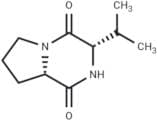
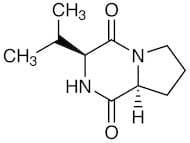
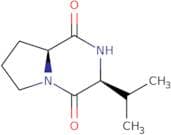
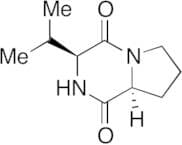
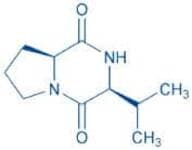
![Pyrrolo[1,2-a]pyrazine-1,4-dione,hexahydro-3-(1-methylethyl)-, (3S,8aS)-](/_next/image/?url=https%3A%2Fstatic.cymitquimica.com%2Fcas-image%2Fthumb-webp%2F316737-cyclo-pro-val.webp&w=3840&q=75)
CAS 2854-40-2
:Pirrolo[1,2-a]pirazina-1,4-diona,hexahidro-3-(1-metiletil)-, (3S,8aS)-
- Pyrrolo[1,2-a]pyrazine-1,4-dione,hexahydro-3-(1-methylethyl)-, (3S-trans)-
- Pyrrolo[1,2-a]pyrazine-1,4-dione,hexahydro-3-isopropyl-, (S,S)- (8CI)
- (-)-(6S,9S)-Cyclo(prolylvalyl)
- Cyclo(L-Pro-L-Val)
- Cyclo(L-Val-L-Pro)
- Cyclo(L-prolyl-L-valine)
- Cyclo(L-prolyl-L-valyl)
- L-Valyl-L-prolyl lactam
- Maculosin 5
- cyclo(Pro-Val)
- (3S,8aS)-3β-Isopropyl-6,7,8,8a-tetrahydropyrrolo[1,2-a]pyrazine-1,4(2H,3H)-dione
- (3S,8aS)-3-propan-2-yl-2,3,6,7,8,8a-hexahydropyrrolo[1,2-a]pyrazine-1,4-dione
- (3S,8aα)-3β-Isopropyloctahydropyrrolo[1,2-a]pyrazine-1,4-dione
- (3S,8aS)-3-Isopropyl-6,7,8,8aα-tetrahydropyrrolo[1,2-a]pyrazine-1,4(2H,3H)-dione
- Pyrrolo[1,2-a]pyrazine-1,4-dione, hexahydro-3-(1-methylethyl)-, (3S,8aS)-
- (3S,8aS)-3-(propan-2-yl)-octahydropyrrolo[1,2-a]p
- (3S,8aS)-Octahydro-3-(1-methylethyl)pyrrolo[1,2-a]pyrazine-1,4-dione
- Ver más sinónimos
PYRROLO[1,2-A]PYRAZINE-1,4-DIONE, HEXAHYDRO-3-(1-METHYLETHYL)-, (3S,8AS)-
CAS:Fórmula:C10H16N2O2Pureza:98%Forma y color:SolidPeso molecular:196.2462Cyclo(L-Pro-L-Val)
CAS:Cyclo(L-Pro-L-Val), from Mycobacterium spp., has anti-inflammatory effects, hinders phytopathogens, and suppresses IKKα, NF-κB, iNOS, and COX-2 activation.
Fórmula:C10H16N2O2Pureza:98.18%Forma y color:SolidPeso molecular:196.25Cyclo(L-Pro-L-Val)
CAS:Fórmula:C10H16N2O2Pureza:>95.0%(GC)Forma y color:White to Light yellow powder to crystalPeso molecular:196.25Cyclo(-Pro-Val)
CAS:Cyclo(-Pro-Val) is a type of natural product that has been shown to inhibit the growth of tumor cells. Cyclo(-Pro-Val) is a metabolite produced by the fungus Cryptococcus neoformans and may serve as a potential anti-cancer drug. The compound blocks mitochondrial membrane potential, which prevents cancer cells from multiplying. Cyclo(-Pro-Val) has also been shown to inhibit the growth of bacteria such as Pseudomonas aeruginosa and Burkholderia cepacia complex, although it has little or no effect on other types of bacteria and fungi.
Fórmula:C10H16N2O2Pureza:Min. 95%Forma y color:White PowderPeso molecular:196.25 g/molCyclo(L-prolyl-L-valyl)
CAS:Producto controladoApplications Cyclo(L-prolyl-L-valyl) is a metabolite found in various marine fungi and bacteria. It is a diketopiperazine derivative isolated from Bacillus thuringiensis and Bacillus endophyticus.
References Bell, R., et al.: J. Nat. Prod., 57, 1587 (1994); Park, Y., et al.: J. Nat. Prod., 69, 580 (2006); Tezuka, Y., et al.: Chem. Pharm. Bull., 42, 2612 (1994); Sansinenea, E., et al.: Tetrahedron Lett., 57, 2604 (2016);Fórmula:C10H16N2O2Forma y color:NeatPeso molecular:196.25Cyclo(-Pro-Val)
CAS:Cyclo(Pro-Val) and other Pro-containing diketopiperazines were detected in roasted coffee. The amount of these compounds increases with the intensity of roasting, they contribute to the bitterness of taste. The bitter-tasting cyclodipeptide has also been detected in other foodstuffs as cocoa, chocolate, beef, and cheese. Cyclo(Pro-Val), which shows antifungal activity, has also been isolated from microorganisms and further natural sources.Fórmula:C10H16N2O2Pureza:> 99%Forma y color:White PowderPeso molecular:196.25
![PYRROLO[1,2-A]PYRAZINE-1,4-DIONE, HEXAHYDRO-3-(1-METHYLETHYL)-, (3S,8AS)-](/_next/image/?url=https%3A%2Fstatic.cymitquimica.com%2Fproducts%2FIN%2Fthumb%2FDA002VNW.jpg&w=3840&q=75)