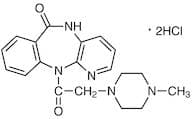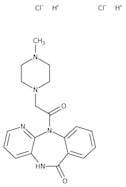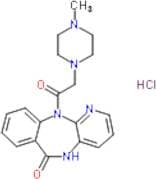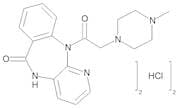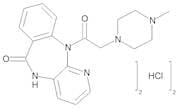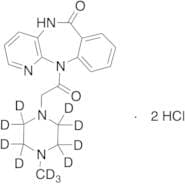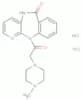
CAS 29868-97-1
:Clorhidrato de pirenzepina
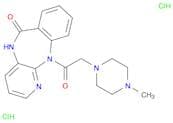
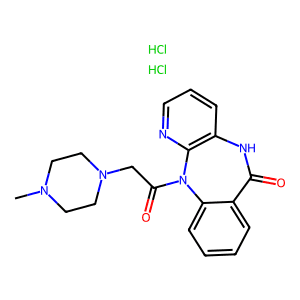
- 11-[(4-methylpiperazin-1-yl)acetyl]-5,11-dihydro-6H-pyrido[2,3-b][1,4]benzodiazepin-6-one dihydrochloride
- 11-[2-(4-methylpiperazin-1-yl)acetyl]-5H-pyrido[2,3-b][1,4]benzodiazepin-6-one hydrate hydrochloride
- 5,11-Dihydro-11-((4-methylpiperazin-1-yl)acetyl)-6H-pyrido(2,3-b)-(1,4)benzodiazepin-6-one dihydrochloride
- 5,11-Dihydro-11-[(4-methyl-1-piperazinyl)acetyl]-6H-pyrido[2,3-b][1,4]benzodiazepin-6-one dihydrochloride
- 6H-Pyrido[2,3-b][1,4]benzodiazepin-6-one, 5,11-dihydro-11-[(4-methyl-1-piperazinyl)acetyl]-, dihydrochloride
- 6H-Pyrido[2,3-b][1,4]benzodiazepin-6-one, 5,11-dihydro-11-[2-(4-methyl-1-piperazinyl)acetyl]-, hydrochloride (1:2)
- Duogastral
- Durapirenz
- Gasteril
- Gastricur
- Gastrozepin
- L-S 519
- LS 519Cl<sub>2</sub>
- LS 59Cl2
- Leblon
- Maghen
- Pirenzepine HCL
- Pirenzepine Hcl Hydrate
- Pirenzepine Hydrochloride
- Renzepin
- Ulcosan
- Ulcuforton
- Ver más sinónimos
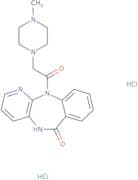
Pirenzepine Dihydrochloride
CAS:Fórmula:C19H21N5O2·2HClPureza:>98.0%(T)(HPLC)Forma y color:White to Yellow to Orange powder to crystalPeso molecular:424.33Pirenzepine dihydrochloride, 99%
CAS:A M1 muscarinic receptor antagonistFórmula:C19H23Cl2N5O2Pureza:99%Forma y color:Crystals or powder or crystalline powder, White to pale yellowPeso molecular:424.33PIRENZEPINE DIHYDROCHLORIDE MONOHYDRATE CRS
CAS:PIRENZEPINE DIHYDROCHLORIDE MONOHYDRATE CRSFórmula:C19H23Cl2N5O2Forma y color:Crystalline Powder. White. Light Yellow. Powder., Crystalline Powder. White. Light Yellow. Powder.Peso molecular:424.3242Pirenzepine dihydrochloride
CAS:Pirenzepine dihydrochloride (LS519) is a selective M1 muscarinic receptor antagonist, inhibiting gastric secretion.Fórmula:C19H21N5O2·2HClPureza:99.48% - 99.62%Forma y color:White PowderPeso molecular:424.32Pirenzepine dihydrochloride
CAS:Fórmula:C19H21N5O2·2HClPureza:98.0 - 102.0 % (dried basis)Forma y color:White to off-white or pale yellow powderPeso molecular:424.32Pirenzepine, Dihydrochloride
CAS:Producto controladoApplications An antiulcerative. Tricyclic gastric-acid inhibitor.
References Eberlein, W., et al.: Arzneimittel-Forsch., 27, 356 (1977), Hellerr, G., et al.: Verh. Deut. Ges. Inn. Med., 84, 991 (1978), Carmine, A.A., et al.: Drugs, 30,85 (1985), El-Obeid, H.A., et al.: Anal. Profiles Drug Subs., 16, 445 (1987), Homon, C.A., et al.: Ther. Drug Monit., 9, 236 (1987),Fórmula:C19H21N5O2·2ClHForma y color:NeatPeso molecular:424.32Pirenzepine-d8 Dihydrochloride
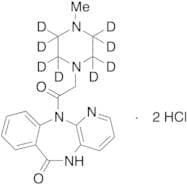
CAS:Producto controladoFórmula:C19H15D8Cl2N5O2Forma y color:NeatPeso molecular:432.37Pirenzepine dihydrochloride
CAS:Pirenzepine is a nonsteroidal anti-inflammatory drug and prokinetic agent used to treat bowel disease. It is also used to treat pancreatic enzyme deficiency, which can result in chronic diarrhea. Pirenzepine has been shown to inhibit protease activity in mouse serum, and it has been reported that this inhibition may be due to its ability to bind with amyloid protein and prevent amyloid aggregation. Pirenzepine also suppresses inflammatory responses by inhibiting the production of inflammatory mediators such as leukotrienes, prostaglandins, and cytokines, thereby providing therapeutic benefits for treating chronic bronchitis and other inflammatory diseases. Pirenzepine is metabolized in the liver by the cytochrome P450 enzyme system into an active form called pirenzepine N-oxide. This active form is then metabolized by hydrolysis or glucuronidation before excretion from the body. The most common sideFórmula:C19H23Cl2N5O2Pureza:Min. 95%Forma y color:White PowderPeso molecular:424.32 g/molPirenzepine-d10 Dihydrochloride
CAS:Producto controladoApplications Pirenzepine-d10 Dihydrochloride is an analogue of Pirenzepine (P508500), an antiucerative agent that works by inhibiting tricyclic gastric-acid secretion.
References Fliri, A . F., et al.: J. Med. Chem., 52, 8038 (2009); Eberlein, W., et al.: Arzneimittel-Forsch., 27, 356 (1977), Hellerr, G., et al.: Verh. Deut. Ges. Inn. Med., 84, 991 (1978), Carmine, A.A., et al.: Drugs, 30,85 (1985), El-Obeid, H.A., et al.: Anal. Profiles Drug Subs., 16, 445 (1987), Homon, C.A., et al.: Ther. Drug Monit., 9, 236 (1987),Fórmula:C19H12D11Cl2N5O2Forma y color:BrownPeso molecular:435.39