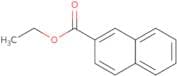
CAS 3007-91-8
:Ácido 2-naftalenocarboxílico, éster etílico
Descripción:
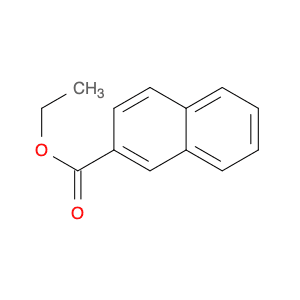
Ácido 2-naftalenocarboxílico, éster etílico, también conocido como etilo 2-naftoato, es un compuesto orgánico caracterizado por su estructura de anillo de naftaleno sustituido con un grupo ácido carboxílico y un éster etílico. Este compuesto generalmente aparece como un líquido incoloro a amarillo pálido con un olor aromático característico. Es moderadamente soluble en disolventes orgánicos como el etanol y el éter, pero tiene una solubilidad limitada en agua debido a su núcleo de naftaleno hidrofóbico. El compuesto es conocido por sus aplicaciones en síntesis orgánica, particularmente en la producción de varios fármacos y fragancias. Exhibe propiedades típicas de los ésteres, incluida la reactividad en reacciones de transesterificación e hidrólisis. Además, Ácido 2-naftalenocarboxílico, éster etílico puede mostrar actividad biológica, lo que lo hace de interés en la química medicinal. Los datos de seguridad indican que debe manejarse con cuidado, ya que puede causar irritación en la piel y los ojos. Se recomienda un almacenamiento adecuado en un lugar fresco y seco, alejado de la luz, para mantener su estabilidad.
Fórmula:C13H12O2
InChI:InChI=1S/C13H12O2/c1-2-15-13(14)12-8-7-10-5-3-4-6-11(10)9-12/h3-9H,2H2,1H3
Clave InChI:InChIKey=HQKSINSCHCDMLS-UHFFFAOYSA-N
SMILES:C(OCC)(=O)C1=CC2=C(C=C1)C=CC=C2
Sinónimos:- 2-Naphthalenecarboxylic acid, ethyl ester
- 2-Naphthoic acid, ethyl ester
- Ethyl 2-naphthalenecarboxylate
- Ethyl Naphthalene-2-Carboxylate
- Ethyl b-naphthoate
- NSC 171216
- Ethyl 2-naphthoate
Ordenar por
Pureza (%)
0
100
|
0
|
50
|
90
|
95
|
100
Encontrado 6 productos.
Ethyl 2-naphthoate
CAS:Ethyl 2-naphthoate is an agent of biochemical.Fórmula:C13H12O2Pureza:98%Forma y color:SolidPeso molecular:200.23β-Naphthoic acid ethyl ester
CAS:β-Naphthoic acid ethyl ester (BNAE) is a synthetic compound that has been used as an intermediate in the synthesis of organic compounds. It is also used to prepare hydroxamic acids, which are active methylene compounds. BNAE reacts with nucleophiles and is susceptible to nucleophilic attack. The reaction mechanism for this type of compound involves a cavity with a constant volume, which increases the reactivity of the molecule. This type of reaction can be explained using the functional theory and the use of organic solvents. BNAE is stable when exposed to carbon tetrachloride and hydroxamic acids, but not when exposed to diethyl succinate or chemical agents such as sodium nitrite.Fórmula:C13H12O2Pureza:Min. 95%Forma y color:PowderPeso molecular:200.23 g/mol