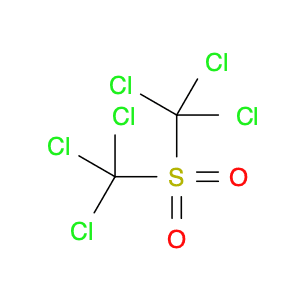
CAS 3064-70-8
:Bis(triclorometil) sulfona
- 1,1′-Sulfonylbis[1,1,1-trichloromethane]
- Bis(trichloromethyl)sulfone
- Brn 1783352
- Caswell No. 104
- Ccris 809
- Chlorosulfona
- Clorosulfona
- EPA Pesticide Chemical Code 035601
- Hexachlorodimethyl sulfone
- Hsdb 7126
- Methane, 1,1'-sulfonylbis(1,1,1-trichloro-
- Methane, sulfonylbis(trichloro-
- N 1386
- N-1386 biocide
- Nsc 21713
- Pcp 23052
- Slimicide E
- Sulfone, bis(trichloromethyl)
- Trichloromethylsulfone
- Bis(trichloromethyl) sulphone
- Ver más sinónimos
Methane, 1,1'-sulfonylbis[1,1,1-trichloro-
CAS:Fórmula:C2Cl6O2SForma y color:LiquidPeso molecular:300.8032Hexachlorodimethyl Sulfone
CAS:Applications Combinations of Bis(trichloromethyl)sulfone, (Hexachlorodimethyl sulfone) and 1,2-Dibromo-2,4-dicyanobutane are shown to have synergistic antimicrobial properties. The synergistic compounds may be used together with a third microbiocide to enhance the compound’s effectiveness against a wide variety of bacteria, molds, and yeasts and other microorganisms.
Not a dangerous good if item is equal to or less than 1g/ml and there is less than 100g/ml in the package
References Pearl, G., et al.: Curr. Top Med. Chem., 1, 247 (2001), Casalegno, M., et al.: Chem. Res. Toxicol., 18, 740 (2005), Toropov, A., et al.: Bioorg. Med. Chem., 14, 2779 (2006),Fórmula:C2Cl6O2SForma y color:NeatPeso molecular:300.8Hexachlorodimethyl sulfone
CAS:Hexachlorodimethyl sulfone (HCDS) is an industrial chemical that is used in the production of polymers, resins, and dyes. It is also used for the decontamination of radiation-contaminated water, soil, and air. HCDS has been shown to be a potent inhibitor of cationic polymerization reactions such as those used to make paints and varnishes. This property makes it useful in the development of paint strippers. Hexachlorodimethyl sulfone has a high resistance to acidity and is stable at high temperatures. This chemical can cause necrosis factor-mediated chronic arthritis in animals following intraperitoneal administration.
Fórmula:C2Cl6O2SPureza:Min. 95%Peso molecular:300.8 g/mol