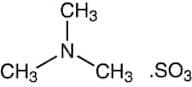
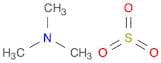
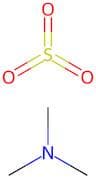
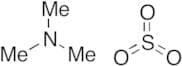
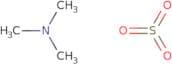
CAS 3162-58-1
:Metanamida, N,N-dimetil-, compuesta con trióxido de azufre (1:1)
Descripción:
La metanamina, N,N-dimetil-, compuesto con trióxido de azufre (1:1), comúnmente conocida como ácido sulfonico de dimetilamina, es un compuesto orgánico caracterizado por su combinación de un grupo de dimetilamina y trióxido de azufre. Este compuesto típicamente aparece como un sólido cristalino blanco y es altamente soluble en agua debido a la presencia de grupos funcionales polares. Exhibe propiedades típicas de las aminas, como la basicidad, y puede participar en varias reacciones químicas, incluyendo sulfonación y sustitución nucleofílica. La presencia de trióxido de azufre confiere características ácidas fuertes, lo que lo hace útil en diversas aplicaciones industriales, incluyendo como reactivo en síntesis orgánica y como catalizador en reacciones químicas. Además, puede servir como un intermedio en la producción de tensioactivos y otros productos químicos. Las consideraciones de seguridad son importantes al manejar este compuesto, ya que puede ser corrosivo y puede representar riesgos para la salud si se inhala o se ingiere. Se deben seguir protocolos adecuados de almacenamiento y manejo para mitigar cualquier peligro potencial asociado con su uso.
Fórmula:C3H9N·O3S
InChI:InChI=1S/C3H9N.O3S/c2*1-4(2)3/h1-3H3;
Clave InChI:InChIKey=DXASQZJWWGZNSF-UHFFFAOYSA-N
SMILES:S(=O)(=O)=O.N(C)(C)C
Sinónimos:- Methanamine, N,N-dimethyl-, compd. with sulfur trioxide (1:1)
- NSC 9838
- Sulfur trioxide trimethylamine complex
- Sulfur trioxide, compd. with N,N-dimethylmethanamine (1:1)
- Sulfur trioxide, compd. with trimethylamine (1:1)
- Sulfur trioxide�Trimethylamine complex
- Sulphur trioxide-trimethylamine complex
- Trimethylamine compound with sulfur trioxide
- Trimethylamine sulfur trioxide
- Trimethylamine, compd. with sulfur trioxide (1:1)
- Trimethylamine-sulphur trioxide complex
Ordenar por
Pureza (%)
0
100
|
0
|
50
|
90
|
95
|
100
Encontrado 7 productos.
Sulfur trioxide-trimethylamine complex, 95%
CAS:Sulfur trioxide-trimethylamine complex acts as a reagent for sulfonation and sulfamation reactions. It is used as a reactant for the synthesis of sulfate-conjugated resveratrol metabolites and chitooligosaccharides. It is used in association with dodecyl thioglycopyranoside, which acts as a surfactaFórmula:C3H9NO3SPureza:95%Forma y color:Powder, White to creamPeso molecular:139.17Sulfur trioxide trimethylamine complex
CAS:Fórmula:C3H9NO3SPureza:95%Forma y color:SolidPeso molecular:139.1735Ref: IN-DA003UH0
5kgA consultar10kgA consultar25kgA consultar5g19,00€10g27,00€25g46,00€100g107,00€500g293,00€Sulphur trioxide trimethylamine complex
CAS:Sulphur trioxide trimethylamine complexFórmula:C3H9N·O3SPureza:95%Forma y color: white powderPeso molecular:139.17345g/molSulfur trioxide trimethylamine complex
CAS:Fórmula:C3H9NO3SPureza:95%Forma y color:SolidPeso molecular:139.17Sulfur Trioxide Trimethylamine Complex
CAS:Producto controladoApplications Sulfur Trioxide Trimethylamine Complex is a reagent that is used for the design and synthesis of Rho kinase inhibitors.
Not a dangerous good if item is equal to or less than 1g/ml and there is less than 100g/ml in the package
References Takami, A., et al.: Bioorg. Med. Chem., 12, 6317 (2004);Fórmula:C3H9NO3SForma y color:NeatPeso molecular:139.17Sulfur Trioxide Trimethylamine Complex
CAS:Sulfur Trioxide Trimethylamine Complex is a metabolic disorder drug that is used to treat hepatic steatosis. It inhibits the production of fatty acids and hydroxyl groups by inhibiting de novo lipogenesis in the liver. The reaction solution of this drug has been shown to inhibit the growth of Hl-60 cells, which are human leukemia cells. The surface methodology for this drug has been shown to be effective against bacteria such as Pseudomonas aeruginosa and Staphylococcus aureus. Sulfur Trioxide Trimethylamine Complex also binds to bacterial 16S ribosomal RNA and inhibits protein synthesis, leading to cell death by inhibiting the production of proteins vital for cell division. This drug also has been shown to have antimicrobial properties through its ability to inhibit bacterial phospholipid synthesis, which may lead to death by lysis or inhibition of cell membrane function.Fórmula:C3H9NO3SPureza:Min. 95%Peso molecular:139.17 g/mol