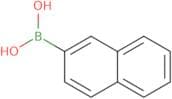
CAS 32316-92-0
:Ácido 2-naftilborónico
Descripción:
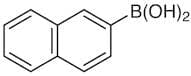
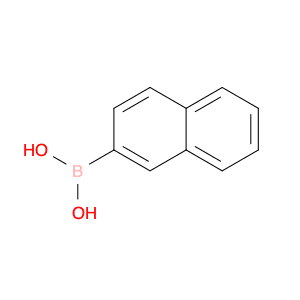
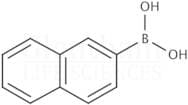
Ácido 2-naftilborónico es un compuesto organoboronado caracterizado por la presencia de un grupo funcional ácido bórico unido a un anillo de naftaleno. Típicamente aparece como un sólido blanco a blanco sucio y es soluble en disolventes orgánicos polares como el etanol y el metanol, pero menos soluble en disolventes no polares. Se conoce que el compuesto tiene la capacidad de formar enlaces covalentes reversibles con dioles, lo que lo hace útil en diversas aplicaciones, incluida la síntesis orgánica y como reactivo en reacciones de acilo cruzado de Suzuki-Miyaura. Su funcionalidad de ácido bórico le permite participar en la formación de ésteres boronados, que son intermediarios importantes en la química orgánica. Además, se ha estudiado Ácido 2-naftilborónico por sus posibles aplicaciones en química medicinal, particularmente en el desarrollo de fármacos que apuntan a vías biológicas específicas. Las consideraciones de seguridad incluyen manejarlo con cuidado, ya que los ácidos bóricos pueden ser irritantes. En general, Ácido 2-naftilborónico es un compuesto versátil con una utilidad significativa tanto en química académica como industrial.
Fórmula:C10H9BO2
InChI:InChI=1/C10H9BO2/c12-11(13)10-6-5-8-3-1-2-4-9(8)7-10/h1-7,12-13H
Clave InChI:InChIKey=KPTRDYONBVUWPD-UHFFFAOYSA-N
SMILES:B(O)(O)C1=CC2=C(C=C1)C=CC=C2
Sinónimos:- (2-Naphthalenyl)boronic acid
- (Naphthalene-2-yl)boronic acid
- 2-Naphthalene Boric Acid
- 2-Naphthaleneboronic acid
- 2-Naphthaleneylboronic acid
- 2-Naphthylbenzoic acid
- 2-Naphthylboric acid
- 2-Naphthylboronic acid
- 2-Naphthylboronic caid
- Akos Brn-0020
- Akos Brn-0041
- Alpha-Naphthylboric Acid
- B-2-Naphthalenylboronic acid
- Boronic acid, 2-naphthalenyl-
- Boronic acid, B-2-naphthalenyl-
- Naphthalen-2-Yl-2-Boronic Acid
- Naphthalen-2-Ylboronic Acid
- Naphthalenyl-2-Boronic Acid
- NAPHTHALENE-2-BORONIC ACID
- NAPHTHALEN-1-YLBORONIC ACID
- 1-NAPHTHALENEBORONIC ACID
- 1-NAPHTHYLBORONIC ACID
- RARECHEM AH PB 0126
- 1-NAPHTHYLENEBORONIC ACID
- NAPHTHALENE-1-BORONIC ACID
- 2-NAPHTHENEBORONIC ACID
- NAPHTHALENYL-1-BORONIC ACID
- Ver más sinónimos
Ordenar por
Pureza (%)
0
100
|
0
|
50
|
90
|
95
|
100
Encontrado 8 productos.
2-Naphthaleneboronic Acid (contains varying amounts of Anhydride)
CAS:Fórmula:C10H9BO2Forma y color:White to Light yellow powder to crystalPeso molecular:171.992-Naphthaleneboronic acid, 97%
CAS:This Thermo Scientific Chemicals brand product was originally part of the Alfa Aesar product portfolio. Some documentation and label information may refer to the legacy brand. The original Alfa Aesar product / item code or SKU reference has not changed as a part of the brand transition to Thermo SciFórmula:C10H9BO2Pureza:97%Forma y color:White to cream to pale brown, Powder or crystalline powder and/or chunksPeso molecular:171.99Ref: IN-DA0033EN
1kgA consultar5kgA consultar10kgA consultar1g26,00€5g27,00€10g33,00€25g54,00€100g123,00€500g339,00€Naphthalene-2-boronic acid
CAS:Naphthalene-2-boronic acidFórmula:C10H9BO2Pureza:≥95%Forma y color: white crystalline powderPeso molecular:171.99g/mol2-Naphthaleneboronic acid
CAS:Fórmula:C10H9BO2Pureza:97%Forma y color:Chunks,Crystalline PowderPeso molecular:171.992-Naphthaleneboronic acid
CAS:2-Naphthaleneboronic acid is an organic compound that has been used as a model system for studying the binding of organic molecules to metal ions. It has been shown to bind with high affinity and specificity to sodium, potassium, and lithium ions. 2-Naphthaleneboronic acid binds to the metal ion by forming a boronate ester linkage with one of its hydroxyl groups. The other two hydroxyl groups are involved in hydrogen bonding interactions with the metal ion. This process is reversible, which allows it to be used as a model system for studying the binding of organic molecules to metal ions. 2-Naphthaleneboronic acid is also used in the synthesis of various compounds, including diphenyl ethers and anhydrous sodium carbonate. It can be prepared by reacting naphthalene with anhydrous sodium carbonate in hydrochloric acid or sodium carbonate solution at temperatures ranging from 50 °C to 150 °CFórmula:C10H9BO2Pureza:Min. 95%Peso molecular:171.99 g/mol