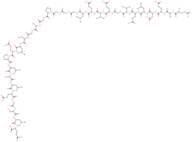
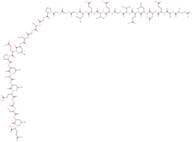
CAS 33017-11-7
:Fragmento de péptido C 3-33
Descripción:
Fragmento de péptido C 3-33, asociado con el número CAS 33017-11-7, es un péptido derivado de la molécula de proinsulina, específicamente de la región del péptido conectante (C-péptido). Este fragmento consiste en aminoácidos del 3 al 33 de la secuencia del C-péptido, que juega un papel crucial en el procesamiento de la proinsulina en insulina. El C-péptido en sí se libera en el torrente sanguíneo en cantidades equimolares con la insulina, sirviendo como un biomarcador útil para la producción de insulina en el cuerpo. El fragmento 3-33 es de interés en la investigación relacionada con la diabetes y los trastornos metabólicos, ya que puede tener implicaciones para entender la secreción y acción de la insulina. Característicamente, este péptido es hidrofílico, lo que influye en su solubilidad e interacción con sistemas biológicos. Se sintetiza típicamente utilizando técnicas de síntesis de péptidos en fase sólida y puede ser analizado a través de métodos como la espectrometría de masas y la cromatografía líquida de alta resolución (HPLC). Su actividad biológica y posibles aplicaciones terapéuticas son temas de investigación en curso, particularmente en el contexto del manejo y tratamiento de la diabetes.
Fórmula:C129H211N35O48
Sinónimos:- Proinsulin C-peptide (human)
- C-Peptide, Proinsulin
- Human proinsulin C-peptide
Ordenar por
Pureza (%)
0
100
|
0
|
50
|
90
|
95
|
100
Encontrado 7 productos.
C-Peptide (human)
CAS:Bachem ID: 4068086.
Fórmula:C129H211N35O48Pureza:96.0%Forma y color:White LyophilisatePeso molecular:3020.3C-Peptide (human)
CAS:The measurement of the C-peptide under standardized conditions provides a sensitive, well accepted, and clinically validated assessment of β-cell function. The C-peptide measurement is the most suitable primary outcome for clinical trials of therapies aimed at preserving or improving endogenous insulin secretion in type 1 diabetes patients. C-peptide also shows hormonal activity. Clinical studies demonstrated that C-peptide administration in type 1 diabetes patients, who lack the peptide, alleviates the diabetes-induced renal and nerve dysfunctions.Fórmula:C129H211N35O48Pureza:96.2%Forma y color:WhitePeso molecular:3020.3Proinsulin C-peptide (human)
CAS:C-peptide, a 31-amino acid, links Proinsulin A & B chains for correct folding and function.Fórmula:C129H211N35O48Pureza:98%Forma y color:SolidPeso molecular:3020.26Proinsulin C-peptide (human)
CAS:Custom research peptide; min purity 95%. For different specs please use the Peptide Quote Tool
Fórmula:C129H211N35O48Peso molecular:3,020.26 g/molC-Peptide (Human)
CAS:C-peptide is a peptide hormone that is cleaved from proinsulin in the pancreatic beta cells. Both C-peptide and insulin are released by the beta cells in the event of glycaemia. Due to it having a relatively long half life, compared to insulin, and the fact it is not immediately metabolised by the liver, makes C-peptide a useful biomarker to monitor beta cell function. Increased levels of C-peptide occurring in patients with insulin resistant type 2 diabetes mellitus, have been associated with macrovascular complications and cardiovascular morbidity. During in vitro studies it has also been found that C-peptide prevents endothelial cell reactive oxygen species from being formed and therefore oxidative stress is reduced. This also may lead to anti-inflammatory and anti-apoptotic responses.Fórmula:C129H211N35O48Pureza:Min. 95%Peso molecular:3,020.27 g/molC-Peptide (human) acetate salt
CAS:C-Peptide (human) acetate salt H-Glu-Ala-Glu-Asp-Leu-Gln-Val-Gly-Gln-Val-Glu-Leu-Gly-Gly-Gly-Pro-Gly-Ala -Gly Ser Leu Gln Pro Leu Ala Leu Glu Gly Ser Leu Gln Pro Leu Ala is a peptide that has been purified from the pancreas of human and bovine sources. It is used in blood sampling and rate constant experiments to measure the response element on a signal peptide. This experiment can be used to study insulin production, as well as other biological samples. C Peptide (human) acetate salt H Glu Ala Glu Asp Leu Gln Val Gly Gln Val Glu Leu Gly Gly Gly Pro Gly Ala Gly Ser Leu Gln Pro Leu Ala has inhibitory properties againstFórmula:C129H211N35O48Pureza:Min. 95%Peso molecular:3,020.26 g/molC-Peptide (human) trifluoroacetate salt
CAS:C-Peptide is a monoclonal antibody that binds to the β-cell and inhibits insulin release. It has been used in diagnosis of type 1 diabetes mellitus. C-Peptide is a hormone that regulates blood glucose levels by controlling the rate of glucose production in the liver, as well as by inhibiting the breakdown of glycogen in the liver. The C-terminal amino acid sequence Glu-Ala-Glu-Asp-Leu-Gln-Val-Gly-Gln-Val-Glu -Leu-Gly can be cleaved from the peptide by trifluoroacetic acid to yield free Gln, which can then be detected using mass spectrometry. Growth factors such as IGF1, FGF21, and HGF have been shown to increase C peptide levels in diabetic patients.Fórmula:C129H211N35O48Pureza:Min. 95%Peso molecular:3,020.26 g/mol