


CAS 33155-90-7
:Hidroxibenzoquinolina
Descripción:
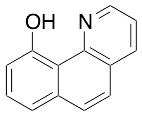
Hidroxibenzoquinolina, con el número CAS 33155-90-7, es un compuesto químico que pertenece a la clase de compuestos orgánicos heterocíclicos. Presenta una estructura de quinolina, que es un compuesto bicíclico compuesto por un anillo de benceno fusionado a un anillo de piridina. La presencia de grupos funcionales hidroxilo (-OH) y carbonilo (C=O) contribuye a su reactividad y aplicaciones potenciales. Hidroxibenzoquinolina es conocido por su papel en varias reacciones químicas, incluyendo como un ligando en la química de coordinación y como un precursor en la síntesis de otros compuestos orgánicos. Exhibe propiedades como la fluorescencia y puede tener actividad biológica, lo que lo hace de interés en la química medicinal y la ciencia de materiales. El compuesto se caracteriza típicamente por su solubilidad en disolventes orgánicos y su estabilidad bajo condiciones de laboratorio estándar. Se deben consultar los datos de seguridad para el manejo y almacenamiento, como con cualquier sustancia química, para asegurar que se tomen las precauciones adecuadas.
Fórmula:C13H9NO
InChI:InChI=1/C13H9NO/c15-11-5-1-3-9-6-7-10-4-2-8-14-13(10)12(9)11/h1-8,15H
SMILES:c1cc2ccc3cccnc3c2c(c1)O
Sinónimos:- 10-Hydroxybenzo[h]quinoline
- Benzo[H]Quinolin-10-Ol
Ordenar por
Pureza (%)
0
100
|
0
|
50
|
90
|
95
|
100
Encontrado 6 productos.
10-Hydroxybenzo[h]quinoline
CAS:Fórmula:C13H9NOPureza:>98.0%(T)(HPLC)Forma y color:Light yellow to Amber to Dark green powder to crystalPeso molecular:195.22Benzo[h]quinolin-10-ol
CAS:Pureza:95.0%Forma y color:Solid, Crystalline PowderPeso molecular:195.22099304199225-Hydroxy-4-azaphenanthrene
CAS:Producto controladoApplications 5-Hydroxy-4-azaphenanthrene is used to detect boronic acids in reactions and boron containing compounds on solid support. 5-Hydroxy-4-azaphenanthrene is also used as a proton transfer-fluoresence probe to be applied to human serum albumin and beaver apomyoglobin.
References Aronoff, M.R., et. al.: Org. Lett., 15, 5382 (2013); Sytnik, A., Kasha, M.: P. Natl. Acad. Sci. USA, 91, 8627 (1994)Fórmula:C13H9NOForma y color:NeatPeso molecular:195.2210-Hydroxy-benzo[H]Quinoline
CAS:10-Hydroxy-benzo[H]quinoline is a fluorescence probe that can be used to detect the presence of human serum. It has been shown to have a high fluorescence intensity and a long lifetime, making it an ideal molecule for use as a fluorescent probe. The light emission from 10-hydroxy-benzo[H]quinoline is due to intramolecular hydrogen bonding and intermolecular hydrogen bonding between the carbonyl group and the phenyl ring. This bond is formed through proton transfer from the oxygen atom in the carbonyl group to the nitrogen atom in the phenyl ring. The quinoline derivatives are synthesized by reacting 2,4-dichloroquinoline with benzaldehyde or acetaldehyde in methanol at room temperature. The reaction mechanism for this synthesis involves the elimination of water, which generates benzoic acid and acetone.Pureza:Min. 95%
![10-Hydroxybenzo[h]quinoline](/_next/image/?url=https%3A%2Fstatic.cymitquimica.com%2Fproducts%2F3B%2Fthumb%2FH0738.jpg&w=3840&q=75)

![Benzo[h]quinolin-10-ol](/_next/image/?url=https%3A%2Fstatic.cymitquimica.com%2Fproducts%2FIN%2Fthumb%2FDA0032NU.jpg&w=3840&q=75)

![10-Hydroxybenzo[h]quinoline](/_next/image/?url=https%3A%2Fstatic.cymitquimica.com%2Fproducts%2F54%2Fthumb%2FOR315046.jpg&w=3840&q=75)

![Benzo[h]quinolin-10-ol](/_next/image/?url=https%3A%2Fstatic.cymitquimica.com%2Fproducts%2F10%2Fthumb%2FF236534.jpg&w=3840&q=75)


![10-Hydroxy-benzo[H]Quinoline](/_next/image/?url=https%3A%2Fstatic.cymitquimica.com%2Fproducts%2F3D%2Fthumb%2FFH40574.jpg&w=3840&q=75)
