CAS 335-27-3
:Perfluoro(1,3-dimetilciclohexano)
Descripción:
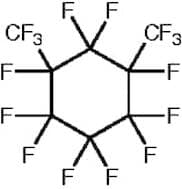
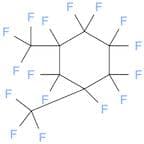
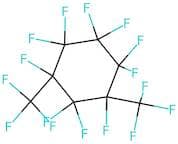
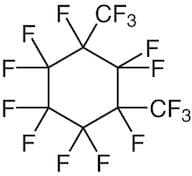
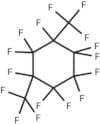
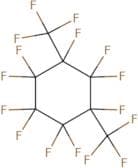
Perfluoro(1,3-dimetilciclohexano) es un compuesto perfluorado caracterizado por un anillo de ciclohexano con dos grupos metilo en las posiciones 1 y 3, completamente sustituidos por átomos de flúor. Esta estructura confiere propiedades únicas, incluyendo alta estabilidad térmica, inercia química y baja tensión superficial. La presencia de átomos de flúor mejora sus características hidrofóbicas y lipofóbicas, haciéndolo útil en diversas aplicaciones, como en recubrimientos especiales, lubricantes y como surfactante en ciertas formulaciones. Además, los compuestos perfluorados son conocidos por su resistencia a la degradación, lo que plantea preocupaciones ambientales sobre su persistencia y posible bioacumulación. El compuesto es típicamente no inflamable y exhibe baja volatilidad, contribuyendo a su estabilidad en una variedad de condiciones. Sin embargo, debido al impacto ambiental asociado con las sustancias perfluoradas, el escrutinio regulatorio ha aumentado, lo que ha llevado a investigar alternativas más seguras. En general, Perfluoro(1,3-dimetilciclohexano) ejemplifica las propiedades únicas de los compuestos perfluorados, equilibrando la utilidad con consideraciones ambientales.
Fórmula:C8F16
InChI:InChI=1S/C8F16/c9-1(7(19,20)21)3(11,12)2(10,8(22,23)24)5(15,16)6(17,18)4(1,13)14
Clave InChI:InChIKey=LOQGSOTUHASIHI-UHFFFAOYSA-N
SMILES:C(F)(F)(F)C1(F)C(F)(F)C(C(F)(F)F)(F)C(F)(F)C(F)(F)C1(F)F
Sinónimos:- 1,1,2,2,3,3,4,5,5,6-Decafluoro-4,6-Dimethylcyclohexane
- Carbogal
- Cyclohexane, 1,1,2,2,3,3,4,5,5,6-decafluoro-4,6-bis(trifluoromethyl)-
- Cyclohexane, decafluoro-1,3-bis(trifluoromethyl)-
- Decafluoro-1,3-bis(trifluoromethyl)cyclohexane
- Flutec PC 3
- Flutec PP 3
- NSC 4782
- Perfluoro(1,3-dimethylcyclohexane)
- 1,1,2,2,3,3,4,5,5,6-Decafluoro-4,6-bis(trifluoromethyl)cyclohexane
Ordenar por
Pureza (%)
0
100
|
0
|
50
|
90
|
95
|
100
Encontrado 8 productos.
Perfluoro(1,3-dimethylcyclohexane), tech. 90%
CAS:This Thermo Scientific Chemicals brand product was originally part of the Alfa Aesar product portfolio. Some documentation and label information may refer to the legacy brand. The original Alfa Aesar product / item code or SKU reference has not changed as a part of the brand transition to Thermo Sci
Fórmula:C8F16Pureza:90%Forma y color:Liquid, Clear, colorlessPeso molecular:400.06Perfluoro-1,3-dimethylcyclohexane
CAS:Fórmula:C8F16Pureza:80%Forma y color:LiquidPeso molecular:400.0601Perfluoro(1,3-dimethylcyclohexane)
CAS:Perfluoro(1,3-dimethylcyclohexane)Fórmula:C8F16Pureza:80%Forma y color: clear colourless liquidPeso molecular:400.06g/molPerfluoro-1,3-dimethylcyclohexane,
CAS:Fórmula:C8F16Pureza:90.0%Forma y color:LiquidPeso molecular:400.062Hexadecafluoro(1,3-dimethylcyclohexane)
CAS:Fórmula:C8F16Pureza:>80.0%(GC)Forma y color:Colorless to Almost colorless clear liquidPeso molecular:400.06Perfluoro(1,3-dimethylcyclohexane)
CAS:Perfluoro-1,3-dimethylcyclohexane, inert, is used in amorphous fluorocarbon film synthesis and alkene hydroformylation.Fórmula:C8F16Pureza:98%Forma y color:Clear And Colourless LiquidPeso molecular:400.06Hexadecafluoro(1,3-dimethylcyclohexane)
CAS:Producto controladoTernary mixtures of hexadecafluoro(1,3-dimethylcyclohexane) with fluorine and hydrogen fluoride are stable compounds. The proton is a constant, which is the only variable in the equation. The analytical method for determining the amount of hexadecafluoro(1,3-dimethylcyclohexane) in a mixture can be found in reference 1. This reference also discusses the matrix effect on this compound's stability and optical properties. Reference 2 discusses transfer reactions that are present when hexadecafluoro(1,3-dimethylcyclohexane) is heated to temperatures of 400°C or above. Reference 3 discusses how polymer films can be formed by heating hexadecafluoro(1,3-dimethylcyclohexane) with a solvent such as pentane. Reference 4 discusses how covid-19 pandemic has been shown to be effective against the H2 strain of subtFórmula:C8F16Pureza:Min. 95%Peso molecular:400.06 g/mol