CAS 33543-55-4
:O-(4-nitrofenil)hidroxilamina
Descripción:
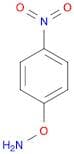
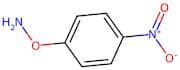
O-(4-nitrofenil)hidroxilamina es un compuesto orgánico caracterizado por la presencia de un grupo funcional hidroxilamina unido a un moiety de para-nitrofenilo. Su estructura molecular presenta un grupo nitro (-NO2) situado en la posición para en relación con el grupo hidroxilamina (-NH2OH), lo que contribuye a su reactividad química y propiedades. Este compuesto es típicamente un sólido cristalino amarillo, reflejando la presencia del grupo nitro, que puede influir en sus propiedades electrónicas y solubilidad. O-(4-nitrofenil)hidroxilamina es conocido por sus aplicaciones en síntesis orgánica, particularmente en la preparación de varios derivados y como reactivo en química analítica. Puede participar en reacciones de sustitución nucleofílica y a menudo se utiliza en la detección de compuestos carbonílicos a través de la derivatización. Además, debido a su grupo nitro, puede exhibir cierto grado de actividad biológica, lo que lo hace de interés en química medicinal. El manejo y almacenamiento adecuados son esenciales, al igual que con muchos compuestos nitro, debido a los peligros potenciales asociados con su reactividad y toxicidad.
Fórmula:C6H6N2O3
InChI:InChI=1S/C6H6N2O3/c7-11-6-3-1-5(2-4-6)8(9)10/h1-4H,7H2
Clave InChI:InChIKey=OOHKBWPOLBTKMR-UHFFFAOYSA-N
SMILES:N(=O)(=O)C1=CC=C(ON)C=C1
Sinónimos:- 1-(Aminooxy)-4-nitrobenzene
- Hydroxylamine, O-(p-nitrophenyl)-
- O-(p-Nitrophenyl)hydroxylamine
- hydroxylamine, O-(4-nitrophenyl)-
- p-Nitrophenoxyamine
- O-(4-Nitrophenyl)hydroxylamine
- O-(4-Nitrophenyl)hydroxylamine
Ordenar por
Pureza (%)
0
100
|
0
|
50
|
90
|
95
|
100
Encontrado 4 productos.
O-(4-Nitrophenyl)hydroxylamine
CAS:O-(4-Nitrophenyl)hydroxylaminePureza:98%Peso molecular:154.12g/molO-(4-Nitrophenyl)hydroxylamine
CAS:O-(4-Nitrophenyl)hydroxylamine (OPH) is an enantioselective, catalytic, and thermal stable reagent for the synthesis of chiral methyl groups. OPH can be used as a nucleophile to convert electron-deficient alkenes into α-chloroalkenes. It also reacts with nitroarenes to give nitroalkenes in high yields. OPH has been shown to be effective in the asymmetric hydrolysis of esters and amides through its ability to oxidize the methyl group on the substrate. This reaction does not occur with other groups such as hydroxyl or hydrogen atoms. Methyl groups are important for many biological molecules, including proteins and nucleic acids, which form the backbone of cells that make up living organisms. The OPH reaction is catalyzed by enzymes called methyltransferases, which transfer one atom of methyl from S-adenosylmethionine (SAM)Fórmula:C6H6N2O3Pureza:Min. 95%Forma y color:PowderPeso molecular:154.12 g/mol