CAS 339286-19-0
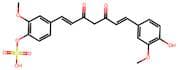
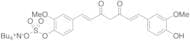
:4-((1E,6E)-7-(4-Hydroxy-3-methoxyphenyl)-3,5-dioxohepta-1,6-dien-1-yl)-2-methoxyphenyl hydrogen sulfate
CAS:4-((1E,6E)-7-(4-Hydroxy-3-methoxyphenyl)-3,5-dioxohepta-1,6-dien-1-yl)-2-methoxyphenyl hydrogen sulfatePureza:95%Peso molecular:448.45g/molCurcumin Sulfate Sodium Salt
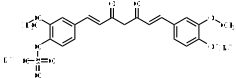
CAS:Fórmula:C21H18O9S·2NaForma y color:Red-Brown SolidPeso molecular:446.44 2 22.99Curcumin Sulfate Triethylamine Salt
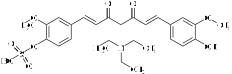
CAS:Fórmula:C21H20O9S·Et3NForma y color:Orange SolidPeso molecular:448.44 101.19Curcumin Sulfate Tetrabutylammonium Salt
CAS:Applications Curcumin Sulfate is a metabolite of Curcumin (C838510) in hepatic tissue and portal blood.
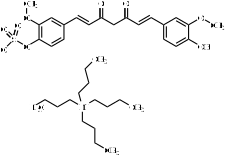
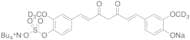
References Sharma, O., et al.: Biochem. Pharmacol., 25, 1811 (1976), Colletti, L., et al.: J. Clin. Invest., 85, 1936 (1990), Sharma, R., et al.: Clin. Cancer Res., 7, 1894 (2001),Fórmula:C37H55NO9SForma y color:Yellow To Dark YellowPeso molecular:689.9Curcumin Sulfate-d6 Tetrabutylammonium Sodium Salt
CAS:Producto controladoFórmula:C37H48D6NNaO9SForma y color:YellowPeso molecular:717.92Curcumin sulfate triethylamine
CAS:Curcumin sulfate triethylamine (CSTEA) is a synthetic derivative of curcumin that has been shown to have anti-inflammatory and anti-cancer properties. CSTEA inhibits the synthesis of prostaglandin E2, a molecule that is associated with cancer progression. It has been shown to induce apoptosis in breast cancer cells and inhibit the proliferation of human breast cancer cells. CSTEA was synthesized using an esterification method, which created a stable form of curcumin that could be administered orally or intravenously. Curcumin sulfate triethylamine is one of many natural compounds that have low bioavailability due to poor absorption in vivo. The stability and bioavailability of this compound can be improved by adding an organic solvent such as triethylamine, which increases its solubility in water and improves its absorption into the bloodstream.
Fórmula:C21H19O9S·C6H16NPureza:Min. 95%Forma y color:PowderPeso molecular:549.63 g/mol