CAS 339990-02-2
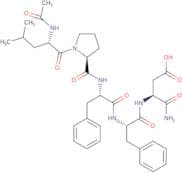
:L-a-Asparagina, N-acetil-L-leucil-L-prolil-L-fenilalanil-L-fenilalanil-
Descripción:
La L-a-Asparagina, N-acetil-L-leucil-L-prolil-L-fenilalanina-L-fenilalanina, identificada por el número CAS 339990-02-2, es un péptido sintético que consiste en una secuencia de aminoácidos, incluyendo asparagina, leucina, prolina y fenilalanina. Este compuesto se caracteriza por su disposición específica de estos aminoácidos, lo que contribuye a sus propiedades únicas y potenciales actividades biológicas. Los péptidos como este a menudo exhiben diversas funciones en sistemas biológicos, incluyendo roles en señalización, actividad enzimática y soporte estructural. La modificación N-acetil típicamente mejora la estabilidad y solubilidad del péptido, haciéndolo más adecuado para diversas aplicaciones en investigación y farmacéutica. Además, la presencia de aminoácidos aromáticos, como la fenilalanina, puede influir en las interacciones del péptido con otras biomoléculas. En general, este compuesto representa una estructura compleja que puede ser de interés en estudios relacionados con la bioquímica, farmacología y síntesis de péptidos.
Fórmula:C35H46N6O8
Sinónimos:- 10:PN: WO03050139 SEQID: 15 claimed protein
- 3: PN: WO0134631 PAGE: 35 claimedprotein
- As 602704
- Ac-Leu-Pro-Phe-Phe-Asp-Nh2
Ordenar por
Pureza (%)
0
100
|
0
|
50
|
90
|
95
|
100
Encontrado 3 productos.
Acetyl-(Pro18,Asp21)-Amyloid b-Protein (17-21) amide
CAS:Acetyl-(Pro18,Asp21)-Amyloid b-Protein (17-21) amide is a peptide that was generated by incubating β-amyloid with the protease papain. This peptide has been shown to induce population and biochemical changes in cells, including focusing of β-amyloid aggregates. It also induces reactive oxygen species and promotes extracellular protofibril formation. Acetyl-(Pro18,Asp21)-Amyloid b-Protein (17-21) amide is a conjugate of acetylated lysine residues and amyloid β-protein that can be used as an anti-amyloid therapeutic. The peptide is characterized by dichroism spectroscopy, which has revealed its specific binding to the fibrils' surface.Fórmula:C35H46N6O8Pureza:Min. 95%Peso molecular:678.78 g/molAcetyl-(Pro¹⁸,Asp²¹)-Amyloid β-Protein (17-21) amide
CAS:The pentapeptide Ac-LPFFD-NH₂ (iAβ5p) is an analog of product H-4876 with small chemical modifications which enhance its stability against proteolytic degradation. iAβ5p acts as a β-sheet breaker peptide and crosses the blood-brain barrier at a higher rate than most proteins and peptides known to be selectively taken up by the brain so that it is assumed that the peptide is being specifically transported to the brain. A significant increase in neuronal survival and decrease in brain inflammation associated with the reduction of amyloid plaques in two different transgenic Alzheimer`s disease (AD) models is additionally reported for iAβ5p.Fórmula:C35H46N6O8Pureza:> 95%Forma y color:White PowderPeso molecular:678.79Ac-Leu-Pro-Phe-Phe-Asp-NH2
CAS:Ac-Leu-Pro-Phe-Phe-Asp-NH2 is a potential therapeutic for Alzheimer's disease. It has been shown to reduce the production of reactive oxygen species and inhibit the formation of amyloid beta oligomers. Ac-Leu-Pro-Phe-Phe-Asp-NH2 also reduces the frequency of protofibrils, which are aggregates that may play a role in Alzheimer's disease pathology. This peptide has been shown to have a protective effect on cell populations, which may lead to therapeutics that can delay or prevent Alzheimer's disease. Ac-Leu-Pro-Phe-Phe-Asp NH2 is an inhibitor of amyloid beta peptides and modulates their aggregation into protofibrils.
Fórmula:C35H46N6O8Pureza:Min. 95%Peso molecular:678.89 g/mol