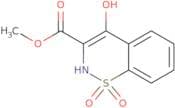
CAS 35511-14-9
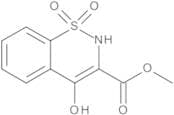
:Ácido 2H-1,2-benzotiazina-3-carboxílico, 4-hidroxi-, éster metílico, 1,1-dióxido
Descripción:
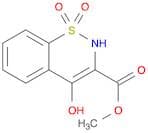
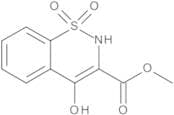
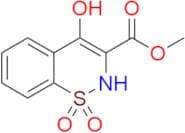
Ácido 2H-1,2-benzotiazina-3-carboxílico, 4-hidroxi-, éster metílico, 1,1-dióxido, comúnmente conocido como un derivado de benzotiazina, exhibe varias características notables. Este compuesto presenta un núcleo de benzotiazina, que es una estructura bicíclica que contiene tanto un anillo de benceno como un anillo de tiazina, lo que contribuye a sus propiedades químicas únicas. La presencia de un grupo carboxílico y un grupo metoxi mejora su solubilidad en disolventes polares y puede influir en su reactividad y actividad biológica. La designación de 1,1-dióxido indica la presencia de un grupo funcional sulfonado, que puede mejorar la estabilidad y reactividad del compuesto. Este compuesto puede exhibir diversas actividades biológicas, potencialmente incluyendo propiedades antiinflamatorias o antimicrobianas, lo que lo hace de interés en la investigación farmacéutica. Su estructura molecular permite interacciones potenciales con objetivos biológicos, y sus derivados pueden ser explorados para aplicaciones terapéuticas. En general, las características de este compuesto lo convierten en un tema de interés tanto en la química sintética como en la química medicinal.
Fórmula:C10H9NO5S
InChI:InChI=1S/C10H9NO5S/c1-16-10(13)8-9(12)6-4-2-3-5-7(6)17(14,15)11-8/h2-5,11-12H,1H3
Clave InChI:InChIKey=GEUURTZIEGFZAG-UHFFFAOYSA-N
SMILES:O=S1(=O)C=2C(C(O)=C(C(OC)=O)N1)=CC=CC2
Sinónimos:- 4-Hydroxy-2H-1,2-benzothiazine-3-carboxylic acid methyl ester 1,1-dioxide
- 2H-1,2-Benzothiazine-3-carboxylic acid, 4-hydroxy-, methyl ester, 1,1-dioxide
- Methyl 4-hydroxy-2H-1,2-benzothiazine-3-carboxylate 1,1-dioxide
Ordenar por
Pureza (%)
0
100
|
0
|
50
|
90
|
95
|
100
Encontrado 8 productos.
Methyl 4-Hydroxy-2H-1,2-benzothiazine-3-carboxylate 1,1-Dioxide
CAS:Fórmula:C10H9NO5SPureza:97%Forma y color:SolidPeso molecular:255.2472Methyl 4-hydroxy-2H-benzo[e][1,2]thiazine-3-carboxylate 1,1-dioxide
CAS:Methyl 4-hydroxy-2H-benzo[e][1,2]thiazine-3-carboxylate 1,1-dioxidePureza:97%Peso molecular:255.25g/molMethyl 4-Hydroxy-2H-1,2-benzothiazine-3-carboxylate 1,1-Dioxide
CAS:Producto controladoFórmula:C10H9NO5SForma y color:NeatPeso molecular:255.25Methyl 4-Hydroxy-2H-1,2-benzothiazine-3-carboxylate 1,1-Dioxide (Piroxicam Impurity G)
CAS:Producto controladoImpurity Piroxicam EP Impurity G
Applications Piroxicam impurity G.
References Lombardino, J., et al.: J. Med. Chem., 14, 1171 (1971), Turck, D., et al.: Clin. Pharmacol., 36, 79 (1996), Bihovsky, R., et al.: Bioorg. Med. Chem. Lett., 14, 1035 (2004),Fórmula:C10H9NO5SForma y color:NeatPeso molecular:255.25Methyl 4-hydroxy-2H-benzo[e][1,2]thiazine-3-carboxylate 1,1-dioxide
CAS:Pureza:98%Peso molecular:255.2400055Methyl 4-hydroxy-2H-1,2-benzothiazine-3-carboxylate 1,1-dioxide
CAS:Methyl 4-hydroxy-2H-1,2-benzothiazine-3-carboxylate 1,1-dioxide (MTBC) is a drug target that is a carboxylate. MTBC has been shown to have potent inhibition activity against benzothiazine oxidases. MTBC can be used as an inhibitor of enzymes involved in the biosynthesis of benzothiazines and may be useful for the treatment of diseases such as Parkinson's disease and schizophrenia. The inhibition potential of MTBC has been unraveled through its interaction with peroxidases and other oxidases. In vitro studies have shown that MTBC can inhibit the oxidation of low molecular weight compounds by acting as a scavenger for hydrogen peroxide. This drug also exhibits unsymmetrical dehydration to produce methyl 4-(hydroxyamino)-2H-1,2-benzothiazine 1,1-dioxoate (MTBA), which is anFórmula:C10H9NO5SPureza:Min. 95 Area-%Forma y color:PowderPeso molecular:255.25 g/mol

![Methyl 4-hydroxy-2H-benzo[e][1,2]thiazine-3-carboxylate 1,1-dioxide](/_next/image/?url=https%3A%2Fstatic.cymitquimica.com%2Fproducts%2F54%2Fthumb%2FOR1054994.jpg&w=3840&q=75)





![Methyl 4-hydroxy-2H-benzo[e][1,2]thiazine-3-carboxylate 1,1-dioxide](/_next/image/?url=https%3A%2Fstatic.cymitquimica.com%2Fproducts%2F10%2Fthumb%2FF615591.jpg&w=3840&q=75)