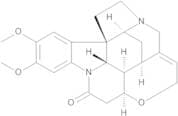
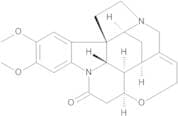
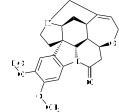
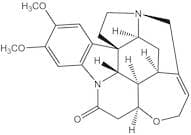
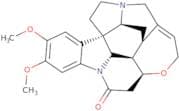
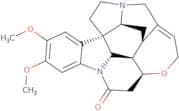
CAS 357-57-3
:Brucina
Descripción:
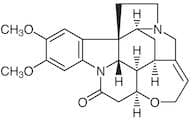
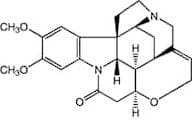
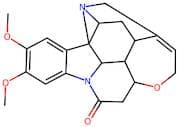
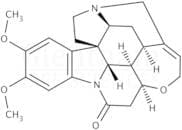
Brucina es un alcaloide derivado de las semillas del árbol Strychnos nux-vomica, que pertenece a la familia Loganiaceae. Es un polvo cristalino blanco que es poco soluble en agua pero más soluble en disolventes orgánicos como el alcohol y el cloroformo. Brucina tiene un sabor amargo y está estructuralmente relacionado con la estricnina, compartiendo algunas propiedades farmacológicas, aunque es menos tóxico. El compuesto exhibe una variedad de actividades biológicas, incluidos posibles efectos estimulantes en el sistema nervioso central. Se ha estudiado para su uso en diversas aplicaciones, incluyendo como reactivo en química analítica y en la síntesis de otros compuestos químicos. Sin embargo, debido a su toxicidad y potencial de abuso, Brucina está regulado en muchos países. Las precauciones de seguridad son esenciales al manejar esta sustancia, ya que puede representar riesgos para la salud si se ingiere o se gestiona de manera inadecuada. En general, Brucina es un compuesto significativo tanto en la química de productos naturales como en la farmacología, lo que justifica un estudio y consideración cuidadosos.
Fórmula:C23H26N2O4
InChI:InChI=1S/C23H26N2O4/c1-27-16-8-14-15(9-17(16)28-2)25-20(26)10-18-21-13-7-19-23(14,22(21)25)4-5-24(19)11-12(13)3-6-29-18/h3,8-9,13,18-19,21-22H,4-7,10-11H2,1-2H3/t13-,18-,19-,21-,22-,23+/m0/s1
Clave InChI:InChIKey=RRKTZKIUPZVBMF-IBTVXLQLSA-N
SMILES:O=C1N2[C@@]3([C@]4(C=5C2=CC(OC)=C(OC)C5)[C@]6([N@@](CC4)CC=7[C@@]([C@]3([C@](C1)(OCC7)[H])[H])(C6)[H])[H])[H]
Sinónimos:- (8Xi,12Xi)-2,3-Dimethoxystrychnidin-10-One
- 10,11-Dimethoxystrychnine
- 2,3-Dimethoxystrychnidin-10-One
- 2,3-Dimethoxystrychnine
- 2,3-Dimethylstrychnine
- 357-57-3
- 4,6-Methano-6H,14H-indolo[3,2,1-ij]oxepino[2,3,4-de]pyrrolo[2,3-h]quinoline, strychnidin-10-one deriv.
- Brucin
- Brucina
- Brucine Alkaloid
- Dimethoxystrychnine
- Strychnidin-10-one, 2,3-dimethoxy
- l-Brucine
- Ver más sinónimos
Ordenar por
Pureza (%)
0
100
|
0
|
50
|
90
|
95
|
100
Encontrado 15 productos.
Brucine Anhydrous
CAS:Fórmula:C23H26N2O4Pureza:>98.0%(T)(HPLC)Forma y color:White to Light yellow to Light orange powder to crystalPeso molecular:394.47Brucine
CAS:Brucine is used as a denaturing alcohol, lubricant additive, separation of racemic mixtures. Proposed to reduce inflammatory mediators including COX-2, PGE2 and thromboxane B2. Able to induce cell apoptosis, with cytotoxic and antiproliferative effects. This Thermo Scientific Chemicals brand productFórmula:C23H26N2O4Peso molecular:394.47Brucine
CAS:Fórmula:C23H26N2O4Pureza:(HPLC) ≥ 98.0%Forma y color:White to off-white powderPeso molecular:394.47Brucine Hydrate
CAS:Fórmula:C23H26N2O4·xH2OPureza:>99.0%(T)Forma y color:White powder to crystalPeso molecular:394.47 (as Anhydrous)Brucine
CAS:Natural alkaloidFórmula:C23H26N2O4Pureza:≥ 98.0 % (HPLC)Forma y color:PowderPeso molecular:394.47Brucine
CAS:Brucine is the 10, 11-dimethoxy derivative of Strychnine; both substances are found in the seeds of Strychnos nux-vomica, the strychnine tree, which is widespread in southern Asia. These Indole-Alkaloids are mainly known for their poisonous properties and they are responsible for the intense bitter taste of the plant extracts. Brucine’s toxicity however is lower compared to the one of Strychnine. Interestingly, some attempts of using Brucine for asymmetric decarboxylations have been reported by Marckwald as early as in 1904. In this context, Brucine can be considered an ancestral organocatalyst.Fórmula:C23H26N2O4Pureza:Min. 98.0 Area-%Peso molecular:394.46 g/molRef: 3D-Q-100426
-Unit-ggA consultar1kgA consultar100gA consultar250gA consultar500gA consultar2500gA consultarBrucine, anhydrous
CAS:Alkaloid with anti-tumoral activityFórmula:C23H26N2O4Pureza:Min. 95%Forma y color:White Off-White PowderPeso molecular:394.46 g/molBrucine Anhydrous Reagent Grade, 98%
CAS:Fórmula:C23H26N2O4Pureza:min.98%Forma y color:White to off white, Crystaline powder /Crystals/ChunksPeso molecular:394.46