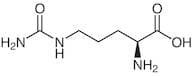
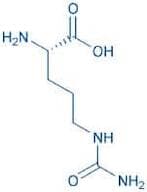
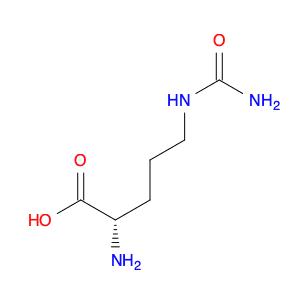
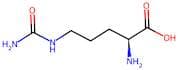
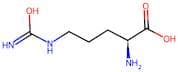
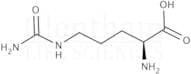
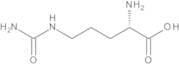
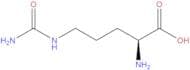
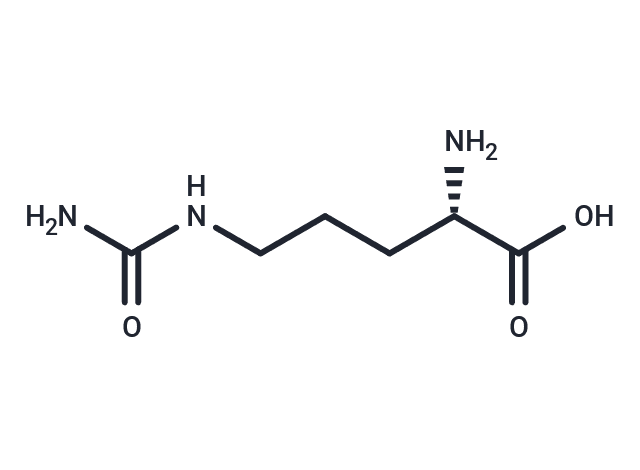
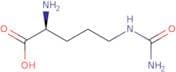
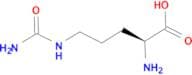
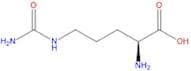
CAS 372-75-8
:L(+)-Citrulina
Descripción:
L(+)-Citrulina es un aminoácido no esencial que desempeña un papel significativo en el ciclo de la urea, facilitando la eliminación de amoníaco del cuerpo. Es una sustancia cristalina e incolora que es soluble en agua y tiene un sabor ligeramente dulce. L(+)-Citrulina se encuentra naturalmente en varios alimentos, particularmente en la sandía, y también se produce endógenamente en el cuerpo. Se conoce por sus posibles beneficios en la mejora del rendimiento atlético, la mejora del flujo sanguíneo y el apoyo a la salud cardiovascular al aumentar los niveles de óxido nítrico. El compuesto se utiliza a menudo como un suplemento dietético, particularmente entre atletas y entusiastas del fitness, debido a su supuesta capacidad para reducir el dolor muscular y mejorar la recuperación. L(+)-Citrulina está disponible típicamente en forma libre y como parte de dipeptidos o proteínas. Su perfil de seguridad es generalmente favorable, con pocos efectos secundarios reportados cuando se consume en cantidades apropiadas. En general, L(+)-Citrulina es reconocido por su importancia fisiológica y sus posibles beneficios para la salud.
Fórmula:C6H13N3O3
InChI:InChI=1S/C6H13N3O3/c7-4(5(10)11)2-1-3-9-6(8)12/h4H,1-3,7H2,(H,10,11)(H3,8,9,12)/t4-/m0/s1
Clave InChI:InChIKey=RHGKLRLOHDJJDR-BYPYZUCNSA-N
SMILES:C(CCNC(N)=O)[C@@H](C(O)=O)N
Sinónimos:- <span class="text-smallcaps">L</span>-(+)-Citrulline
- <span class="text-smallcaps">L</span>-Ornithine, N<sup>5</sup>-(aminocarbonyl)-
- Citrulina
- Citrullin
- Citrulline
- Citrulline, L-
- H-Cit-OH
- L-(+)-2-Amino-5-ureidovaleric acid
- L-Cit-OH
- L-Citrullin
- L-Citrulline (1.12117)
- L-Ornithine, N5-(aminocarbonyl)-
- N5-carbamoyl-L-ornithine
- N<sup>5</sup>-(Aminocarbonyl)-<span class="text-smallcaps">L</span>-ornithine
- N<sup>5</sup>-Carbamoyl-<span class="text-smallcaps">L</span>-ornithine
- N<sup>δ</sup>-Carbamylornithine
- Nsc 27425
- Nδ-Carbamylornithine
- Ornithine, N5-carbamoyl-, L-
- Ornithine, N<sup>5</sup>-carbamoyl-, <span class="text-smallcaps">L</span>-
- α-Amino-δ-ureidovaleric acid
- δ-Ureidonorvaline
- L-(+)-Citrulline
- L-Citrulline
- N5-(Aminocarbonyl)-L-ornithine
- Ver más sinónimos
Ordenar por
Pureza (%)
0
100
|
0
|
50
|
90
|
95
|
100
Encontrado 19 productos.
L-Citrulline
CAS:Fórmula:C6H13N3O3Pureza:>98.0%(T)Forma y color:White to Almost white powder to crystalPeso molecular:175.19L-Citrulline, 98%
CAS:L-Citrulline, is used as an essential intermediate in the biosynthesis of nitric oxide from L-arginine . It is also used as a nutritional drink and biochemical reagent. This Thermo Scientific Chemicals brand product was originally part of the Alfa Aesar product portfolio. Some documentation and la
Fórmula:C6H13N3O3Pureza:98%Forma y color:Powder, WhitePeso molecular:175.19H-Cit-OH
CAS:L-citrulline is an intermediate in the biosynthesis of nitric oxide.Fórmula:C6H13N3O3Pureza:> 99%Forma y color:WhitePeso molecular:175.19L-Citrulline
CAS:Acyclic amides (including acyclic carbamates) and their derivatives and salts thereof, nesoiFórmula:C6H13N3O3Forma y color:White Crystalline PowderPeso molecular:175.09569N5-(Aminocarbonyl)-L-ornithine
CAS:Fórmula:C6H13N3O3Pureza:97%Forma y color:SolidPeso molecular:175.1857L-Citrulline
CAS:L-CitrullinePureza:98%Forma y color: white crystalline powderPeso molecular:175.18572g/molL-Citrulline
CAS:Fórmula:C6H13N3O3Pureza:98.0 - 102.0 % (dried basis)Forma y color:White or almost white crystalline powderPeso molecular:175.19(2S)-2-Amino-5-(carbamoylamino)pentanoic Acid (Citrulline)
CAS:Producto controladoFórmula:C6H13N3O3Forma y color:NeatPeso molecular:175.19L-Citrulline
CAS:L-Citrulline is an amino acid derived from ornithine in the catabolism of proline or glutamate and glutamine, or from l-arginine via arginine-citrulline pathwayFórmula:C6H13N3O3Pureza:99.70% - 99.79%Forma y color:SolidPeso molecular:175.19L-Citrulline
CAS:Producto controladoApplications An amino acid, first isolated from the juice of watermelon, Citrullus vulgaris Schrad., Cucurbitaceae. Used in the treatment of asthenia.
References Kurtz, et al.: J. Biol. Chem., 122, 477 (1938), Rajantie, J., et al.: J. Pediatr., 97, 927 (1980), Carpenter, T.O., et al.: N. Engl. J. Med., 312, 290 (1985),Fórmula:C6H13N3O3Forma y color:NeatPeso molecular:175.19L-Citrulline
CAS:L-Citrulline is a non-protein amino acid that is found in plants and animals. It is synthesized from the amino acid arginine and may be converted to L-arginine, which is an important precursor for nitric oxide synthesis. L-Citrulline has been shown to improve myocardial infarct size and reduce the severity of heart failure in rats. The mechanism of action may be due to its ability to increase ATP production and preserve mitochondrial function. L-Citrulline also has been shown to have chemiluminescence properties, which can be used as a diagnostic tool for bowel disease. L-Citrulline may also help increase the proliferation of pluripotent cells and promote their differentiation into cardiomyocytes, which could be useful for treating heart diseases.Fórmula:C6H13N3O3Pureza:Min. 95%Forma y color:White PowderPeso molecular:175.19 g/molL-Citrulline extrapure CHR, 99%
CAS:Fórmula:C6H13N3O3Pureza:min. 99%Forma y color:White, Crystalline powderPeso molecular:175.19L-Citrulline ExiPlus, Multi-Compendial, 99%
CAS:Fórmula:C6H13N3O3Pureza:min. 99%Forma y color:White, Crystalline powderPeso molecular:175.19