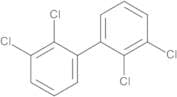
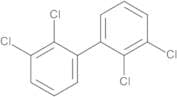
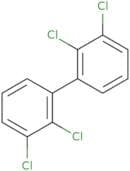
CAS 38444-93-8
:PCB 40
Descripción:
PCB 40, o bifenilo policlorado 40, es un miembro de la familia de los bifenilos policlorados (PCB), que consiste en productos químicos orgánicos sintéticos conocidos por sus aplicaciones industriales, particularmente como refrigerantes y fluidos aislantes en equipos eléctricos. PCB 40 se caracteriza por su estructura aromática clorada, que contribuye a su estabilidad química y resistencia a la degradación. Este compuesto típicamente exhibe baja volatilidad y alta lipofilia, lo que lleva a la bioacumulación en el medio ambiente y en organismos vivos. Los PCB, incluido PCB 40, son conocidos por sus posibles efectos tóxicos, incluyendo la interrupción endocrina y propiedades carcinogénicas. Debido a estas preocupaciones de salud y medioambientales, la producción y el uso de PCB han sido fuertemente regulados o prohibidos en muchos países. PCB 40 se puede encontrar en diversas aplicaciones industriales, pero su persistencia en el medio ambiente plantea desafíos significativos para la remediación y gestión. En general, aunque PCB 40 tiene propiedades útiles en aplicaciones específicas, sus impactos ambientales y en la salud requieren un manejo y regulación cuidadosos.
Fórmula:C12H6Cl4
InChI:InChI=1S/C12H6Cl4/c13-9-5-1-3-7(11(9)15)8-4-2-6-10(14)12(8)16/h1-6H
Clave InChI:InChIKey=VTLYHLREPCPDKX-UHFFFAOYSA-N
SMILES:ClC1=C(C=CC=C1Cl)C2=C(Cl)C(Cl)=CC=C2
Sinónimos:- 1,1'-Biphenyl, 2,2',3,3'-Tetrachloro-
- 1,1′-Biphenyl, 2,2′,3,3′-tetrachloro-
- 2,2',3,3'-Pcb
- 2,2',3,3'-Tetrachloro-1,1'-biphenyl
- 2,2′,3,3′-Tetrachloro-1,1′-biphenyl
- 2,2′,3,3′-Tetrachlorobiphenyl
- 38444-93-8
- Pcb 40
Ordenar por
Pureza (%)
0
100
|
0
|
50
|
90
|
95
|
100
Encontrado 3 productos.
PCB No. 40 10 µg/mL in Isooctane
CAS:Producto controladoFórmula:C12H6Cl4Forma y color:Single SolutionPeso molecular:291.992,2',3,3'-Tetrachlorobiphenyl
CAS:Producto controlado<p>2,2',3,3'-Tetrachlorobiphenyl is an inhibitor that has been shown to have anticancer properties. It inhibits the growth of tumor cells by blocking the activity of protein kinases, which are enzymes that regulate cell division and proliferation. This compound has been tested in Chinese hamster ovary cells and has been found to induce apoptosis in cancer cells. Additionally, 2,2',3,3'-Tetrachlorobiphenyl has analog inhibitors that have been tested in human urine samples and have shown potential as anticancer agents. These analogs inhibit cyclin-dependent kinases (CDKs), which play a crucial role in regulating the cell cycle. The inhibition of CDKs leads to the suppression of cancer cell growth and division, making this compound a promising candidate for future cancer treatments.</p>Fórmula:C12H6Cl4Pureza:Min. 95%Peso molecular:292 g/mol