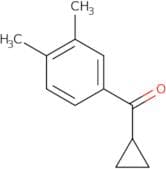
CAS 38675-78-4
:Ciclopropil(3,4-dimetilfenil)metanona
Descripción:
Ciclopropil(3,4-dimetilfenil)metanona, con el número CAS 38675-78-4, es un compuesto orgánico caracterizado por su estructura única que incluye un grupo ciclopropilo y un grupo funcional cetona unido a un moiety de 3,4-dimetilfenilo. Este compuesto típicamente exhibe una apariencia cristalina de blanco a amarillo claro. Se conoce por sus posibles aplicaciones en síntesis orgánica y como intermediario en la producción de varios productos farmacéuticos y agroquímicos. La presencia del grupo ciclopropilo contribuye a su reactividad, a menudo influyendo en la estabilidad del compuesto y en su interacción con otras especies químicas. Además, la sustitución dimetílica en el anillo fenilo puede afectar sus propiedades electrónicas, potencialmente mejorando su reactividad en reacciones de sustitución aromática electrofilica. Al igual que muchos compuestos orgánicos, su solubilidad, punto de fusión y punto de ebullición pueden variar según las condiciones ambientales y la pureza. Se deben consultar los datos de seguridad para el manejo y almacenamiento, ya que puede representar riesgos para la salud si no se gestiona adecuadamente.
Fórmula:C12H14O
InChI:InChI=1S/C12H14O/c1-8-3-4-11(7-9(8)2)12(13)10-5-6-10/h3-4,7,10H,5-6H2,1-2H3
Clave InChI:InChIKey=RVHOLOURUAQTTL-UHFFFAOYSA-N
SMILES:C(=O)(C1=CC(C)=C(C)C=C1)C2CC2
Sinónimos:- Cyclopropyl 3,4-dimethylphenyl ketone
- Cyclopropyl(3,4-Dimethylphenyl)Methanone
- Ketone, cyclopropyl 3,4-xylyl
- Methanone, cyclopropyl(3,4-dimethylphenyl)-
- NSC 71983
- Cyclopropyl 3,4-xylyl ketone
Ordenar por
Pureza (%)
0
100
|
0
|
50
|
90
|
95
|
100
Encontrado 2 productos.
Cyclopropyl(3,4-dimethylphenyl)methanone
CAS:<p>Cyclopropyl(3,4-dimethylphenyl)methanone (CPM) is a synthetic cannabinoid that has been shown to have similar effects to the natural cannabinoids found in cannabis. CPM binds to and activates the CB2 receptor, which is found on cells of the immune system, brain, and other organs. It has been studied for its ability to reduce glioma tumor growth in mice by inhibiting glutamate release. The molecular modeling study showed that CPM binds to the receptor with a geometry similar to other CB2 agonists like JWH-133. In addition, CPM inhibits locomotor activity in rats and has been shown to produce some symptoms of anxiety in mice. A receptor knockout study with mice showed that CPM can bind to CB2 receptors without activating them. X-ray diffraction data indicated that CPM is an achiral molecule with an idealized molecular geometry of "s".</p>Fórmula:C12H14OPureza:Min. 95%Peso molecular:174.24 g/mol