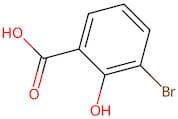
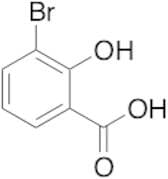
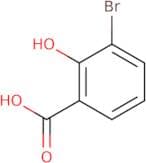
CAS 3883-95-2
:Ácido 3-bromosalicílico
- 3-Bromosalicylic acid
- Benzoic Acid, 3-Bromo-2-Hydroxy-
- Salicylic acid, 3-bromo-
- 3-Bromo-2-hydroxybenzoic acid
3-Bromo-2-hydroxybenzoic acid
CAS:Fórmula:C7H5BrO3Pureza:96%Forma y color:SolidPeso molecular:217.01683-Bromo-2-hydroxybenzoic acid
CAS:3-Bromo-2-hydroxybenzoic acidFórmula:C7H5BrO3Pureza:≥95%Forma y color: grey-yellow solidPeso molecular:217.02g/mol3-Bromo-2-hydroxybenzoic acid
CAS:Fórmula:C7H5BrO3Pureza:96%Forma y color:SolidPeso molecular:217.0183-Bromo-2-hydroxybenzoic Acid
CAS:Producto controladoApplications 3-Bromo-2-hydroxybenzoic Acid is a potential an intermediate formed in the synthesis of 3-[4-(2-Pyridylsulfamoyl)phenyl] Sulfasalazine (P995810), an impurity of Sulfasalazine (S699084), an anti-inflammatory (gastrointestinal). Sulfasalazine has been used in granulomatous colitis.
References Schroder, H., et al.: Clin. Pharmacol. Ther.,13, 539 (1972); McDonnell, J.P., et al.: Anal. Profiles Drug Subs., 5, 515 (1976); Klotz, U., et al.: Clin. Pharmacokinet.,10, 285 (1985)Fórmula:C31H62O3SiForma y color:NeatPeso molecular:510.9083-Bromosalicylic acid
CAS:3-Bromosalicylic acid is a metabolite of salicylic acid and has shown clinical use in the treatment of cancer. 3-Bromosalicylic acid is synthesized from cyclohexanol and chlorine. It is a toxic compound that has been shown to inhibit protein synthesis in bacteria, including soil bacteria, but not in mammalian cells. This is due to its interaction with organic ligands that are present in the bacterial cell wall and not in mammalian cells. 3-Bromosalicylic acid also has been found to be a ligand for the receptor, PI3Kδ inhibitor, which inhibits tumor growth and metastasis by inhibiting phosphatidylinositol 3-kinase (PI3K) delta activity.
Fórmula:C7H5BrO3Pureza:Min. 95%Forma y color:PowderPeso molecular:217.02 g/mol