


CAS 38964-22-6
:2,8-Diclorodibenzo-p-dioxina
Descripción:
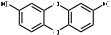
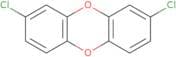
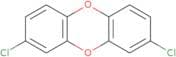
2,8-Diclorodibenzo-p-dioxina (CAS 38964-22-6) es un compuesto orgánico clorado que pertenece a la clase de las dioxinas, conocidas por su persistencia ambiental y su potencial toxicidad. Este compuesto presenta una estructura de dioxina caracterizada por dos anillos de benceno conectados por dos átomos de oxígeno, con sustituyentes de cloro en las posiciones 2 y 8. Es un sólido incoloro a amarillo pálido que es insoluble en agua pero soluble en disolventes orgánicos. 2,8-Diclorodibenzo-p-dioxina es de particular interés debido a su potencial como contaminante en varios procesos industriales y su asociación con efectos adversos para la salud, incluyendo carcinogenicidad y disrupción endocrina. El compuesto se forma típicamente como un subproducto en la combustión de materiales orgánicos clorados y durante la producción de ciertos herbicidas y pesticidas. Debido a su estabilidad y potencial de bioacumulación, representa riesgos ambientales y para la salud significativos, lo que lleva a regulaciones estrictas sobre su liberación y gestión.
Fórmula:C12H6Cl2O2
InChI:InChI=1S/C12H6Cl2O2/c13-7-1-3-9-11(5-7)16-12-6-8(14)2-4-10(12)15-9/h1-6H
Clave InChI:InChIKey=WMWJCKBJUQDYLM-UHFFFAOYSA-N
SMILES:ClC=1C=C2C(OC=3C(O2)=CC(Cl)=CC3)=CC1
Sinónimos:- 2,8-Dichlordibenzo-p-dioxin
- 2,8-Dichloro-dibenzo[1,4]dioxin
- 2,8-Dichlorodibenzo-p-dioxin
- 2,8-Dichlorodibenzo[b,e][1,4]dioxin
- 2,8-Dichlorodibenzodioxin
- 3,6-Dichloro-9,10-dioxaanthracene
- Dibenzo[B,E][1,4]Dioxin, 2,8-Dichloro-
- Pcdd 12
- 2,8-Dichlorooxanthrene
Ordenar por
Pureza (%)
0
100
|
0
|
50
|
90
|
95
|
100
Encontrado 5 productos.
2,8-Dichlorodibenzo-p-dioxin
CAS:2,8-Dichlorodibenzo-p-dioxin (2,8-DCDD) is a chlorinated dioxin. It is used as an analytical reagent in wastewater treatment methods. 2,8-DCDD can be prepared by the reaction of chlorine atoms with a sample that contains dioxins. The preparation of 2,8-DCDD involves the use of solvents such as dichloromethane or toluene and has been shown to require activation energies between 10 and 40 kcal/mol. 2,8-DCDD is a postulated carcinogen because it binds to receptor sites on cells and promotes tumor formation in animal models. The rate of formation of 2,8-DCDD has been shown to increase when triclosan is present in the environment at concentrations greater than 0.1 ppm. Triclosan can also promote the formation of 2,6-dichlorophenolFórmula:C12H6Cl2O2Pureza:Min. 95%Peso molecular:253.08 g/mol2,8-Dichlorodibenzo-p-dioxin
CAS:2,8-Dichlorodibenzo-p-dioxin is a high quality chemical that is used as a building block in the synthesis of more complex compounds. It can be used as a reagent and speciality chemical, as well as being a versatile intermediate in organic synthesis. The CAS number for 2,8-Dichlorodibenzo-p-dioxin is 38964-22-6.Fórmula:C12H6Cl2O2Pureza:Min. 95.0 Area-%Peso molecular:253.08 g/molRef: 3D-J-200144
10mgA consultar25mgA consultar50mgA consultar100mgA consultar250mgA consultar-Unit-ggA consultar2,8-Dichlorodibenzo[b,e][1,4]dioxin
CAS:Producto controlado<p>Applications 2,8-Dichlorodibenzo[b,e][1,4]dioxin is a standard used for environmental testing and research such as the study of hydrophobic organic contaminants in river water.<br>References Khairy, M. et al.: Env. Sci. Tech., 48, 2533 (2014);<br></p>Fórmula:C12H6Cl2O2Forma y color:NeatPeso molecular:253.08


![2,8-Dichlorodibenzo[b,e][1,4]dioxin](/_next/image/?url=https%3A%2Fstatic.cymitquimica.com%2Fproducts%2FTR%2Fthumb%2FD436513.jpg&w=3840&q=75)


