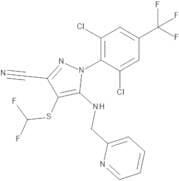
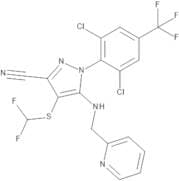
CAS 394730-71-3
:Piriprol
- 1-[2,6-Dichloro-4-(trifluoromethyl)phenyl]-4-[(difluoromethyl)thio]-5-[(2-pyridinylmethyl)amino]-1H-pyrazole-3-carbonitrile
- 1H-Pyrazole-3-carbonitrile, 1-[2,6-dichloro-4-(trifluoromethyl)phenyl]-4-[(difluoromethyl)thio]-5-[(2-pyridinylmethyl)amino]-
- 394730-71-3
- Prac-tic
- Pyriprole
1-(2,6-Dichloro-4-(trifluoromethyl)phenyl)-4-((difluoromethyl)thio)-5-((pyridin-2-ylmethyl)amino)-1H-pyrazole-3-carbonitrile
CAS:1-(2,6-Dichloro-4-(trifluoromethyl)phenyl)-4-((difluoromethyl)thio)-5-((pyridin-2-ylmethyl)amino)-1H-pyrazole-3-carbonitrilePureza:98%Peso molecular:494.28g/molPyriprole
CAS:Producto controladoApplications Pyriprole is a useful reagent in preparation of N-Difluoromethylthiphthalimide as a difluoromethylthiolating reagent.
References Zhu, D., et al.: J. Am. Chem. Soc., 137, 10547 (2015);Fórmula:C18H10Cl2F5N5SForma y color:NeatPeso molecular:494.27Pyriprole 100 µg/mL in Acetonitrile
CAS:Producto controladoFórmula:C18H10Cl2F5N5SForma y color:Single SolutionPeso molecular:494.27Pyriprole
CAS:Pyriprole is a chemical compound that belongs to the group of control agents. It is used in animal health as an insecticide and acaricide. Pyriprole works by interfering with the function of the nicotinic acetylcholine receptor, which is found in the central nervous system and on muscle cells. It has been shown to be effective against mosquitoes and other insects. The chemical structure of pyriprole contains a piperonyl butoxide group, which prevents it from binding to mammalian nicotinic acetylcholine receptors. This allows pyriprole to be used in areas where mammals are present, such as homes or farms. The effective dose for pyriprole varies depending on the type of application; for example, it is 0.1-0.2 mg/kg when applied orally to animals and 50-100 mg/kg when applied topically.
Fórmula:C18H10Cl2F5N5SPureza:(¹H-Nmr) Min. 95 Area-%Forma y color:White PowderPeso molecular:494.27 g/molRef: 3D-FP29238
Producto descatalogado