CAS 39800-63-0
:Dibutoxibifenilo
Descripción:
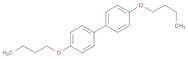
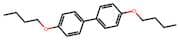
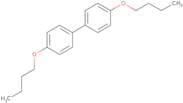
Dibutoxibifenilo, con el número CAS 39800-63-0, es un compuesto orgánico caracterizado por su estructura de bifenilo sustituido con dos grupos butóxido. Este compuesto típicamente aparece como un líquido o sólido incoloro a amarillo pálido, dependiendo de su formulación específica y pureza. Se conoce por su baja volatilidad y relativamente alta estabilidad térmica, lo que lo hace adecuado para diversas aplicaciones, incluyendo como disolvente o intermedio en síntesis orgánica. Dibutoxibifenilo es generalmente insoluble en agua pero soluble en disolventes orgánicos, lo que mejora su utilidad en procesos químicos. Su estabilidad química y resistencia a la oxidación contribuyen a su efectividad en formulaciones que requieren un rendimiento duradero. Los datos de seguridad indican que, al igual que muchos compuestos orgánicos, debe manejarse con cuidado, ya que puede presentar riesgos para la salud al ser expuesto. En general, Dibutoxibifenilo es valorado en aplicaciones industriales por sus propiedades únicas y versatilidad en reacciones químicas.
Fórmula:C20H26O2
InChI:InChI=1/C20H26O2/c1-3-5-15-21-19-11-7-17(8-12-19)18-9-13-20(14-10-18)22-16-6-4-2/h7-14H,3-6,15-16H2,1-2H3
SMILES:CCCCOc1ccc(cc1)c1ccc(cc1)OCCCC
Sinónimos:- 4,4-Di-n-butoxybiphenyl
- 4,4'-Dibutoxybiphenyl
Ordenar por
Pureza (%)
0
100
|
0
|
50
|
90
|
95
|
100
Encontrado 5 productos.
4,4'-Dibutoxybiphenyl
CAS:Fórmula:C20H26O2Pureza:>98.0%(GC)Forma y color:White to Almost white powder to crystalPeso molecular:298.434,4'-Dibutoxybiphenyl
CAS:4,4'-Dibutoxybiphenyl is a crystalline solid that has a density of 1.902 g/cm3. It is a mesophase and has the ability to form liquid crystals with other molecules. 4,4'-Dibutoxybiphenyl can be used to create devices such as light-emitting diodes and liquid crystal displays. This molecule also has dicarboxylic acid esters, which are compounds that have two carboxylic acids on one carbon chain. The electronic theory of liquid crystals proposes that the molecules in this class are dipoles, with an uneven distribution of charge across their molecular structure. This uneven distribution causes the molecules to align in a particular direction when they come into contact with other molecules or surfaces. Liquid crystals are characterized by having long rod-like molecules that form helical structures when in contact with each other or surfaces. The molecule's orientation affects how light passes through it, making itFórmula:C20H26O2Pureza:Min. 95%Peso molecular:298.42 g/mol