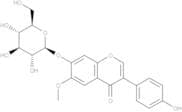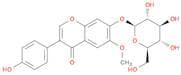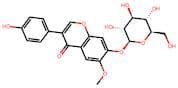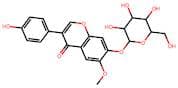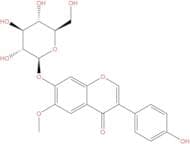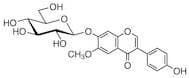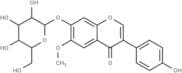
CAS 40246-10-4
:Glicitina
Descripción:
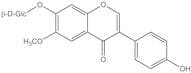
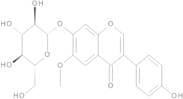
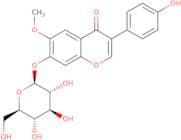
Glicitina, con el número CAS 40246-10-4, es un glucósido de isoflavona que se encuentra de forma natural principalmente en la soja y otras legumbres. Es un derivado de la isoflavona genisteína, donde se adjunta una molécula de glucosa, mejorando su solubilidad y biodisponibilidad. Glicitina exhibe propiedades antioxidantes, contribuyendo a sus posibles beneficios para la salud, incluidos efectos antiinflamatorios y posibles roles en la regulación hormonal. Como fitoestrógeno, puede imitar el estrógeno en el cuerpo, lo que puede tener implicaciones para los síntomas menopáusicos y la salud ósea. Glicitina se estudia a menudo por sus posibles aplicaciones terapéuticas en diversas condiciones de salud, incluidas el cáncer y las enfermedades cardiovasculares. En términos de propiedades físicas, Glicitina es típicamente un polvo blanco a blanco sucio, soluble en agua y estable en condiciones de almacenamiento normales. Su perfil de seguridad se considera generalmente favorable, aunque se están realizando más investigaciones para comprender completamente sus efectos biológicos y mecanismos de acción.
Fórmula:C22H22O10
InChI:InChI=1S/C22H22O10/c1-29-15-6-12-14(30-9-13(18(12)25)10-2-4-11(24)5-3-10)7-16(15)31-22-21(28)20(27)19(26)17(8-23)32-22/h2-7,9,17,19-24,26-28H,8H2,1H3/t17-,19-,20+,21-,22-/m1/s1
Clave InChI:InChIKey=OZBAVEKZGSOMOJ-MIUGBVLSSA-N
SMILES:O=C1C=2C(=CC(O[C@@H]3O[C@H](CO)[C@@H](O)[C@H](O)[C@H]3O)=C(OC)C2)OC=C1C4=CC=C(O)C=C4
Sinónimos:- 3-(4-Hydroxyphenyl)-6-methoxy-7-[(2S,3R,4S,5S,6R)-3,4,5-trihydroxy-6-(hydroxymethyl)oxan-2-yl]oxychromen-4-one
- 3-(4-hydroxyphenyl)-6-methoxy-4-oxo-4H-chromen-7-yl beta-D-glucopyranoside
- 4H-1-Benzopyran-4-one, 7-(β-<span class="text-smallcaps">D</span>-glucopyranosyloxy)-3-(4-hydroxyphenyl)-6-methoxy-
- 7-(β-<span class="text-smallcaps">D</span>-Glucopyranosyloxy)-3-(4-hydroxyphenyl)-6-methoxy-4H-1-benzopyran-4-one
- Glycitein 7-O-glucoside
- Glycitein 7-O-β-glucoside
- Glycitein-7-β-O-glucoside
- 4H-1-Benzopyran-4-one, 7-(β-D-glucopyranosyloxy)-3-(4-hydroxyphenyl)-6-methoxy-
- 7-(β-D-Glucopyranosyloxy)-3-(4-hydroxyphenyl)-6-methoxy-4H-1-benzopyran-4-one
Ordenar por
Pureza (%)
0
100
|
0
|
50
|
90
|
95
|
100
Encontrado 13 productos.
Glycitin
CAS:Glycitin analytical standard provided with w/w absolute assay, to be used for quantitative titration.Fórmula:C22H22O10Pureza:(HPLC) ≥98%Forma y color:PowderPeso molecular:446.41Glycitin
CAS:Other glycosides, natural or reproduced by synthesis, aFórmula:C22H22O10Forma y color:White Beige PowderPeso molecular:446.12134H-1-Benzopyran-4-one,7-(b-D-glucopyranosyloxy)-3-(4-hydroxyphenyl)-6-methoxy-
CAS:Fórmula:C22H22O10Pureza:98%Forma y color:SolidPeso molecular:446.4041Glycitin
CAS:GlycitinFórmula:C22H22O10Pureza:By hplc: 98.5% (Typical Value in Batch COA)Forma y color: off-white powderPeso molecular:446.40g/molGlycitin
CAS:An isoflavone glycitin is isolated from the licorice, which has good inhibitory effect on α-glucosidase with IC50of 0.5646 mg·mL- 1, better than the position control acarbose.Fórmula:C22H22O10Pureza:95%~99%Forma y color:PowderPeso molecular:446.408Glycitin
CAS:Fórmula:C22H22O10Pureza:>95.0%(HPLC)Forma y color:White to Light yellow powder to crystalPeso molecular:446.41Glycitin
CAS:Glycitin (Glycitein 7-O-β-glucoside), a natural isoflavone isolated from legumes, can promote the proliferation of bone marrow stromal cells and osteoblasts andFórmula:C22H22O10Pureza:99.71% - 99.84%Forma y color:White SolidPeso molecular:446.40Glycitin
CAS:Natural glycosideFórmula:C22H22O10Pureza:≥ 95.0 % (HPLC)Forma y color:PowderPeso molecular:446.41Glycitin
CAS:Stability Hygroscopic
Applications A metabolite of isoflavone derivatives. A derivative of Glycitein. Inhibitor.
References Whalley, J.L., et al.: Bioorg. Med. Chem. Lett., 8, 1569 (1998), Song, T., et al.: J. Agric. Food Chem., 47, 1607 (1999),Fórmula:C22H22O10Forma y color:WhitePeso molecular:446.4Glycitin
CAS:Glycitin is an isoflavone glycoside, which is a bioactive compound primarily derived from soybeans. This natural compound is sourced from the soy plant, Glycine max, where it serves as one of the predominant isoflavones. Isoflavones like glycitin function as phytoestrogens, plant-derived compounds that can mimic or modulate the action of estrogen in the body. Glycitin undergoes hydrolysis in the digestive system to produce its aglycone form, glycitein, which can interact with estrogen receptors and exert estrogenic effects.Fórmula:C22H22O10Pureza:Min. 98 Area-%Forma y color:White PowderPeso molecular:446.4 g/mol