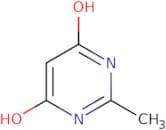
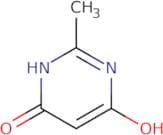
CAS 40497-30-1
:2-Metil-4,6-pirimidinediona
Descripción:
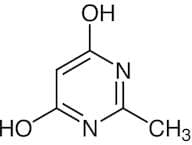
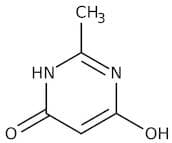
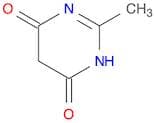
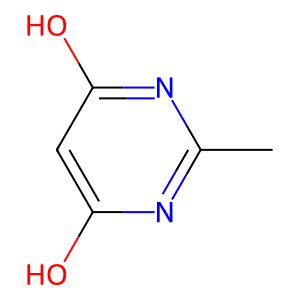
2-Metil-4,6-pirimidinediona, también conocido como 2-metil-4,6-dioxipirimidina, es un compuesto orgánico caracterizado por su estructura de anillo de pirimidina, que presenta dos grupos carbonilo (C=O) en las posiciones 4 y 6 y un grupo metilo en la posición 2. Este compuesto es típicamente un sólido cristalino blanco a blanco sucio y es soluble en disolventes polares como agua y alcoholes, debido a su capacidad para formar enlaces de hidrógeno. Exhibe tautomería, donde puede existir en diferentes formas debido a la reubicación de átomos de hidrógeno y enlaces dobles. La presencia de los grupos carbonilo contribuye a su reactividad, lo que lo convierte en un posible intermedio en varias reacciones de síntesis orgánica, particularmente en las industrias farmacéutica y agroquímica. Además, 2-Metil-4,6-pirimidinediona puede exhibir actividad biológica, que puede ser explorada para aplicaciones potenciales en química medicinal. Al igual que con muchas sustancias químicas, se deben observar las precauciones adecuadas de manejo y seguridad debido a su potencial toxicidad y reactividad.
Fórmula:C5H6N2O2
InChI:InChI=1S/C5H6N2O2/c1-3-6-4(8)2-5(9)7-3/h2H2,1H3,(H,6,7,8,9)
Clave InChI:InChIKey=GNVCKXIBBIIFPE-UHFFFAOYSA-N
SMILES:O=C1CC(=O)N=C(C)N1
Sinónimos:- 2-Methyl-1H-pyrimidine-4,6-dione
- 2-Methyl-4,6(1H,5H)-pyrimidinedione
- 2-Methylpyrimidin-4,6(3H,5H)-dione
- 2-methyl-1H,5H-pyrimidine-4,5-dione
- 2-methylpyrimidine-4,6(1H,5H)-dione
- 4(1H)-Pyrimidinone,6-hydroxy-2-methyl-
- 4,6(1H,5H)-Pyrimidinedione, 2-methyl-
- 4,6(1H,5H)-Pyrimidinedione, 2-methyl- (9CI)
- 6-Hydroxy-2-methylpyrimidin-4(3H)-one
- 2-Methyl-4,6-pyrimidinedione
- 2-Methyl-4,6-dichloropyrimidine
Ordenar por
Pureza (%)
0
100
|
0
|
50
|
90
|
95
|
100
Encontrado 8 productos.
4,6-Dihydroxy-2-methylpyrimidine
CAS:Fórmula:C5H6N2O2Pureza:>96.0%(T)Forma y color:White to Light yellow to Light orange powder to crystalPeso molecular:126.124,6-Dihydroxy-2-methylpyrimidine, 99%
CAS:4,6-Dihydroxy-2-methylpyrimidine is used in the preparation of 4,6-dichloro-2-methyl-pyrimidine. This Thermo Scientific Chemicals brand product was originally part of the Alfa Aesar product portfolio. Some documentation and label information may refer to the legacy brand. The original Alfa Aesar prFórmula:C5H6N2O2Pureza:99%Forma y color:White to pale cream or pale pink, PowderPeso molecular:126.122-Methylpyrimidine-4,6(1H,5H)-dione
CAS:Fórmula:C5H6N2O2Pureza:98%Forma y color:SolidPeso molecular:126.11334,6-Dihydroxy-2-methylpyrimidine
CAS:4,6-Dihydroxy-2-methylpyrimidinePureza:98%Peso molecular:126.11g/mol4,6-Dihydroxy-2-methylpyrimidine
CAS:Fórmula:C5H6N2O2Pureza:≥ 98.0%Forma y color:White to off-white crystalline powderPeso molecular:126.124,6-Dihydroxy-2-methylpyrimidine
CAS:4,6-Dihydroxy-2-methylpyrimidine is a versatile building block that can be used in the synthesis of a wide variety of chemical compounds. As a reagent, 4,6-dihydroxypyrimidine is used to synthesize many important chemicals, such as 5-aminoimidazole and 2,5-diaminopyrimidine. It is also a useful scaffold for the preparation of research chemicals and speciality chemicals. This compound has been described as high quality with an easy purification process. CAS No. 40497-30-1Fórmula:C5H6N2O2Peso molecular:126.12 g/molRef: 3D-D-3570
-Unit-kgkgA consultar1kgA consultar5kgA consultar10kgA consultar500gA consultar2500gA consultar4.6-Dihydroxy-2-methylpyrimidine
CAS:4,6-Dihydroxy-2-methylpyrimidine is a monomer that is used in the synthesis of polyurethanes. It is an intermediate in the reaction between hydrochloric acid and nitrous acid, which produces 4,6-dichloro-2-methylpyrimidine. The reaction mechanism involves transfer of a methyl group from an organic molecule to hydrochloric acid. This reaction can be carried out at either low or high pH values. The addition of magnesium salt increases the rate of the reaction by increasing the solubility of chloroformate in water. When ethyl esters are used as starting materials, a constant conversion rate can be obtained with a large excess of magnesium salt.Fórmula:C5H6N2O2Pureza:Min 99%Forma y color:PowderPeso molecular:126.11 g/mol